


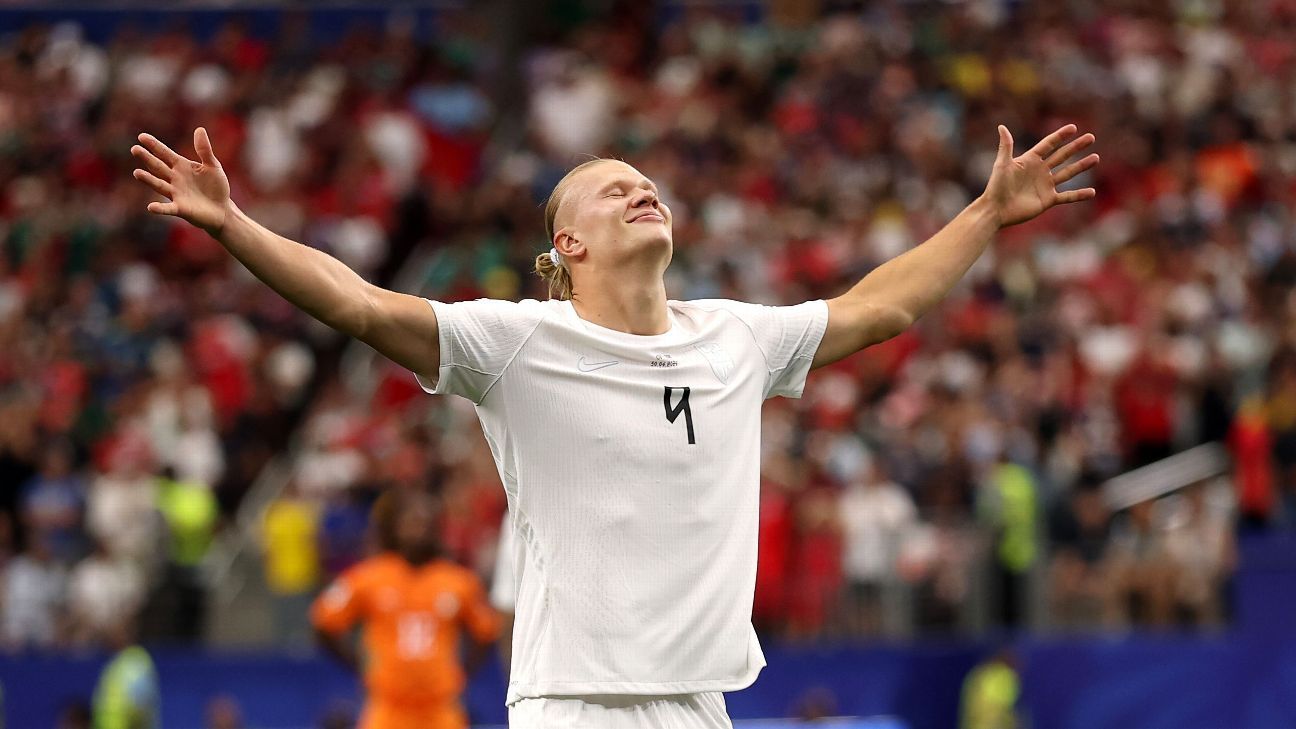
Erling Haaland’s Impact on Norway’s World Cup Journey
DALLAS — The question on everyone’s mind is whether Erling Haaland can guide Norway to World Cup success, and the answer may hinge on contributions from his teammates as well.
During Norway’s narrow 2-1 victory over Ivory Coast in the Round of 32, Haaland had a relatively subdued performance. However, when it mattered most, the Manchester City striker delivered, netting the decisive goal with just four minutes left on the clock.
Ivory Coast largely dominated the match, boasting more shots, more shots on target, and nearly double the touches inside Norway’s penalty area—48 to 25. Despite this advantage, their lack of a prolific goalscorer became apparent. For Norway, Haaland might just be the critical asset they need to advance in this tournament.
As it stands, Lionel Messi tops the World Cup scoring charts with six goals from three matches, but Haaland isn’t far behind, having scored five in the same number of appearances. His recent goal continued an impressive scoring streak for Norway, which now totals 25 goals across 13 matches dating back to October 2023.
Norway’s Reliance on Haaland
Norway’s dependence on Haaland is undeniable; they haven’t won a match without him finding the net in nearly three years. The last such victory occurred in November 2023 against the Faroe Islands, where Haaland made only a second-half appearance.
Is Norway too reliant on Haaland? While this might seem true, the reality is that his presence elevates the entire team. Coach Staare Solbakken has crafted a competitive squad that leans on its superstar forward to convert chances into victories, a model akin to Argentina’s reliance on Messi and England’s on Harry Kane.
A game-changing goalscorer can transform a solid team into a formidable contender, and Norway is eager to achieve that status in this World Cup.
The Supporting Cast Around Haaland
Although the team is often seen as “Haaland’s team,” captain Martin Ødegaard brings creativity and flair that can enhance Haaland’s scoring opportunities. Wingers Antonio Nusa and Oscar Bobb have shown they can challenge defenders and deliver precise crosses, giving the striker vital chances to score.
In the recent match, Nusa added his own flair, scoring a stunning first-half goal—a right-footed curler into the top corner. His ability to stretch the defense may pose a challenge for Brazilian manager Carlo Ancelotti ahead of their impending clash.
Norway’s midfield, featuring Sander Berge and Patrik Berg, adds another layer of strength. Their tenacity and versatility could exploit weaknesses, especially against a Brazilian side exhibiting limited mobility in the center. Berg’s energy was evident as he played a crucial role in setting up Haaland’s equalizing goal late in the game.
Haaland’s Unique Contribution
While Norway possesses a competent squad, Haaland’s influence is unmistakable. Without him, the team risks slipping into mediocrity, merely a participant rather than a contender in the tournament.
This latest victory not only marked Norway’s first triumph in the knockout stages of a World Cup but also ignited aspirations for more success. With Haaland in the lineup, Norway aims to go the distance in this tournament.
Historically, Norway has yet to clinch a major tournament title. However, having avoided defeat in their last four encounters with Brazil—who has won the World Cup five times—gives them an edge. A win over Ancelotti’s side would likely lead to a quarter-final match against England, a challenge that would excite Solbakken and his players.
Yet, despite the team’s depth, it ultimately hinges on Haaland. If he remains fit, Norway can realistically pursue a deep run in the tournament. His ability to instill apprehension in opposing defenses is well-documented; his performances this World Cup align him alongside the likes of Messi, Kane, and Kylian Mbappe.
The spotlight rests on Haaland, who is undoubtedly aware of the weight of expectation. He believes that with each goal, he can steer Norway closer to World Cup glory.
