


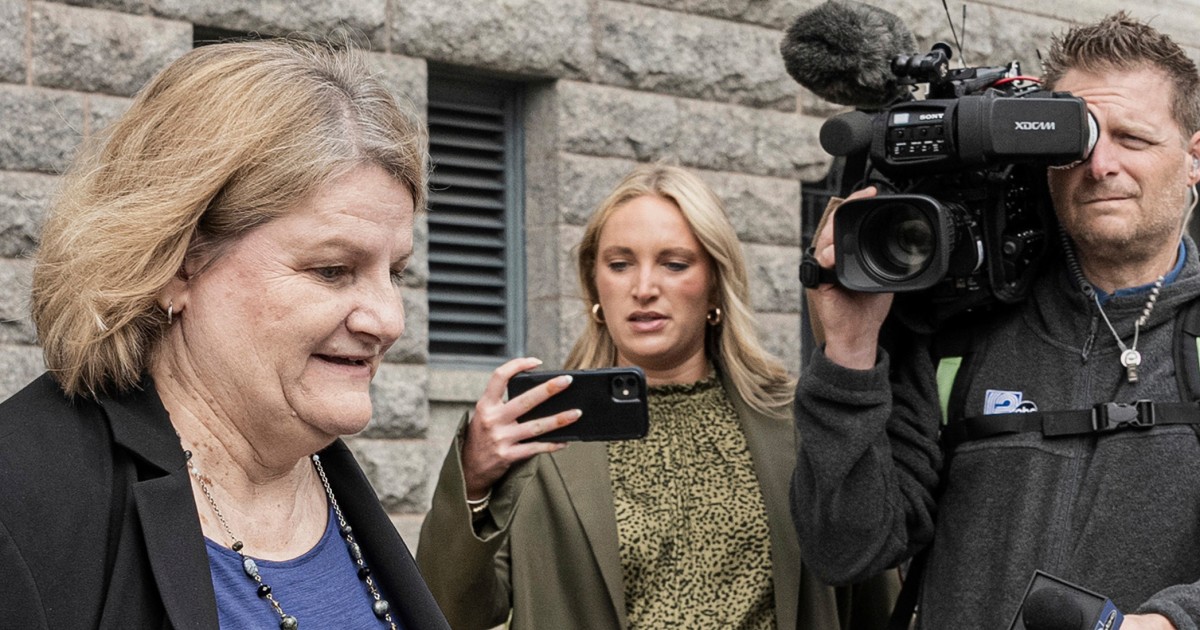
MILWAUKEE – A federal judge is deliberating on whether to overturn the guilty verdict against former Wisconsin judge Hannah Dugan, who was convicted of a felony for assisting an immigrant in evading federal authorities.
This case serves as an early indicator of how courts may handle the far-reaching immigration policies implemented during President Donald Trump’s administration.
Dugan was expected to receive her sentence on Wednesday; however, U.S. District Judge Lynn Adelman postponed the sentencing to evaluate arguments regarding the validity of her conviction.
Adelman has yet to announce a decision, and neither Dugan nor her attorneys commented to the media following the court session.
Defense cites key Virginia ruling
In her defense, attorney Stephen Biskupic contended that Dugan’s conviction is flawed and warrants dismissal. He referenced a significant Virginia immigration case that was overturned by a federal appeals court in April, arguing it undermines the foundation of Dugan’s case.
Biskupic maintained that Dugan’s conviction was procedurally erroneous, asserting that the recent ruling from the Fourth Circuit invalidated the legal reasoning used against her.
The central argument presented by Biskupic is that the theory of guilt applied in Dugan’s case is not valid.
The overturned Virginia case involved an immigrant who, after being detained by U.S. Immigration and Customs Enforcement (ICE), fled and was later rearrested on charges of obstructing immigration proceedings.
The appeals court determined that ICE’s lawsuit did not qualify as a “pending proceeding,” a key component of federal obstruction law.
Dugan’s legal team argues that she should not have faced charges, as there was no legitimate “pending proceeding” that ICE agents were pursuing against the individual, merely a warrant for arrest. Biskupic emphasized that a warrant, in this context, does not constitute a “proceeding” as defined by law.
Prosecutors, however, contend that the nuances of the Virginia case are not applicable to Dugan’s situation, pointing to other legal precedents that support the validity of her conviction.
Richard Frohling, Assistant U.S. Attorney for the Eastern District of Wisconsin, stated, “The court should uphold its sentence.” In his argument, he criticized the appellate court’s decision regarding the Virginia case and elaborated on the legal definitions surrounding lawsuits.
Sentencing delayed for further consideration
Dugan, who is 67 years old, faces a potential maximum sentence of five years in prison following a jury’s conviction on December 19. However, legal experts suggest it is unlikely that Dugan will face actual imprisonment, given federal guidelines typically favor probation for first-time offenders of nonviolent offenses.
In the wake of her conviction, Dugan resigned from her position as a Milwaukee County Circuit Judge, driven by threats of impeachment from Republican lawmakers. Her judicial career spanned nine years.
While Dugan was present during the court arguments on Wednesday, she refrained from making any statements to the media.
The charges against Dugan arise from the Trump administration’s aggressive immigration enforcement strategy. Critics labeled her an activist judge; however, Dugan’s attorneys argued that she was being unfairly targeted and that her position as a judge should exempt her from prosecution.
Dugan’s trial represents the first instance in Wisconsin where a state judge has faced charges for allegedly obstructing immigration law enforcement. She was acquitted of a misdemeanor charge related to concealing an identity to prevent arrest.
Dugan’s involvement with the immigrant under scrutiny
On April 18, 2025, immigration officials arrived at the Milwaukee County Courthouse to arrest Eduardo Flores-Ruiz, who had unlawfully reentered the country and was due to appear before Dugan regarding a state assault charge.
Dugan allegedly intervened with investigators, directing them away from Flores-Ruiz’s location and asserting that the administrative warrant was insufficient for arrest.
After the investigators departed, Dugan reportedly used a private door to facilitate the exit of Flores-Ruiz and his lawyer, leading to his eventual apprehension outside the courthouse following a brief chase.
Flores-Ruiz was subsequently deported in November.
