


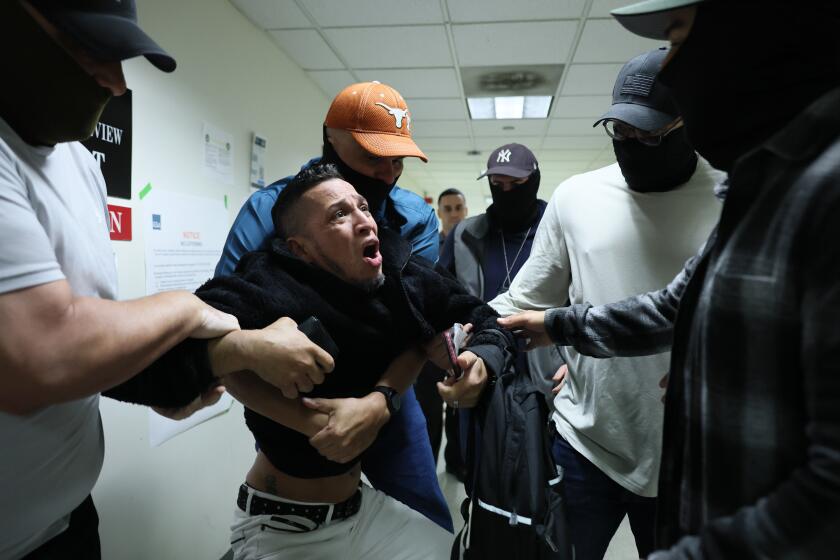
Federal Judge Blocks ICE Arrests in Immigration Courthouses Nationwide
A federal judge in California has prohibited Immigration and Customs Enforcement (ICE) agents from making arrests within immigration courthouses across the country, impeding a strategy of mass deportations initiated by the Trump administration.
Following the administration’s aggressive stance on illegal immigration last year, ICE rescinded prior guidelines that restricted arrests in or around immigration courts. This change led to an alarming number of arrests, often separating families during routine border checks or inspections.
In Los Angeles, this policy shift resulted in significant courtroom arrests, including a case where a teenager was taken into custody just a day after graduating high school with honors. In another incident, a father was handcuffed in front of his eight-year-old son moments after a judge dismissed his deportation case.
Immigration attorneys have decried these practices, asserting that they create a culture of fear and hinder individuals who attempt to comply with legal procedures. The Department of Homeland Security maintains that courtrooms are safe environments for detaining undocumented immigrants, citing increased efficiency.
On Tuesday, Judge P. Casey Pitts of the U.S. District Court for the Northern District of California delivered a 71-page ruling that characterized ICE’s courthouse arrest practices as “arbitrary and capricious.” The ruling underscored concerns about how such tactics may deter individuals from attending court, a sentiment previously noted by ICE itself.
Judge Pitts, who was nominated by President Biden, remarked on the ruling’s implications: “The policy fails to address the chilling effect of court arrests on noncitizen court attendance, an issue central to ICE’s 2021 guidance.” In response, James Percival, general counsel for the Department of Homeland Security, criticized the ruling, insisting that the same protocol should apply to foreign nationals as it does for criminal defendants.
The ruling originates from a class-action lawsuit filed by noncitizens contesting ICE’s practice of courthouse arrests. This legal challenge began in August, brought forth by a Guatemalan asylum seeker who was apprehended after a routine immigration meeting in San Francisco, and later detained in unsanitary conditions without legal representation.
This latest judicial decision follows a prior ruling by Pitts in November, which severely curtailed ICE’s ability to execute arrests in immigration courts throughout Northern California. Pitts stated that noncitizens face “two irreparable harms” when deciding whether to appear in court: the risk of arrest and detention, or the forfeiture of their rights to seek asylum.
Data from the Justice Department reveals a striking increase in the number of absentee orders since this policy shift, with figures climbing from approximately 19,000 in fiscal year 2024 to over 50,000 in fiscal year 2025. Meanwhile, another federal judge recently ruled against ICE’s arrest practices in New York City’s immigration court.
On the same day as the ruling, Democratic Representative Bonnie Watson Coleman from New Jersey urged Congress to codify Pitts’ decision by introducing legislation that would prevent federal agents from arresting individuals attending court to review their immigration cases. She emphasized that immigrants seeking to comply with laws should not face penalties for their efforts, highlighting the fundamental principles of fairness in the legal system.
This report includes contributions from Sonja Sharp, a writer for the Los Angeles Times.
