


Florida International University Faces Backlash for Disciplinary Action Against Students
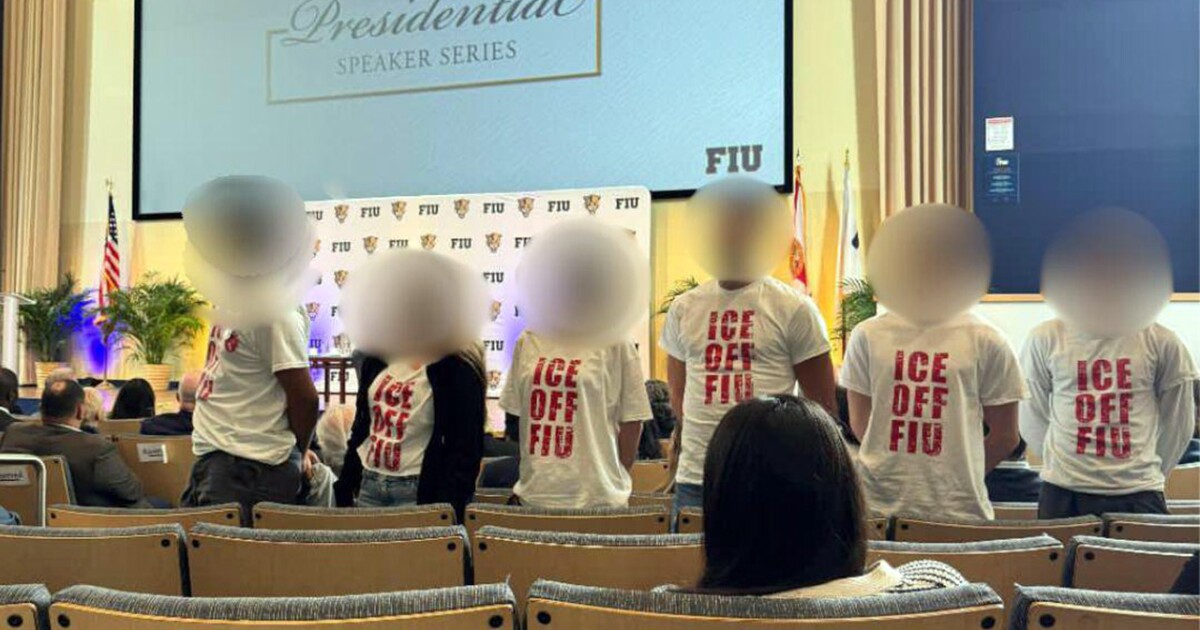
Florida International University (FIU) is taking disciplinary measures against seven students who engaged in a silent protest during a campus event in March. The students and their legal representatives argue that this action is a significant infringement on their First Amendment rights.
This week, the students received written reprimands and were instructed to produce a video discussing the FIU regulations they are alleged to have violated. They expressed concerns to WLRN that this video requirement might compel them to voice opinions that contradict their beliefs.
The events leading to this situation are straightforward. On March 13, during an event hosted by FIU President Janet Nunez featuring former Major League Baseball star Alex Rodriguez, a group of students silently stood up, removed shirts that proclaimed “ICE OFF FIU,” and remained still for several minutes before leaving the event.
FIU maintains that the silent demonstration breached campus policies that prohibit “expressive activities” in indoor settings. However, the university’s own rules explicitly recognize “protests, parades, and marches,” and broadly include the “exercise of free speech” as activities protected by the First Amendment.
In addition to receiving reprimands, each student was required to record a two-minute video addressing expectations related to both indoor and outdoor expressive activities and how they will apply this understanding in the future. An internal document reviewed by WLRN specifies that the videos must be “original” and “thoughtful and substantive,” with the potential for the Office of Student Conduct and Academic Integrity to request re-recordings if they deem necessary.
Alison Basden, a third-year political science student among those disciplined, expressed her astonishment at the consequences. She remarked on the perception that universities may not always prioritize student rights as previously believed.
Students Challenge University Policy on Free Speech
The students’ protest was a response to FIU’s voluntary cooperation with immigration enforcement. After months of attempting to meet with President Nunez to voice their concerns about this policy, they felt their only recourse was to stage a protest.
FIU spokeswoman Madeline Barro defended the university’s stance, asserting that the policies are compliant with both the First Amendment and Florida law. She emphasized that the university consistently enforces rules prohibiting protests within campus buildings to ensure that educational and research activities remain uninterrupted. According to Barro, outdoor protests are permitted, allowing individuals to express their views meaningfully.
This situation bears a resemblance to the historic Supreme Court case, Tinker v. Des Moines, which upheld students’ rights to free speech in schools. The 1965 case involved students who wore black armbands to protest the Vietnam War, leading to their suspension. The Court ruled that students do not surrender their constitutional rights at school, and prohibitions on expression can only occur if they disrupt the school’s functions.
An internal email from an FIU official indicated that the silent protest did not disrupt the event, as no complaints were raised by those in attendance. Additionally, federal courts in Florida have previously supported student free speech rights in similar cases regarding pro-LGBTQ expression.
Concerns About Coerced Speech and Legal Representation
Basden expressed her dismay at the apparent erosion of student rights on campus, noting her family’s deep ties to FIU. Her father, also an alumnus, participated in protests without facing disciplinary action during his time at the university.
The requirement for students to create videos reflecting on campus policies has raised concerns about potential coercion. Basden fears that if her video critiques the school’s regulations, FIU may require multiple re-recordings until the content aligns with their expectations, thereby limiting authentic self-expression.
Community Justice Project, a local nonprofit organization, is representing Basden and her peers in this matter. Staff attorney Adam Saper highlighted the potential legal implications of the video requirement, suggesting it could violate free expression principles and lead to “coerced speech.” He noted that as a public institution, FIU cannot compel students to express opinions against their own beliefs.
Following the disciplinary decision, the students are contemplating internal appeals. Caitlin Dailey, a third-year psychology and art student, expressed skepticism about the effectiveness of the appeal process, citing the institution’s tendency to prioritize its own interests. She stated that the video requirement felt like a punitive measure aimed at silencing dissent.
Dailey further emphasized the troubling question of how far universities should go in regulating “expressive activities” on campus, pointing out that political groups often set up tables indoors at FIU. She raised concerns about the ambiguity surrounding the university’s policies, suggesting that the suppression of student protests could have broader implications for free speech at FIU and beyond.
