


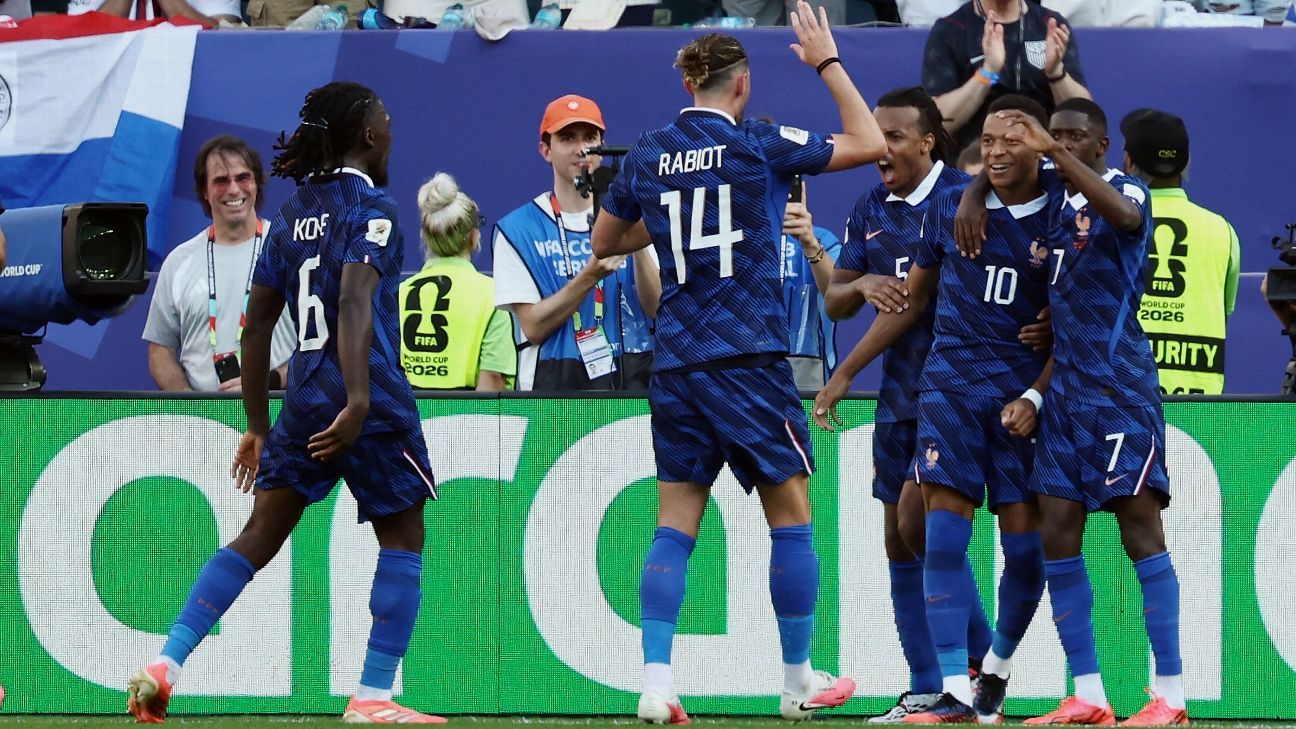
PHILADELPHIA — Kylian Mbappé’s penalty in the 70th minute was the decisive moment in a tense match on Saturday, leading France to a 1-0 victory over Paraguay and securing their place in the Round of 16.
The match began slowly, with both teams struggling in the sweltering summer heat. Tensions ran high, resulting in numerous fouls and heated exchanges throughout the first half. The gameplay saw only five total shots, with France amassing a meager 0.15 expected goals (xG) compared to Paraguay’s 0.05. The deadlock was eventually broken when Paraguay’s Diego Gomez fouled substitute Desiree Douai in the box, prompting a lengthy VAR review and a penalty decision from referee Ilgiz Tantashev.
Mbappé confidently converted the penalty, sending goalkeeper Orlando Gil the wrong way and solidifying his status in the Golden Boot race as he netted his seventh World Cup goal. This accomplishment places him alongside Argentina’s Lionel Messi as the only players to score seven or more goals in two separate World Cups, achieving this feat in both 2022 and 2026.
Looking ahead, France will face Morocco in Boston on Thursday, while Paraguay will depart the tournament with pride after a commendable performance.
France Faces a Different Kind of Challenge
Having previously defeated teams like Senegal, Iraq, and Norway in the group stage, Paraguay encountered a markedly different challenge against France, following their earlier victory over Sweden in the Round of 32. The adrenaline from their win over four-time champions Germany bolstered the team’s confidence, as they hoped their successful tactics against Germany could likewise yield results in the knockout stages.
The Paraguayans implemented a compact defensive strategy aimed at mitigating the impact of France’s formidable attacking players, including Mbappé, Ousmane Dembélé, Michael Oliseh, and Bradley Barcola. They disrupted the game flow with strategic fouls, physical tackles, and a measured pace, hoping for moments of brilliance from renowned players like Miguel Almirón and Julio Enciso. This taxing contest was played in extreme conditions, with temperatures soaring in South Philadelphia.
France’s coach Didier Deschamps anticipated the nature of this matchup, opting to retain most of his squad while making minor adjustments, such as substituting the injured Aurélien Tchouaméni for Manu Kone. The decision signaled confidence in his star players to navigate the challenges ahead. As expected, the match became a test of resilience for both teams.
Despite facing a physically demanding and strategic opponent, France struggled to convert scoring opportunities, managing only a single goal in the first half from Mbappé while the remainder of the shots came from central midfielder Kone and Adrien Rabiot—none from the front four. Deschamps’ faith in his players to remain composed as tensions rose was ultimately validated.
Evaluating Paraguay’s Strategies
Paraguay’s game plan was evident; they aimed to frustrate opposing teams. While their tactics successfully stymied Germany, they also managed to impose themselves on France for nearly 70 minutes until Mbappé’s penalty broke the stalemate.
To stretch out the game, Paraguay engaged in time-wasting tactics, with one defender notably sending the ball into the stands to consume precious seconds. There were frequent late challenges, and every foul by France prompted animated protests from the Paraguayan bench.
While the match may not have captivated neutrals, one must consider whether Paraguay is culpable for the overall quality of play. Having suffered significant losses in past matches when adopting an attacking strategy, their defensive approach against France was arguably justified, given the firepower they faced. Coach Gustavo Alfaro emphasized the necessity of playing to his players’ strengths, especially against a team boasting elite offensive talents.
Deschamps echoed these sentiments, acknowledging the potential fallout if his team had reacted to provocations as Germany did. He expressed satisfaction with how his players managed the game’s emotional landscape.
Historical Parallels with 1998
As a coach who embodies the philosophy that results trump aesthetics in soccer, Deschamps certainly appreciates the significance of this victory against Paraguay. He understands the challenge of overcoming South American teams in the knockout phase of the World Cup, particularly teams adept at disrupting rhythm and playing defensively.
Reflecting on the 1998 World Cup, Deschamps faced a similar situation. Back then, France struggled to break through a robust Paraguayan defense before clinching victory with a golden goal in extra time. Though they secured this win earlier, the parallels between the two experiences are unmistakable. The triumph in 1998 served as a turning point for France, propelling them towards ultimate success in the tournament.
With the weight of history upon them, this current French team also confronted a significant test in Philadelphia. As they gear up for the quarterfinals against Morocco, they carry with them the confidence gained from navigating such a challenging match.
