


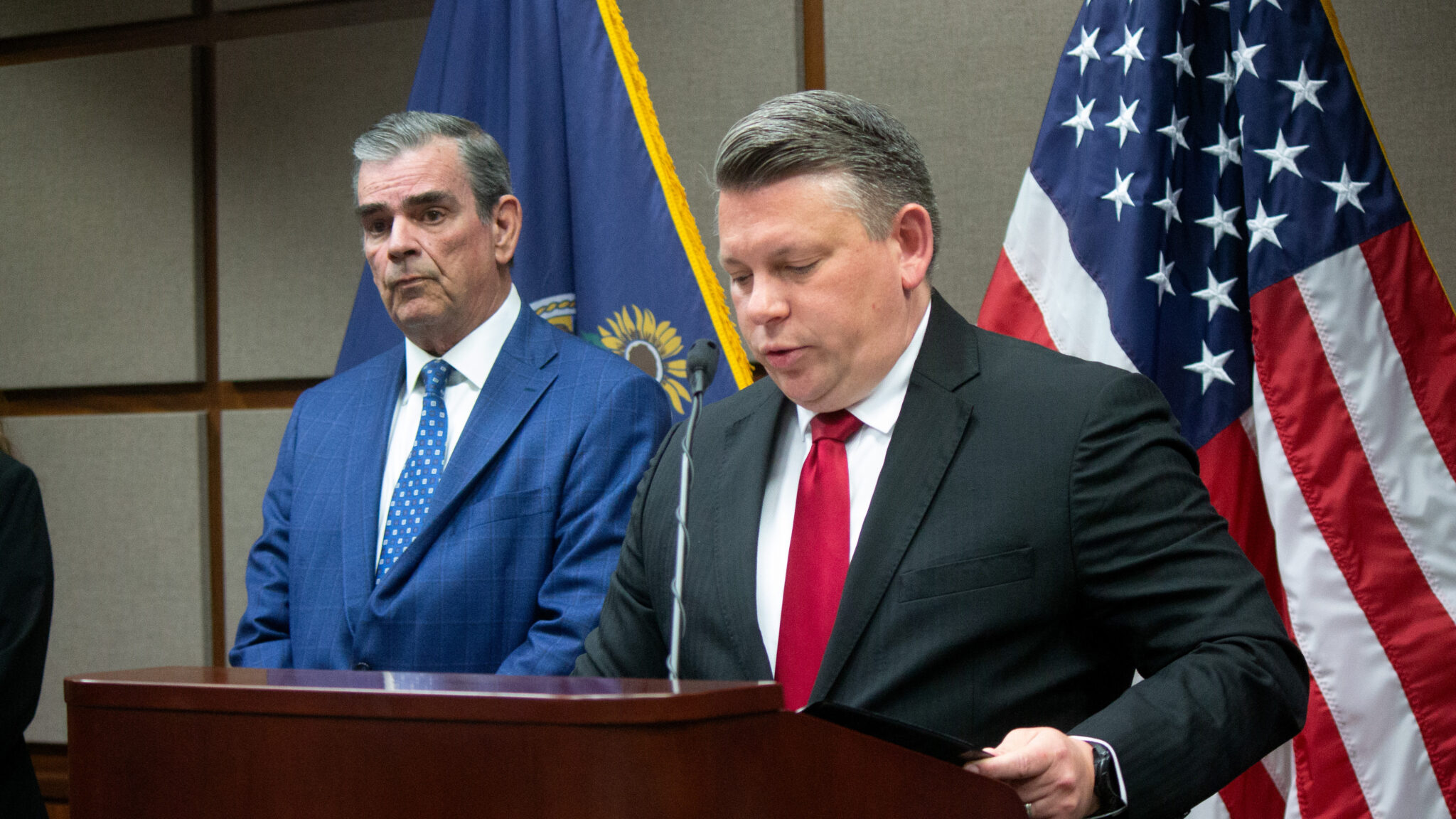
Federal Government Challenges Kansas Tuition Law
The U.S. Department of Justice, under President Donald Trump’s administration, filed a lawsuit against the state of Kansas this past Wednesday, seeking to nullify a law that permits undocumented college students to access in-state tuition rates.
Kansas Attorney General Kris Kobach swiftly joined forces with the Justice Department, urging the court to prevent Kansas universities, colleges, and state officials from enforcing a 2004 statute. This law allows certain students, who have attended Kansas high schools for at least three of the last four years and have either graduated from an accredited institution or obtained equivalent certification, to qualify for in-state tuition.
The Justice Department contends that this state law is discriminatory toward U.S. citizens and promotes illegal immigration by offering financial benefits that are inaccessible to legal residents who do not live in Kansas.
Assistant Attorney General Brett Shumate described the Kansas law as an infringement on constitutional rights, asserting that it is “unconstitutional and un-American” and should never have been enacted.
Shumate highlighted the Justice Department’s previous victories in similar cases in Texas, Oklahoma, Kentucky, and Nebraska, signaling an ongoing commitment to challenge state policies that are deemed not to prioritize American citizens.
Meanwhile, Democratic Governor Laura Kelly has filed a motion to intervene in the lawsuit, arguing that Kobach is neglecting to uphold the Kansas law that has regulated in-state tuition for over two decades.
In her statement, Kelly emphasized the need for collaboration to address the nation’s immigration challenges, stating that targeting young Kansans brought to the U.S. as children does not solve core systemic issues. She noted that higher education enables these individuals to contribute positively to the state’s economy, ultimately benefiting the workforce.
Legislative Responses to Immigration Issues
State Senator Mike Thompson, a Republican from Shawnee, proposed a bill earlier this year aimed at barring undocumented residents from receiving state and local public benefits. The bill specifically targeted Kansas students lacking legal immigration status but did not secure a veto-proof majority, leading to its rejection by Kelly.
In a Facebook post, Thompson criticized lawmakers from both parties who opposed his proposal, arguing that their votes were influenced by the number of undocumented immigrants in their districts. He voiced skepticism about the state’s chances in the federal lawsuit, expressing confidence that the Supremacy Clause would prevail. Thompson plans to reintroduce his bill in the next legislative session with an aim to align Kansas laws with federal regulations.
The governor’s office had been cautioned that legal challenges could arise due to the state’s in-state tuition policies. In April, following Thompson’s vetoed bill, Kelly condemned it as “cruel” and not beneficial for the nation as a whole.
Reactions from Key Stakeholders
Justice Department officials have praised Kobach’s involvement, with Deputy Attorney General Stanley Woodward labeling it a “common sense fix.” Ryan Kriegshauser, the U.S. Attorney for the District of Kansas, remarked that the move to block the state law reflects a strong partnership between local leaders and the Justice Department in ensuring that federal resources are not misallocated against legal residents.
On the other hand, Micah Kubik, the executive director of the American Civil Liberties Union of Kansas, criticized the federal effort as a coordinated assault against Kansas children. He accused Kobach of seeking to collude with the federal administration to undermine state laws.
A spokesperson for Kobach did not respond immediately to requests for comments from regional media. Kubik highlighted the significance of in-state tuition over the past two decades, noting that it has enabled Kansas students to pursue careers in critical fields such as healthcare, law, and education. He characterized the federal lawsuit as an aggressive move that threatens the aspirations of many young Kansans.
