


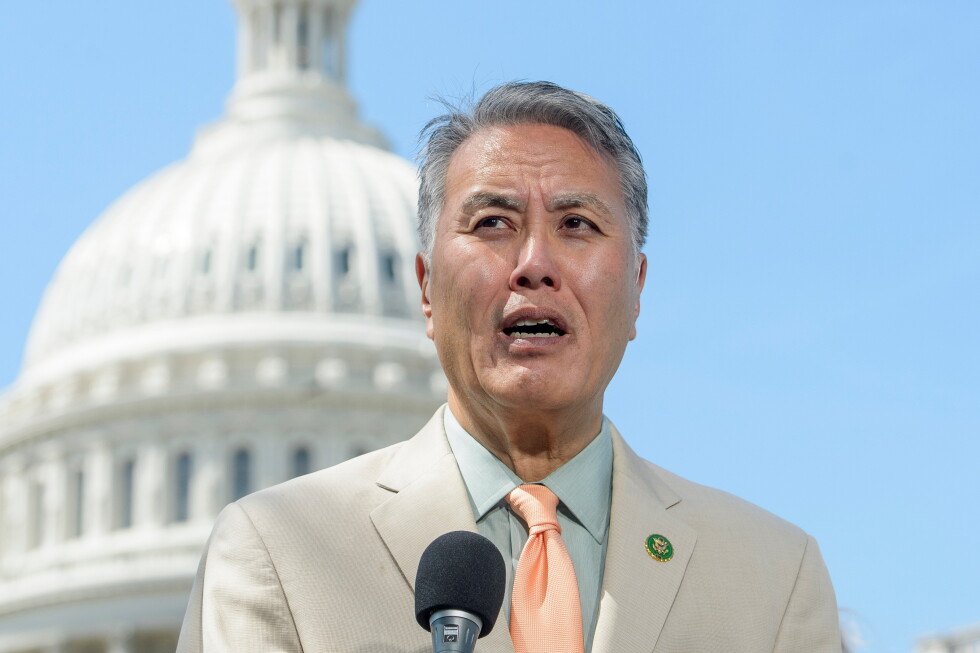
WASHINGTON (AP) – Last July 4, a congressman returned home to Southern California and encountered an unexpected story. While traversing his district, one constituent revealed that he had started carrying a passport to prove his eligibility to remain in the country.
Representative Mark Takano, whose American-born parents experienced incarceration during the forced relocation of Japanese Americans in World War II, drew parallels between that harrowing chapter of history and the present. He reflected on his family’s past and noted the alarming similarities to the current treatment of immigrant communities.
“It feels as if my own father, at two years old, and my mother, at one, were labeled as enemy aliens and deemed a threat to national security,” he explained in an interview with The Associated Press. “They were placed in concentration camps.” He emphasized that the current administration is espousing a similar narrative: that immigrants pose a significant danger, justifying drastic measures in the name of national safety.
Historical Echoes in Current Immigration Policies
President Donald Trump’s assertive stance on immigration, which prominently features mass deportation, marks a pivotal moment in American history. Citizens are witnessing the implications of policies that involve rounding up, detaining, and deporting individuals, especially against the backdrop of recent fatalities. Protests against these actions intensified earlier this year, as several Americans took to the streets, rallying against the administration’s immigration strategy originating from Minneapolis.
In light of considerable public outcry, the White House has recently ushered in new leadership at the Department of Homeland Security, aiming to reshape its approach. Newly appointed Commissioner Mark Wayne Mullin has expressed a commitment to redirect the department’s focus away from sensational headlines.
Nonetheless, Trump faces considerable pressure from conservative factions, adamant about maintaining the government’s goal of deporting one million individuals annually. His Republican allies in Congress are fueling heated debates surrounding immigration policy, advocating for the allocation of billions of dollars towards enforcement initiatives.
Takano, who serves as the ranking Democrat on the House Veterans Affairs Committee, vehemently criticizes Trump’s immigration policies, informed by his family’s own history along with the eventual national reparations for Japanese Americans who were detained. “We reflect on that era as a disgraceful episode when political leaders overlooked the Constitution, betraying the very people they were sworn to protect,” he stated.
A Personal Narrative Amid Broader Issues
A former high school history teacher elected to Congress in 2012, Takano grew up in Southern California, where he gained a deep appreciation for his family’s history. His grandfather, Isao Takano, emigrated from Hiroshima and wed American-born Kazue Takahashi. They settled in Bellevue, Washington, where they launched a successful venture cultivating tomatoes, strawberries, and chrysanthemums for the Seattle market.
During World War II, Isao and Kazue were among approximately 120,000 individuals of Japanese descent—both immigrants and American citizens—who faced forced relocation following the Pearl Harbor attack. Takano’s father, William, was only two years old when the family was taken to a concentration camp in 1942 in California, while his mother, Nancy Tsugie Sakamoto, was held in a detention center in Heart Mountain, Wyoming, at just one year of age.
Reflecting on this troubling legacy, Takano articulated a sense of foreboding regarding the legacy of anti-immigrant sentiments. “Generations of Americans will look back and question how their government could have perpetrated such acts,” he remarked on the House floor, drawing attention to the detention centers established under the Trump-era policies.
Lessons from the Past and Paths for Reform
Takano remembers his father taking him to visit the land that once belonged to their family. He learned about his great-uncles who served valiantly in the Army’s 442nd Regimental Combat Team, a battalion composed predominantly of Japanese American soldiers. One of his relatives was killed in action during their campaigns in Italy. Years later, Takano’s father contributed to the national reparations movement.
In 1988, Congress passed the Civil Liberties Act, which acknowledged the “gross injustices” inflicted upon Japanese Americans during the war and mandated a $20,000 payment to each detainee. This landmark legislation was signed into law by President Ronald Reagan.
Takano’s parents were among those who received both apologies and reparations from the federal government. Currently, discussions are emerging in Congress regarding similar relief for individuals whose lives have been profoundly disrupted by the current administration’s immigration enforcement operations.
“This country has shown an ability to recognize its past mistakes,” Takano stated. “While we are confronted with challenges today, I believe we will emerge from this moment more resolutely committed to justice and humane treatment of all people.”
