


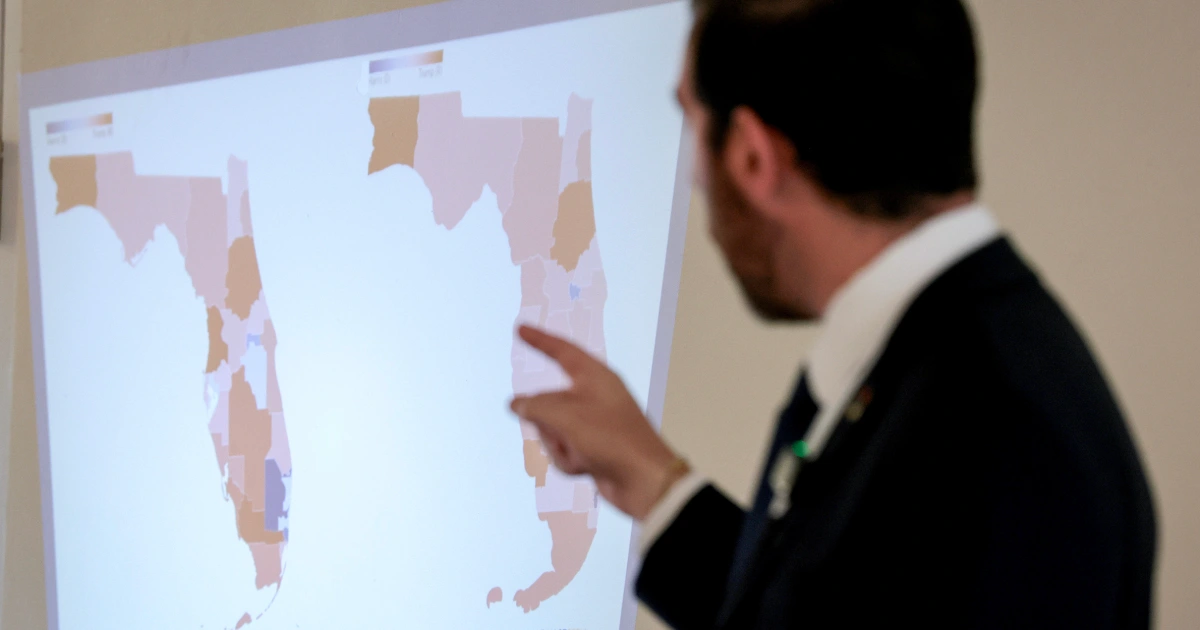
Florida Judge Hears Challenge to DeSantis’ Redistricting Plans
TALLAHASSEE, Fla. — Florida Governor Ron DeSantis’ initiative to repeal an anti-gerrymandering clause in the state constitution took center stage in court on Friday. Opposing attorneys urged a Tallahassee judge to issue a temporary suspension of recently introduced legislative maps, which could potentially add four more seats favoring Republicans.
Numerous lawsuits filed by advocacy groups contend that the mapping process overseen by DeSantis administration aide Jason Pereda employed political data to craft new congressional districts. This, they argue, violates Florida’s constitution, particularly after the Fair Districts Amendment was supported by 63% of voters in 2010.
During recent testimony before the state House, Pereda admitted to utilizing political data, among other factors, in developing the new map. Christina Ford, an attorney with the advocacy group Equal Ground, stated that this case stands out as the map creators publicly acknowledged using partisan data without adhering to the Fair Districts Amendment’s mandates.
DeSantis and his legal team countered that adherence to the Fair Districts Amendment is unnecessary. They assert that the language in the amendment, which also safeguards district formations that empower specific minority groups to elect their representatives, conflicts with current federal laws. This stance has been bolstered by a U.S. Supreme Court ruling which imposes limits on race considerations during redistricting.
The governor’s ultimate objective is for the Florida Supreme Court to review the matter, hoping for an overturn of the Fair Districts guidelines. In a session exceeding two hours, DeSantis’ attorneys, along with Florida Secretary of State Cord Byrd, contended that a temporary restraining order against the new maps should not be granted without a comprehensive trial, arguing that the new boundaries should be implemented in the upcoming 2026 midterm elections.
“Mr. Pereda provided detailed explanations of the map-drawing process for hours,” noted attorney Mohammad Jazir. “The plaintiffs have opted to focus on a singular statement about partisanship instead of the broader context.” Meanwhile, Simone Leeper, an attorney affiliated with the Campaign Legal Center, challenged this characterization and emphasized the risks of unwarranted partisan motives shaping the redistricting process.
Judge Joshua Hawkes indicated he would issue a written decision concerning the alleged need to temporarily block the new map but refrained from making an immediate ruling following the hearing. Last month, the Florida Legislature approved the map outlined by DeSantis’ office, as part of an ongoing national effort to redraw district lines and solidify Republican gains in the House ahead of the 2026 elections.
This strategy evolved from initial efforts by the Texas Republican Party, leading several other states—both red and blue—to navigate the contentious landscape of redistricting. As things currently stand, Republicans maintain 20 of Florida’s 28 congressional districts, with the new map proposing 24 districts leaning Republican.
Claims also arose from plaintiffs regarding partisan motivations behind the mapping, particularly concerning which areas are most influenced by DeSantis’ redistricting agenda in light of demographic shifts. They argued that Northeast Florida, one of the fastest-growing areas, has not seen an increase in Republican-held seats, while the Tampa Bay region has experienced substantial changes in district delineations, including the redistricting of Democratic U.S. Rep. Kathy Castor’s seat.
“This new map exists to marginalize Democrats and amplify Republican advantage,” asserted Chris Shenton, an attorney representing Common Cause Florida. However, state attorneys refuted calls to block the map prior to a full evidentiary trial, emphasizing the urgency of proceeding with the newly approved districts for the sake of the upcoming midterm elections.
As candidate filing for the 2026 primary is set to begin on May 25, Jazir cautioned the court about the impracticality of implementing changes at this juncture. The plaintiffs maintained that the map established in 2022 should remain effective until after the midterm elections, citing precedent from prior electoral cycles.
