


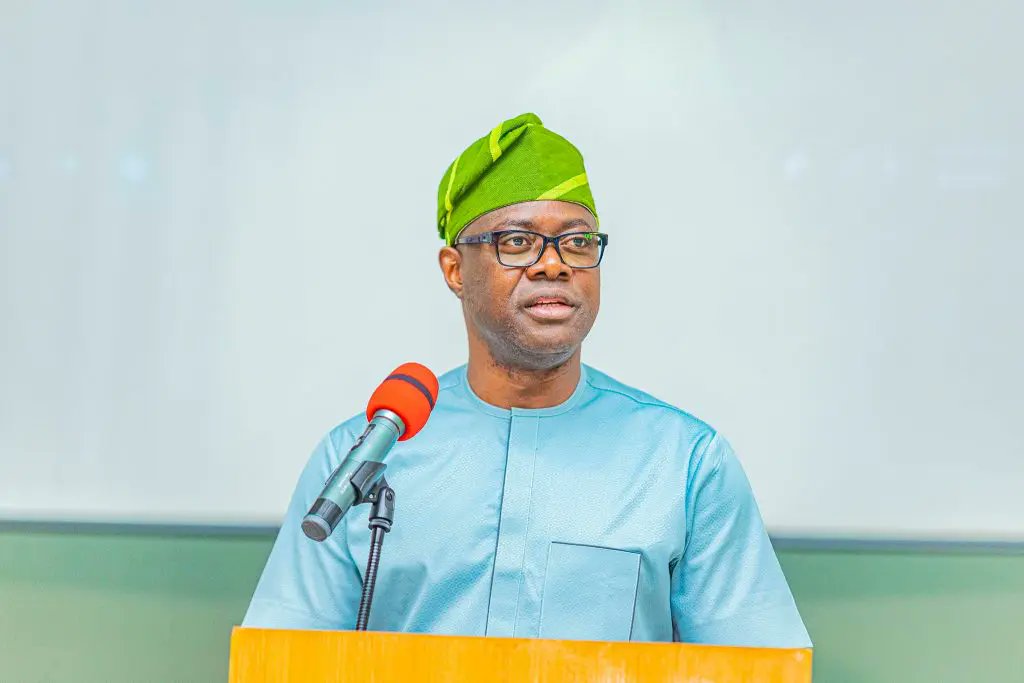
Oyo State Governor Addresses Security Challenges in Nigeria
Oyo State Governor Enguru Seyi Makinde has voiced concerns regarding the persistent insecurity within the state, highlighting the ongoing captivity of abducted schoolchildren and residents as evidence of the limitations faced by state leaders under Nigeria’s existing security framework.
During a speech in Ibadan on Saturday, where he accepted the presidential nomination of the African People’s Movement (APM), Makinde underscored the lack of constitutional authority over security forces, which impedes the ability of governors to effectively combat crime, despite their role as the chief security officers of their states.
“Innocent schoolchildren and civilians abducted by criminals in Oyo State remain in captivity,” he stated. “As Governor, I bear the weight of being the Chief Security Officer, yet we are constrained by a lack of necessary constitutional controls over our security agencies to adequately address these threats.”
The governor pointed out the unfairness of holding state leaders accountable for security lapses when they possess limited authority over the institutions tasked with maintaining public safety. He emphasized that a governor without the requisite power to act should not face accountability for security failures.
Makinde took this opportunity to advocate for comprehensive reforms to Nigeria’s security architecture, urging for the devolution of greater powers to state governments to facilitate swift and efficient responses to security challenges.
His remarks come in the wake of increasing concerns regarding the safety of children and teachers abducted by gunmen in the Oriile Local Government Area of Oyo State earlier this month. The victims were reportedly kidnapped while traveling along the Ogbomoso-Igboho route, igniting public outrage and further unease regarding the state’s security situation.
In response to the abductions, families of the victims have repeatedly called for urgent government action, while security forces have initiated search and rescue operations across affected communities and neighboring areas. Despite assurances from government officials about ongoing efforts for their release, the hostages remain unaccounted for, exacerbating public anxiety and criticism of the state’s response to the crisis.
“With God’s guidance, if I am elected President of Nigeria, I will prioritize reforming the national security architecture, ensuring our nation is not left vulnerable during crises,” he said, emphasizing decentralization as a crucial element of his future security strategy.
Makinde reiterated that if elected in 2027, he would prioritize decentralization as a means to achieve more effective security management. He declared, “The safety and security of Nigerians will never be reduced to mere political rhetoric.” He concluded by asserting that Nigeria requires a fresh approach to both governance and security, stressing that the current methods are failing to produce satisfactory outcomes.
“We cannot keep relying on the same old tactics while expecting different results. A new direction is essential—one that is grounded in capacity, courage, accountability, and compassion,” Makinde emphasized.
