


Artists Unite Against Immigration Enforcement During World Cup
As the FIFA World Cup draws fans from around the globe to South Florida, local artists are seizing the opportunity to address critical issues surrounding immigration enforcement in the region. The community arts collective, Artists for Artists: MIA (A4A: MIA), has allied with the national “No ICE in the Cup” (NIITC) campaign, aiming to illuminate the repercussions of immigration crackdowns in World Cup host cities, especially in Miami.
Mark Wayne Mullin, Secretary of the Department of Homeland Security, confirmed the heightened presence of Immigration and Customs Enforcement (ICE) during the tournament, stating that ICE agents “will be on the scene every day.” The soccer games symbolize a gathering point for the rich tapestry of diaspora communities in the U.S., offering a platform for artists and advocates to share vital information about immigrant rights.
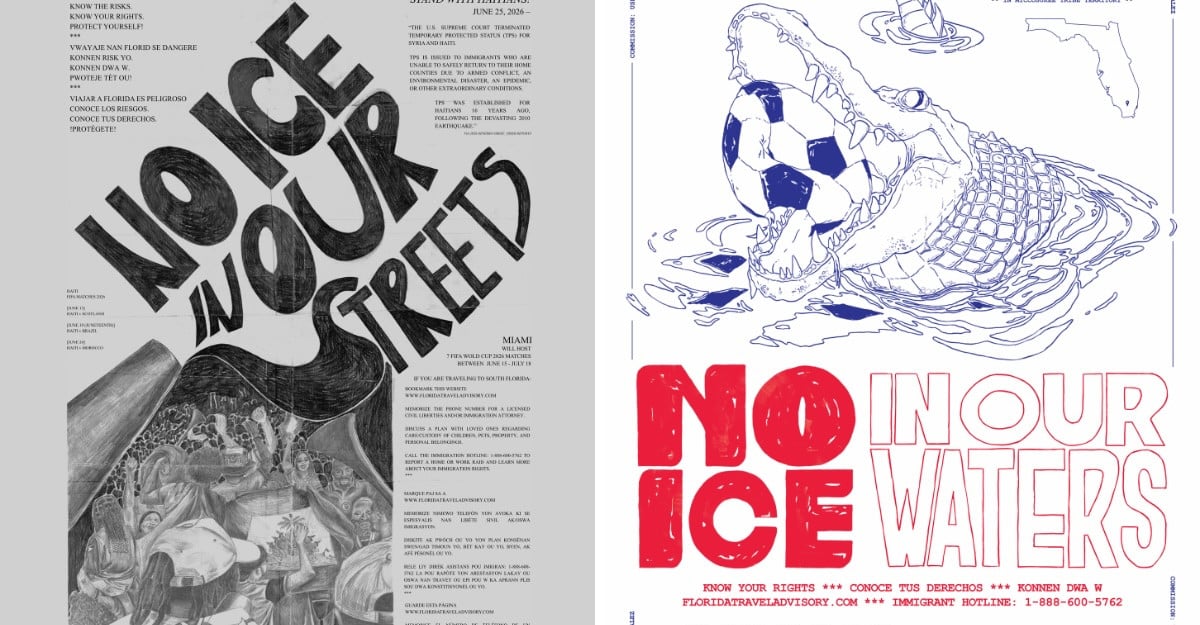
A4A: MIA co-organizer Johan Muñoz Tapasco is among the artists commissioned for the campaign, creating one of 11 posters designed to protest immigration enforcement in World Cup cities across the nation. Muñoz Tapasco notes the pervasive fear stemming from ICE’s presence in Miami, which has become a significant hub for detentions in the country. “While Miami has long been viewed as a refuge for many undocumented people, the immigration landscape here has drastically shifted,” they remarked.
This initiative emerged from a coalition of national organizations united against ICE’s encroachment on World Cup events and immigrant communities. Muñoz Tapasco’s participation reflects years of collaboration with immigrant rights groups in South Florida, including Florida Rising and the Florida Immigration Coalition.
“The violence inflicted by ICE on immigrant communities has left millions feeling isolated and scared,” stated Paola Mendoza, co-chair of the NIITC Artists Committee. “Artists have a unique ability to unite people and inspire action. When combined with the passion surrounding soccer, this campaign has the potential to safeguard individual rights and democratic values.”
Muñoz Tapasco’s poster design, inspired by vintage Florida tourist postcards, cleverly conveys Miami’s current realities. Featuring an alligator tearing apart a soccer ball, the artwork directs viewers to an emergency travel advisory crafted by campaign organizers. This advisory includes essential multilingual resources such as “Know Your Rights” information, an immigration hotline, and support for families facing deportation procedures.
The piece is also a nod to the detention facility dubbed “Alligator Alcatraz,” a focal point for local organizing efforts against immigration abuses in the past year. “This artwork serves as a historical reminder of the political climate that has allowed for such facilities to exist,” Muñoz Tapasco added. By reclaiming the symbol of the alligator—often weaponized in negative narratives—Muñoz Tapasco aims to connect the imagery to Florida’s cultural heritage while highlighting the injustices faced by immigrant populations.
For Muñoz Tapasco, the fight for immigrant rights is deeply personal. Having immigrated from Colombia and experienced life in the U.S. under constant threat of deportation, they recognize the urgency of this campaign. “The World Cup offers a unique chance to interact with individuals who might not otherwise engage with immigrant advocacy,” they said. A recent travel advisory released by over 120 organizations expressed concerns about increased immigration risks during the tournament, underscoring the importance of accessible information for both residents and visitors.
“These games symbolize unity,” Muñoz Tapasco emphasized. “Through our art, we cultivate a space for curiosity, dialogue, and collective empowerment.” They highlighted recent events, like the Brazil vs. Haiti matchup, where posters were distributed to attract attention and disseminate crucial information. Julia Roig, founder of the Horizons Project, echoed this sentiment, asserting that the World Cup should reflect inclusivity and embody the spirit of fair competition.
A4A: MIA is expanding the scope of the campaign beyond its initial commissioned pieces, recently launching an open call for South Florida artists to submit posters that resonate with the political realities of the state’s immigrant communities. Muñoz Tapasco concluded, “We face a landscape where important truths are often obscured by sports and entertainment. We want our community to confront these sobering realities and advocate for change through art.” Some submitted posters will be made available for download, allowing wider access to pivotal information.
Looking forward, Muñoz Tapasco hopes to ensure that the narratives of families affected by detention remain in the public consciousness long after the FIFA World Cup concludes. This initiative aims to preserve the social memory of these experiences and foster critical discussions on immigration enforcement policies in Florida. “Political education is vital,” they asserted. “Understanding the historical contexts that led to these situations is essential for preventing them from recurring.”
