


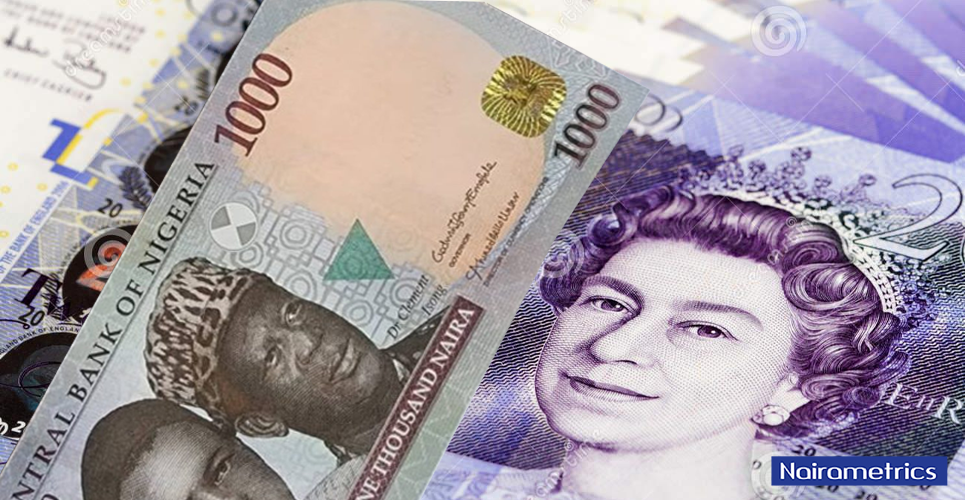
Naira Shows Stability Against British Pound Amid Market Fluctuations
As the British pound experiences a rebound in the global foreign exchange market, the Nigerian naira is maintaining relative stability against it in local trading. Recent data from the Central Bank of Nigeria (CBN) indicates that the GBP/NGN exchange rate has settled at approximately 1,850 naira per pound.
This year, the naira’s strongest performance was recorded on April 16, when it peaked at approximately 1,814 naira per GBP in the spot market. Over the medium term, the naira has appreciated approximately 6.6% against the British pound, improving from an initial rate of 1,948.9 naira per pound.
Current market conditions reveal that the naira is trading at a stable range in the official counter (NFEM), currently between 1,350 and 1,370 naira per dollar. Conversely, in the informal market, the British pound is being purchased at around 1,900 naira and sold at approximately 1,925 naira per pound, highlighting a significant demand for foreign currency driven by importers and tourists.
Operators in the local market have noted a high demand for the pound, as citizens are willing to pay premiums for various overseas expenses, including tuition, medical care, business transactions, and international travel. The central bank of Nigeria has been actively implementing intervention strategies and maintaining a tight monetary policy, keeping the Monetary Policy Rate (MPR) steady at 26.5%.
The effectiveness of the central bank’s efforts in managing foreign exchange availability has attracted international portfolio investors to Nigeria’s fixed-income products, contributing to a consistent supply of foreign currency. Furthermore, increases in crude oil production coupled with rising global energy prices during the first half of the year have bolstered Nigeria’s foreign exchange reserves, alongside robust remittances from the Nigerian diaspora.
British Pound Engages in Tug-of-War with the Dollar
Currently, the British pound is locked in a competitive stance against the US dollar, trading around the 1.34 mark. This volatility reflects ongoing developments in global finance, including significant events associated with ‘Central Banking Week’ and geopolitical shifts affecting the market.
The market is witnessing a balance between geopolitical concerns and measured monetary policies. At the beginning of the week, the pound surged towards 1.3450, displaying notable ‘risk-on’ strength, influenced by the promising ceasefire discussions between the US and Iran, and the reopening of the Strait of Hormuz—factors that have caused oil prices to decline.
This situation momentarily diminished the dollar’s strength, often viewed as the preferred “risk-off” asset. However, as market focus shifted back to macroeconomic policies, the initial relief rally lost momentum. Traders are currently poised for pivotal central bank meetings scheduled for Wednesday and Thursday, with the dollar showing modest strength in anticipation of potential announcements.
The Bank of England is set to convene the following day, with the latest UK Consumer Price Index (CPI) data expected to be released on Wednesday. Typically, weakness in US manufacturing and regional production indices translates to dollar depreciation; however, current conditions exhibit some resilience ahead of the Federal Reserve’s meeting.
The market is closely monitoring the UK’s economic performance and grappling with concerns regarding potential stagnation. Though the pound has rebounded from its lows in May, it appears to have encountered a formidable resistance level. If the exchange rate remains below the long-term moving average, a mildly bearish to neutral outlook can be expected. Critical resistance hangs at the psychological 1.3500 mark, reflecting the high achieved on May 26.
In the coming week, the exchange rate is anticipated to stabilize around this resistance level. The Relative Strength Index (RSI) is currently hovering between 48 and 53, indicating that market sentiment is consolidating in preparation for impactful economic developments ahead.
