


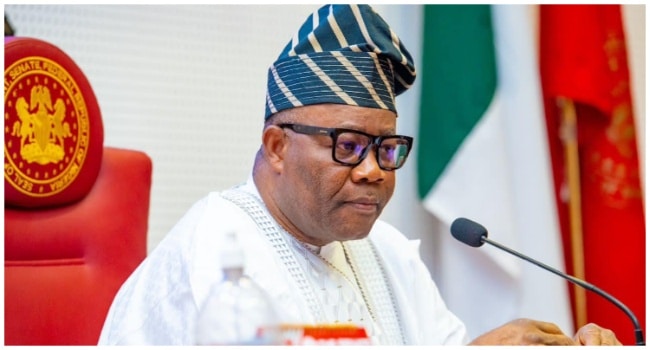
Senate President Calls for Transparency in National Budget Management
Senator Godswill Akpabio, President of the Senate and former Governor of Akwa Ibom State, has faced growing scrutiny regarding the management of Nigeria’s national budget. As public concerns mount, he is urged to clarify how the budget became a subject of contention, particularly under his leadership.
Recent Revelations of Budget Manipulation
In the past few weeks, allegations have surfaced surrounding irregularities in the 2026 budget, sparking debates about accountability. House Appropriations Committee Chairman Abdulmumin Jibrin has accused fellow lawmakers, including former Speaker Yakub Dogara, of inflating the budget by adding nearly 2,000 unauthorized projects, totaling over ₦284 billion.
Convoluted Budget Documentation
The 2026 budget, sprawling across 2,790 pages, has raised questions about the legitimacy of its contents. Critics assert that the extensive documentation has become a vehicle for fake government agencies and fabricated projects, such as numerous solar street lights that seem disconnected from actual infrastructural needs.
Past Controversies and Consequences
Jibrin has a history of addressing these issues, recalling his 2016 accusations that led to his suspension. Despite his claims of being a whistleblower, he faced backlash, and no colleagues supported him while those he named continued to occupy key positions. This has led many to question the integrity of the anti-corruption measures promised by the Buhari administration.
Discrepancies in Project Implementation
An example of the questionable allocation of resources is the construction of a road by the Federal College of Education in Umunze, Anambra State, intended for an area far from its location in Surulere, Lagos State. This situation exemplifies the mismanagement of budgetary allocations, where local needs are disregarded in favor of political maneuvering.
Opaque Financial Practices in Government
Reports from the Auditor General highlighted troubling trends, including undocumented expenditures by the Corporate Affairs Commission, amounting to ₦118.75 million for oversight functions. With a lack of clarity in financial reporting, the prospects for genuine reform remain uncertain, raising questions about the role of the Public Accounts Committee in investigating these matters.
Leadership Accountability and Future Directions
As the national budget continues to face scrutiny, Akpabio’s recent comments about addressing contractors have drawn criticism. Observers question why he would focus on minor issues, such as microphone malfunctions, when more severe concerns about budget mismanagement loom large. The need for decisive leadership and a focus on national interests has never been clearer.
Grassroots Initiatives and Broader Implications
In a separate development, Mrs. Oluremi Tinubu recently pledged ₦2 billion to rejuvenate textile production in Abia State. While such initiatives are commendable, questions persist about the origins of these funds and their potential impact on the local economy. Without transparency and sound governance, the efficacy of these investments remains in doubt.
