


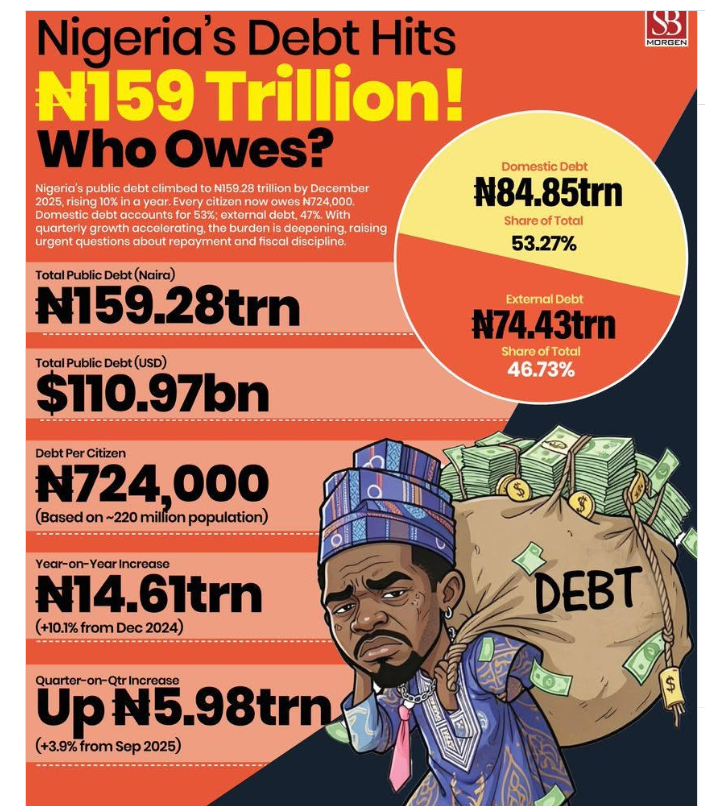
Nigeria Faces Increasing Debt Crisis Amid Weak Revenue Mobilization
The term “debt” often evokes significant concern among Nigerians, particularly when announcements from the Debt Management Office (DMO) surface. News outlets highlight growing public debt figures, sparking social media outrage and a national reminder of the financial burdens citizens face. However, this reaction overlooks a more profound issue: Nigeria’s fiscal predicament is not solely rooted in the volume of debt but rather in the fragile financial foundation that sustains it.
Escalating Public Debt and Its Implications
As of December 31, 2025, Nigeria’s total public debt amounted to ₦159.28 trillion (approximately US$110.97 billion), marking a sharp increase from ₦144.67 trillion (US$94.23 billion) reported at the end of 2024. This represents a year-on-year rise of ₦14.61 trillion, or 10.1%. With an estimated population of 220 million, this translates to about ₦720,000 per capita. As the government enters 2024, it is projected to allocate a staggering 96% of its revenue to debt servicing, severely limiting financial resources available for critical sectors like infrastructure, education, and health.
Critical Revenue Shortfalls and Economic Challenges
Nigeria’s tax-to-GDP ratio languishes between 6% and 8%, one of the lowest globally, compared to Africa’s average of 18%. This discrepancy creates a fiscal trap: borrowing to cover deficits while most revenue is consumed by debt repayments. The consequences are dire—politicians face the challenge of deciding whether to reform the taxation system to increase revenue or to address the accumulating debt that stifles investment.
A Vicious Cycle of Debt and Revenue Deficiency
To comprehend Nigeria’s fiscal challenges, it is essential to recognize the paradox of insufficient revenue generation. In the 2026 federal budget, expenditures are anticipated to hit ₦58.18 trillion against projected revenues of ₦34.33 trillion, yielding a budget deficit of ₦23.85 trillion (4.28% of GDP). Following parliamentary adjustments, the spending ceiling escalated to ₦68.32 trillion, with borrowing expectations surging to ₦29.2 trillion. Such discrepancies between anticipated revenues and excessive spending highlight a troubling trend: a growing reliance on debt financing.
Consequences of a Weak Revenue Base
The chronic underperformance in revenue collection leads to a dependence on borrowing, which, in turn, fuels debt servicing that consumes nearly all retained earnings—97% recorded in 2022. A mere improvement in financial management still sees projected debt servicing consuming approximately 61% of revenues in 2024, starkly exceeding the 30-40% threshold deemed sustainable for developing nations. Nigeria’s public debt has surged from ₦49.85 trillion in 2023 to ₦159.3 trillion by late 2025, with forecasts suggesting it could hit ₦187.79 trillion by the end of 2026.
Addressing Debt Sustainability Concerns
Nigeria’s sustainable debt challenges underline a critical hindrance to its fiscal landscape. The ongoing imbalance between borrowing and revenue growth compounds the problem, as newly acquired loans are increasingly employed to offset older debts. For instance, the Central Bank of Nigeria (CBN) loaned the federal government extensively, leading to a staggering accumulation exceeding ₦22.7 trillion before it transitioned into long-term debt. Such maneuvers jeopardize investor confidence and hinder economic policy flexibility.
Breaking the Fiscal Trap: A Roadmap Forward
Nigeria’s economic future hinges on overcoming its fiscal predicaments. Immediate reforms should focus on ensuring that borrowing is productive, particularly for infrastructure and development initiatives, rather than recurrent expenditures. Implementing the new tax law effectively, enhancing digital revenue collection methods, and curbing oil revenue losses will be crucial steps. Additionally, enforcing fiscal responsibility and improving governmental transparency regarding loan approvals can pave the way for sustainable economic growth. The crux of the matter is not whether Nigeria should borrow but how it can do so judiciously and concurrently bolster revenue to ensure that debt fosters growth rather than detracts from it.
