


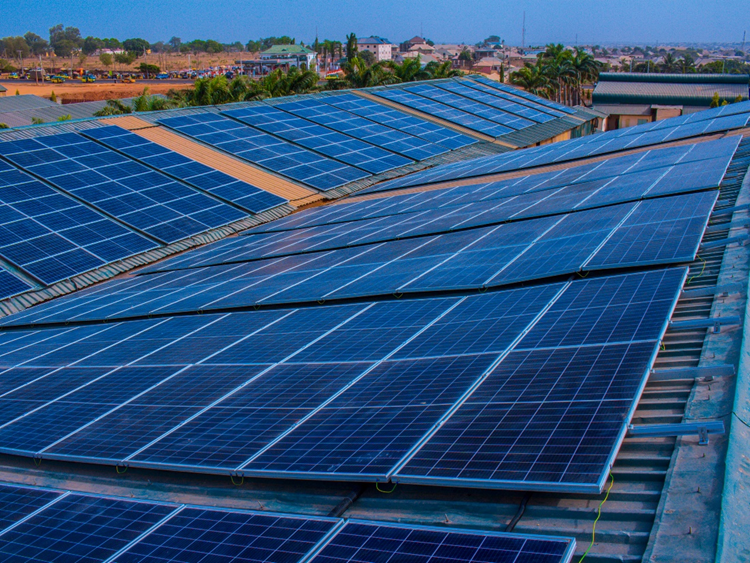
Nigeria Emerges as Africa’s Fastest-Growing Small-Scale Solar Market
Nigeria has been identified as the fastest-growing small-scale solar power market in sub-Saharan Africa. However, inadequate investment in utility-scale renewable energy projects has hindered the nation’s ability to leverage this growth into substantial enhancements in large-scale power supply.
This insight comes from a recent report released by BloombergNEF (BNEF), titled Sub-Saharan Africa Renewable Energy Market Outlook. The report forecasts that Nigeria will lead small-scale solar installations in the region until 2035, while South Africa is anticipated to maintain its position as the continent’s front-runner in utility-scale renewable energy deployment.
The findings reveal diverging paths among African nations in the energy transition, with Nigeria’s growth primarily driven by households and businesses opting for rooftop solar and battery storage systems, stepping away from the unreliable national electricity grid. BNEF’s analysis reflects a comprehensive profiling of 16 markets in sub-Saharan Africa, informed by utility-scale project pipelines and import data to gauge small-scale demand.
Among the region’s five largest clean energy technology importers projected beyond 2025—South Africa, Nigeria, the Democratic Republic of Congo (DRC), Zambia, and Kenya—only South Africa, the DRC, and Zambia have developed significant utility-scale project pipelines. In contrast, both Nigeria and Kenya currently exhibit demand largely from small-scale solar initiatives. However, Kenya could see a resurgence in utility-scale investment if its governmental bidding plans advance.
Nigeria Outpaces in Off-Grid Solar Power Development
According to BloombergNEF, Nigeria has approximately 20 gigawatts (GW) of installed electricity capacity, predominantly derived from gas-fired sources, while solar power expansion is occurring almost entirely independent of the national grid. The report predicts that Nigeria will add 3.1GW of small-scale solar capacity in 2024 and 2025, pushing cumulative installed capacity to about 6GW.
Furthermore, BloombergNEF estimates that Nigeria’s cumulative solar power generation capacity could reach 87GW by 2035, showing an annual increase from 2.4GW in 2026 to 7.8GW by 2030 and expanding to 16.2GW in 2035. This rapid growth is attributed to escalating power shortages, soaring diesel and gasoline prices, and increasing demand for reliable electricity from households and businesses.
The report emphasizes that the expansion of small-scale solar photovoltaics (PV) and energy storage systems is crucial in propelling growth across sub-Saharan Africa, particularly in Nigeria, which is shifting from gasoline generators to solar solutions. This trend mirrors similar developments observed in Pakistan, where consumers increasingly rely on rooftop solar to compensate for power grid deficiencies.
Utility-Scale Projects Face Stagnation
Despite the rapid advancement of distributed solar power, Nigeria’s utility-scale renewable energy market remains largely stagnant. Between 2020 and 2025, only two significant grid-connected solar PV projects were commissioned: the 70MW Zungeru hydropower-linked solar PV initiative and the 10MW Kumbotso solar power plant, Nigeria’s inaugural grid-connected solar facility.
Unlike South Africa, which employs competitive procurement programs for renewable energy project awards, Nigeria’s approach is marked by isolated projects lacking predictable auction mechanisms essential for attracting large-scale private investments. The report notes that uncertainty around future utility-scale procurements hampers developers’ ability to plan for long-term investments.
South Africa Maintains Dominance in Large-Scale Investments
As Nigeria leads in small-scale deployments, South Africa continues to spearhead large-scale renewable energy investments in the region. BloombergNEF estimates South Africa’s installed electricity capacity at 67GW by 2025, with a combination of government procurement and power purchase agreements from rapidly expanding companies expected to drive cumulative renewable energy additions.
The report anticipates that South Africa will average 2GW of renewable energy additions per year between 2020 and 2025, increasing to 4.67GW annually from 2025 to 2030. Notably, corporate power purchases are expected to contribute approximately 1.7GW of the anticipated 2.3GW of renewable energy installations in 2026.
Challenges for Nigeria’s Renewable Energy Investment
The report highlights that Nigeria’s primary hurdle has shifted from consumer demand for solar technology to the absence of a robust procurement framework for utility-scale renewable energy projects. It is evident that utility-scale investments in sub-Saharan Africa are concentrated in countries operating under competitive bidding and transparent power purchase agreement frameworks.
BloombergNEF warns that without reforms to Nigeria’s electricity procurement system, investment will predominantly flow toward off-grid and mini-grid solutions, sidelining large-scale renewable power plants that have the potential to enhance the nation’s electricity grid.
Growing Demand Reflected in Imports
Interestingly, the report positions Nigeria as the largest importer of clean energy equipment in sub-Saharan Africa. Between 2025 and April 2026, Nigeria imported approximately 2,370 MW of clean energy equipment, trailing only South Africa’s 5,416 MW. This underscores Nigeria’s increasing demand for solar panels, batteries, and related technologies.
Despite this strong import activity, BloombergNEF notes that Nigeria has seen minimal funded utility-scale renewable energy capacity during the same period, signaling a disconnect between rising consumer demand and investments in large-scale power infrastructure. The report projects that the total installed capacity of solar, wind, and battery storage across sub-Saharan Africa will reach 13GW by 2025, potentially doubling to 29GW by 2030.
Ultimately, the findings indicate that economic factors, rather than climate change policy, are primarily driving the adoption of renewable energy, as households and businesses increasingly replace costly diesel and gasoline generators with solar power systems and batteries. While Nigeria’s transition to clean energy appears promising, the report cautions that a lack of transparency in utility-scale project pipelines could limit the impact of the solar power boom on the overall electricity supply.
