


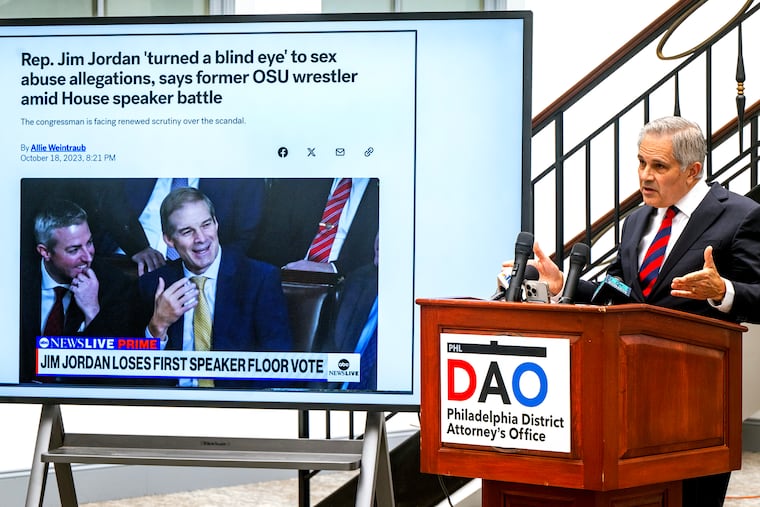
Philadelphia District Attorney Challenges House Judiciary Committee
Philadelphia District Attorney Larry Krasner expressed his disapproval of the House Judiciary Committee on Wednesday, urging Republican leaders to refrain from utilizing taxpayer dollars for what he termed “false and authoritarian political campaigns.”
Criticism from Republican Lawmakers
Krasner’s remarks followed a letter in which Ohio State Chairman Jim Jordan and Immigration Subcommittee Chairman Tom McClintock accused Philadelphia officials of shielding criminal immigrants under sanctuary policies. The lawmakers scrutinized the city’s immigration management in correspondence addressed to Krasner, Police Chief Kevin Bethel, and Sheriff Rochelle Bilal.
Krasner’s Response to Immigration Policy Allegations
During a press conference on Wednesday, Krasner characterized the Trump administration’s approach to immigration as a “war.” He welcomed the opportunity for a public hearing before the commission, which has hinted it may summon witnesses to testify.
An Invitation for Scrutiny
Krasner openly invited committee chairman Jim Jordan to engage further, stating, “I’m free next week. Let’s go.” He expressed uncertainty about whether Jordan understood Philadelphia’s stance but emphasized the need for accountability, urging Jordan to “Pull up! Pull up! Pull up!”—a phrase inviting someone to confront the issues head-on.
Document Transparency and Committee Demands
Krasner assured the committee that he would provide as many requested documents as possible by the May 18 deadline. He also indicated plans to request documentation from the commission and federal authorities in a bid for transparency amid escalating scrutiny of the city’s immigration policies.
Escalation of Tensions over Sanctuary Policies
The Judiciary Committee’s actions represent a significant escalation in criticism from Trump-aligned Republicans toward Philadelphia’s government regarding its sanctuary policies, particularly the city’s efforts to limit cooperation with U.S. Immigration and Customs Enforcement (ICE). A May 4 letter accused Krasner and other officials of undermining the rule of law under the pretext of public safety while allegedly granting preferential treatment to undocumented immigrants.
Krasner Refutes Claims of Crime Links
Krasner countered Republican assertions by noting that a minimal segment of undocumented immigrants commit serious offenses, arguing that it is, in fact, Trump’s immigration policies that inadvertently allow serious criminals to evade justice. He delineated how defendants facing arrest by ICE can be deported and held responsible before they are brought to trial, effectively creating a “get-out-of-jail-free card.” “Are you listening, Donald Trump?” he questioned. “There has been no conviction or sentence.”
Broader Implications for Philadelphia’s Immigration Policy
Philadelphia has historically faced scrutiny regarding its stance on immigration. Recently, Mayor Sherrell L. Parker endorsed legislation that enshrines the city’s protective immigration policy, explicitly barring ICE from operating on city property. Among the nominated “ICE Out” bills, he signed six into law while allowing another to remain unchanged, which prohibits immigration officials from concealing their identities.
The new regulations, set to take effect in July, demand up to six years’ worth of immigration-related communications between local entities and federal officials. The committee’s letter has also reached Virginia law enforcement, accusing local leaders in Arlington County and Falls Church of violating federal immigration laws—an issue that has drawn significant attention in recent months.
This ongoing situation regards the complex landscape of immigration policy in the U.S. and reflects rising tensions between federal and local authorities. As developments continue, the implications for cities with sanctuary policies remain significant, as platforms for further dialogue become increasingly important amidst shifting political landscapes.
