


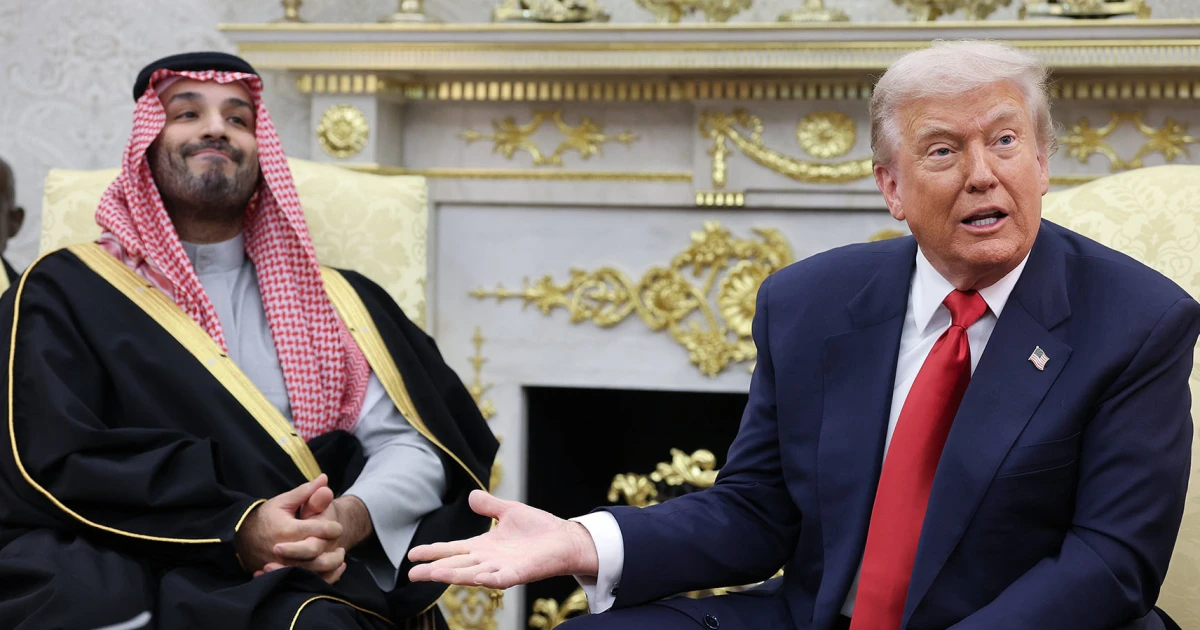
Trump Links U.S.-Saudi Nuclear Agreement to Relations with Israel
President Donald Trump confirmed on Thursday that the U.S.-Saudi nuclear deal hinges on Saudi Arabia normalizing its relations with Israel. This significant stipulation had not been disclosed at the time of the agreement’s announcement.
In a post on Truth Social, Trump noted that the agreement precludes any enrichment of nuclear material, emphasizing that it is intended solely for non-military applications. However, this aspect has raised concerns among lawmakers and experts regarding the potential for civil nuclear agreements to foster nuclear proliferation in the Middle East.
Trump further stated that the agreement is “entirely conditional” upon Saudi Arabia’s participation in the Abraham Accords, a set of normalization agreements established during his first term. These accords have already been signed by several prominent Muslim nations, including the United Arab Emirates and Bahrain, as well as Sudan and Morocco. The expansion of these accords represents a key goal for Trump in his second term.
A normalization agreement between Israel and Saudi Arabia has long been viewed as a prerequisite for allowing the Gulf kingdom to enrich uranium, although Saudi leaders have consistently argued that this cannot occur without substantial advancements toward establishing a Palestinian state.
Israeli Prime Minister Benjamin Netanyahu has dismissed the notion of forming a Palestinian state, adding another layer of complexity to the negotiations.
The U.S. Energy Department stated on Wednesday that the deal “lays the legal foundation for a multi-decade, multi-billion dollar partnership” that aligns with key economic and strategic goals, particularly concerning nuclear non-proliferation.
A senior administration official indicated to NBC News that Trump has given the green light for the deal, which will soon be forwarded to Congress for review. Reports suggest that the agreement is not expected to mandate stringent U.N. inspections or impose restrictions on uranium enrichment and the reprocessing of spent nuclear fuel. This would allow American firms to establish a uranium enrichment facility in Saudi Arabia, contingent upon a joint U.S.-Saudi study to assess its feasibility.
While the Department of Energy’s announcement did not mention the Abraham Accords, the specific terms of the agreement remain undisclosed to the public. The agreement was officially signed by Energy Secretary Chris Wright and Saudi Prince Abdulaziz bin Salman.
In its own announcement regarding the deal, Saudi Arabia did not acknowledge Trump’s conditions, instead highlighting the agreement’s aim to “diversify energy sources, advance cutting-edge technologies, and expand opportunities for cooperation and investment” between the two nations.
As a member of the International Atomic Energy Agency (IAEA), Saudi Arabia is involved in promoting peaceful nuclear development while also undergoing inspections to ensure the absence of covert nuclear weapons programs. The agency, headquartered in Vienna, reports to both the United Nations General Assembly and Security Council.
Nuclear enrichment serves as a vital part of civil nuclear power generation and, at elevated enrichment levels, can also play a role in the development of nuclear weapons.
