


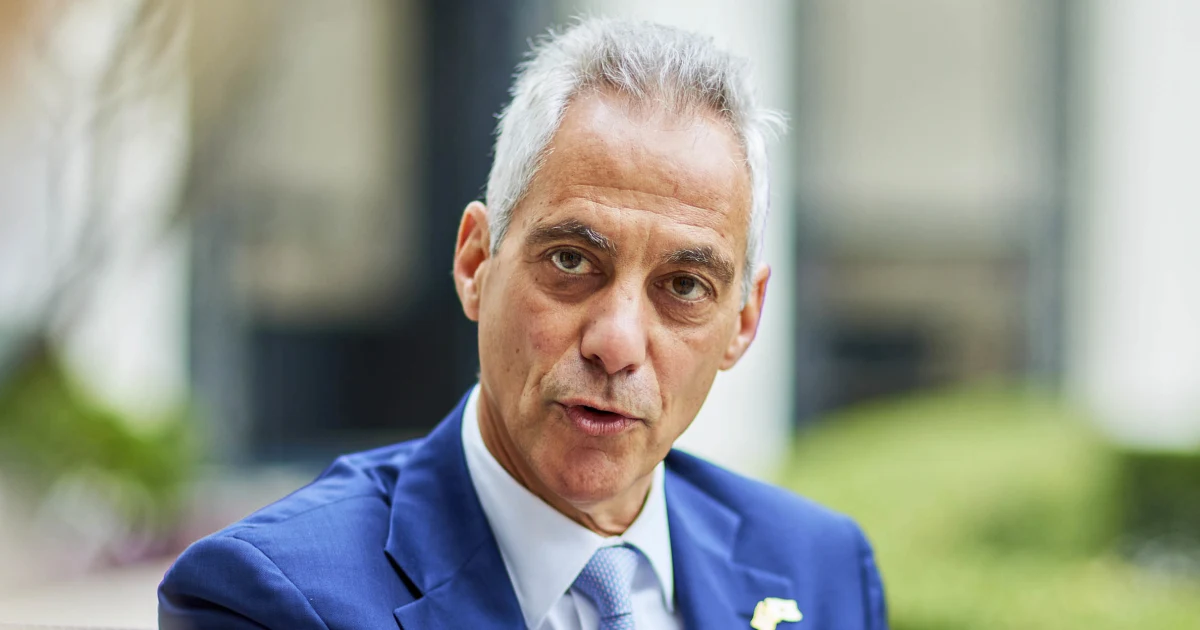
Rahm Emanuel Calls for Shift in Military Aid Approach to Israel
Rahm Emanuel, who served as President Barack Obama’s chief of staff and is considered a potential candidate for the 2028 presidential election, is generating considerable discussion by advocating for the cessation of U.S. taxpayer-funded military aid to Israel.
Emanuel’s perspective stands out, especially as he identifies as a moderate within the Democratic Party, leading to speculation about whether other prospective candidates will adopt similar views on an issue previously favored by the party’s far-left factions.
Historically a supporter of Israel, Emanuel was part of the Obama administration when the U.S. allocated over $1.3 billion towards Israel’s Iron Dome defense system. Nonetheless, he contends that American taxpayers should no longer bear this financial responsibility.
This sentiment was expressed during an appearance on “Real Time with Bill Maher,” where Emanuel received applause for his assertion that Israel, like other allies such as Japan, South Korea, and the UK, should fund its own military expenses.
“We don’t need any more American troops… It’s taxpayer funding for Israel. You have to abide by the law,” Emanuel stated, highlighting a significant shift from past policies where military aid was deemed essential. He pointed out that Israel’s situation has evolved over the last two decades and suggested that military assistance from U.S. taxpayers is no longer justifiable.
Echoing this sentiment, Representative Alexandria Ocasio-Cortez recently declared her withdrawal of support for U.S. aid to Israel, framing her stance as consistent with her voting record and arguing against funding a government that disregards international law. Fellow Representative Ro Khanna joined her in this call, emphasizing that with Israel’s substantial budget, it should support its own defense needs without American subsidies.
Growing Democratic Discontent with Military Aid to Israel
As tensions surround Israel’s actions in Gaza, opposition to U.S. taxpayer military aid has intensified among Democrats. An NBC News poll found that a significant number of registered voters now have a negative view of Israel, a sentiment particularly strong among independents and Democrats. Public dissatisfaction also extends to former President Trump’s military actions in the Middle East.
The divide within the Democratic Party is becoming more pronounced over support for the American Israel Public Affairs Committee (AIPAC), historically a substantial political contributor. A recent resolution at the Democratic National Committee meeting aimed to condemn AIPAC, leading to protests from party members who expressed their outrage toward the committee’s leadership.
AIPAC’s Perspective on the Future of Military Support
AIPAC spokesperson Delin Sousa defended the need for continued U.S. support for Israel—labeling it critical for both American national security and for maintaining strategic democratic alliances. Sousa emphasized that military aid should be viewed not as a handout but as a significant investment that benefits both nations.
Concerns of American Jewish Democrats
Jewish Democrats are voicing rising concerns about their place within the party amid increasing anti-Israel sentiment and fears that the party is insufficiently addressing anti-Semitism. Emanuel, who identifies as Jewish, has had a complex relationship with Israeli Prime Minister Benjamin Netanyahu, who once labeled him a “self-hating Jew.”
Emanuel’s Evolving Position on U.S. Aid to Israel
Since December, Emanuel has gradually shifted toward advocating for the end of U.S.-funded military aid, citing Israel’s improved security as a rationale. He remarked that Israel should be treated as any other foreign purchaser of U.S. military equipment, emphasizing that they will no longer receive taxpayer support and must adhere to the same rules as other nations.
While Emanuel’s remarks aim to foster a conversation about military aid and responsibility, some on the far left remain skeptical about his motivations. Activists argue that Emanuel’s lengthy history suggests that his recent stance may merely be an attempt to align with a growing human rights agenda rather than a genuine change of heart.
