


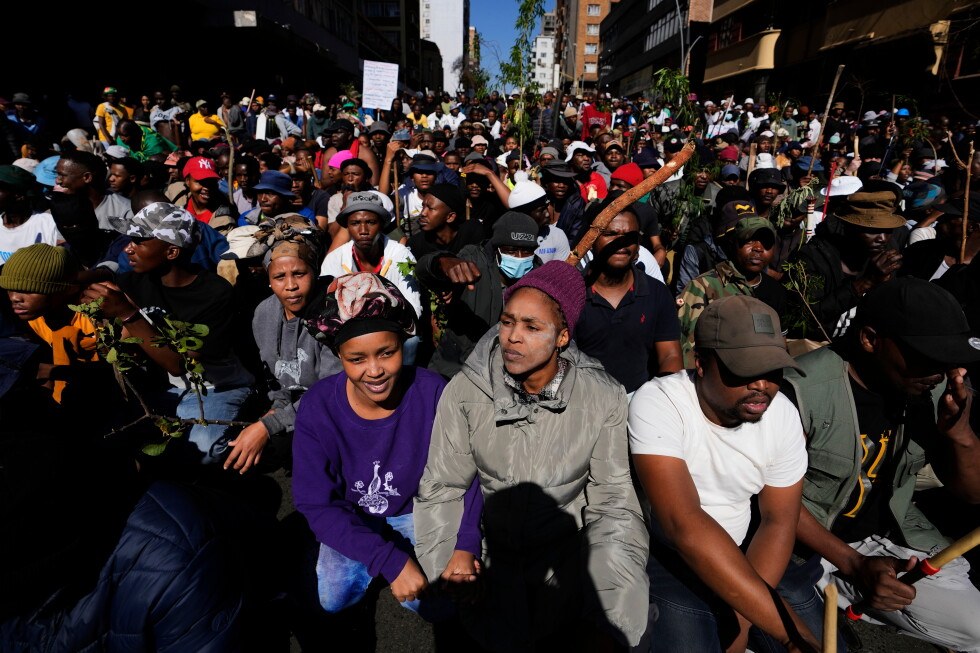
JOHANNESBURG — Thousands of demonstrators have mobilized in several regions of South Africa to protest against illegal immigration. Authorities reported that the march remained largely peaceful, despite some isolated incidents of looting.
The police confirmed multiple arrests but did not disclose the specific number. Justice Minister Mmamoloko Kubai commended the protests for their overall peaceful nature during a press conference on Tuesday, yet she warned that individuals engaging in violent or criminal behavior would face prosecution.
“Those who choose to exploit the march to commit criminal acts will face the full force of the law,” Kubai stated. “Police will continue to identify, arrest, and prosecute all those responsible for criminal activity.”
Disparate Views on Immigration and Economic Challenges
The demonstrations followed a self-imposed deadline of June 30, established by certain protest groups, demanding the expulsion of all migrants, specifically targeting those deemed to be in the country illegally. Activists argue that immigrants exacerbate unemployment by accepting lower wages and contribute to societal issues, including rising crime rates.
The South African government dismissed the deadline, asserting that only official agencies have the authority to enforce immigration laws. Prominent organizations opposing illegal immigration, such as March and March, Operation Dudula, and the Progressive Army, have gained significant traction. In response to the protesters’ claims, President Cyril Ramaphosa engaged in discussions with leaders of these groups, urging them to maintain peaceful demonstrations.
One protest leader, Ngizwe Mchunu, stated that illegal immigration fuels the proliferation of narcotics in South Africa. He expressed concerns over the high number of informal shops operated by immigrants, insisting that these businesses should be owned by South Africans. “It’s disheartening that we have been raising this issue since the dawn of democracy,” Mchunu lamented. “It’s time for our government to prioritize South Africa.”
Amnesty International South Africa asserts that migrants, refugees, and asylum seekers are unjustly blamed for the nation’s unemployment, inequality, and deteriorating public services. The organization insists that these challenges arise from the historical legacy of apartheid, ongoing inequalities, and systemic failures in the asylum framework.
Growing Discontent Among Protesters
Marchers in Johannesburg included a diverse group, from young men wielding traditional weapons to women of all ages, some donning South African flags and singing liberation songs. Their placards carried messages such as “SA withdraws from the United Nations Refugee Convention” and “The future of our children.”
“Today is the last day,” asserted protester Nkele Thebe at the beginning of the march. “After today, we will be negotiating with the president and the state. We demand no outside interference.” Other demonstrators echoed similar sentiments, arguing that concerns raised about illegal immigration are legitimate and not merely xenophobic.”
Alongside gatherings in Johannesburg, similar protests took place in Durban, and reports indicated that demonstrators were present in the North West and Free State provinces. To mitigate potential violence, South African police deployed hundreds of officers across key cities, including Johannesburg and Durban. Previous anti-immigration marches have turned violent, leading to assaults on immigrants and vandalism of foreign-owned shops, prompting many businesses to close ahead of the protests.
Impact of Protests on Immigration Patterns
The protests have led to a surge in the outflow of immigrants, primarily from neighboring countries like Zimbabwe and Malawi, who are seeking transportation back home. Traffic at the Beitbridge checkpoint along the Zimbabwean border has intensified, with buses transporting migrants departing South Africa. Reports indicate that thousands of Malawians have returned from furlough centers in Durban.
A group of 271 Nigerian immigrants arrived in Lagos after returning from South Africa, highlighting the heightened anti-immigrant sentiment. According to Nigerian officials, out of over 1,000 individuals who registered for voluntary repatriation, 632 have been successfully sent back home. Justice Minister Kubai stated that South Africa has repatriated 4,286 individuals and deported an additional 419 in recent days.
Among those returning is Emanuela Akabosun, who fled South Africa due to fears for her safety after anti-immigrant protests targeted her shared shop. She recounted the harrowing experience of witnessing her merchandise being looted. “We had to leave because we were not safe,” Akabosun shared, reflecting the sentiments of many returning nationals.
