


Mapping the Evolving Landscape of Immigration Policies in the U.S.
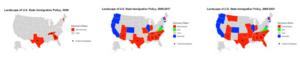
A new study published in the American Journal of Preventive Medicine presents a detailed analysis of the shifting legal immigration environment in the United States from 2000 to 2021. Researchers mapped sanctuary and anti-sanctuary policies across state and local governments, uncovering significant trends that highlight the use of “punitive” preemption. This legal approach often sees state governments enacting laws that oppose the current federal stance, with conservative states utilizing preemption strategies to exert control over more liberal regions. The study’s findings provide insights into how these changing policies can affect the health outcomes of immigrants and their communities.
The Role of Immigrants in the U.S. Population
Immigrants account for over 14% of the total population in the United States. While the Constitution grants the federal government authority to regulate immigration—including admission, status assignment, and naturalization—state and local governments can enact policies that influence cooperation between law enforcement and federal immigration agencies. This dynamic creates a complex interplay of regulations that can either support or hinder immigrant communities.
Understanding Sanctuary and Anti-Sanctuary Policies
Sanctuary policies are designed to limit cooperation between local law enforcement and immigration authorities, particularly the U.S. Immigration and Customs Enforcement (ICE). These policies aim to reduce the use of public resources for immigration enforcement, foster trust within communities, and promote inclusivity. Jurisdictions adopting sanctuary policies have been associated with lower crime rates, decreased poverty, higher employment levels, and enhanced community confidence.
Conversely, anti-sanctuary policies mandate or encourage law enforcement to work with immigration authorities, creating an atmosphere of fear among immigrant populations. These measures can have detrimental effects on the health of immigrants by making them feel unwelcome and raising their risk of deportation, which is linked to increased rates of depression, anxiety, post-traumatic stress disorder, and chronic illnesses.
The Evolution of Immigration Enforcement
Since the terrorist attacks of September 11, 2001, immigration enforcement policies have rapidly evolved, with numerous states and local governments introducing new measures. According to lead author Caroline Kravitz, Ph.D., MPH, of Drexel University’s Department of Health Management Policy, the selection of 2000 as the analysis’s starting point reflects the historical trends initiated by localities responding to national security concerns. Understanding this context is essential, as new legislative trends continue to emerge and impact population health.
Methodologies and Key Findings of the Study
The researchers employed rigorous policy monitoring techniques to catalog state and local sanctuary and anti-sanctuary policies enacted between 2000 and 2021. Their work included an exhaustive review of legislative databases and Department of Homeland Security 287(g) agreements, identifying a total of 27 state anti-sanctuary policies, 25 state sanctuary policies, 24 city sanctuary ordinances, and 284 local 287(g) agreements over the study period.
Preemption’s Impact on Health Equity
Preemption arises when higher-level government policies override those at lower levels, a phenomenon particularly relevant in the context of sanctuary and anti-sanctuary policies. The researchers sought to quantify how preemption influences health equity in immigrant communities. In recent years, punitive preemption has emerged as a term describing how states threaten punitive measures to influence local policy decisions. This legal approach has often led to a chilling effect on local legislative actions, as policymakers become wary of potential retaliation, which in turn could stymie efforts to improve healthcare access and equity.
Creating Foundations for Future Research
This study marks one of the first comprehensive legal mapping efforts to track the interplay of state and local sanctuary and anti-sanctuary policies over an extended timeframe. While the research concludes in 2021 and does not account for current developments, it lays the groundwork for subsequent studies aiming to monitor evolving policies at the local level. According to Kravitz, the findings provide a solid foundation for quantitative analyses that can offer deeper insights into the causal health effects of immigration policy—a particularly relevant topic in contemporary American discourse.
