


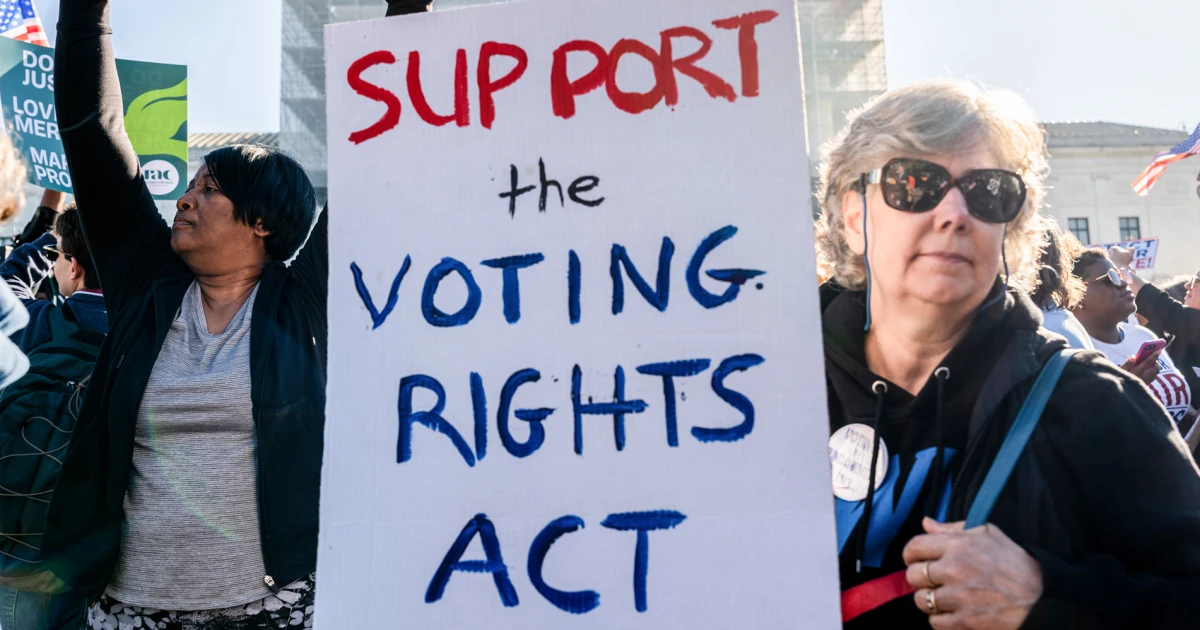
Supreme Court Decisions Undermine the Voting Rights Act
WASHINGTON – The Supreme Court delivered a significant blow to the Voting Rights Act on Wednesday, declaring Louisiana’s congressional map a racial gerrymander. This ruling comes despite the map being drawn in accordance with legislation designed to safeguard minority voters.
The justices were divided 6-3, with the conservative majority indicating that there should be minimal to no consideration of race when creating electoral maps under Section 2 of the Voting Rights Act, which was established to protect minority voters historically impacted by electoral discrimination.
Justice Samuel Alito, representing the majority opinion, stated that while there could be extreme situations that warrant incorporating race into map drawing, Louisiana’s case did not meet that threshold. Consequently, the newly drawn maps were deemed an “unconstitutional racial gerrymander.”
This ruling necessitates that Louisiana redraw its congressional maps. Other states facing similar scrutiny may attempt modifications as well, though time is limited with primaries for the upcoming November midterm elections just around the corner. Louisiana’s primary date is scheduled for May 16th, leaving little time for comprehensive revisions.
Previously, the court had suggested that states could consider race in efforts to meet the Voting Rights Act’s requirements. However, Alito stated that allowing race to influence governmental decision-making diverges from constitutional norms applicable in almost every other context.
In justifying this shift in policy, Alito referenced recent societal changes in the South, where most challenges to race-based redistricting have emerged. He also pointed to a 2019 court ruling that facilitated unrestrained partisan gerrymandering.
Thus, when civil rights advocates contest newly drawn maps, states may defend their actions by asserting they were merely attempting to enhance partisan advantages. This is especially pertinent in the South, where party loyalties often align with race, with a significant majority of Black voters supporting the Democratic Party.
In a separate concurring opinion, Justice Clarence Thomas, a long-time adversary of the Voting Rights Act, suggested that this ruling could signal an end to a system he contends illicitly segregates individuals into districts based on race.
The dissenting voices of three liberal justices raised concerns, with Justice Elena Kagan arguing that the ruling’s ramifications could be vast and significant, effectively nullifying Article II.
Kagan expressed that the new interpretation of Article II permits states to systematically dilute the voting power of minority populations without facing legal consequences.
Louisiana Republican Attorney General Liz Murrill characterized the ruling as “significant,” asserting that the original map was designed to comply with legal standards. She emphasized that race could only be considered in exceptional circumstances where there is proof of deliberate discrimination.
Conversely, NAACP President Derrick Johnson condemned the decision as a betrayal, articulating that the Supreme Court has failed Black voters and, by extension, the nation’s democracy. He warned that this judgment challenges the progress made through hard-fought victories in civil rights.
This latest ruling compounds previous Supreme Court decisions that undermined critical components of the Voting Rights Act in 2013 and 2021. Notably, in 2023, a court invalidated Alabama’s Republican-drawn congressional districts, marking a rare affirmation of voting rights.
In the Louisiana case, the court concluded that the state improperly considered race in its efforts to redraw its 2024 congressional boundaries, initially establishing only one majority-Black district out of six, despite the Black population constituting one-third. Following a lower court’s finding that the original map violated the Voting Rights Act, Louisiana attempted to amend its boundaries to create two majority-Black districts; however, this new map has now also been deemed illegal.
The case underscores a fundamental tension between the Voting Rights Act’s mandates and the principles outlined in the 14th and 15th Amendments, enacted post-Civil War to guarantee voting rights for former slaves. Advocates for a “color-blind” legal framework argue that these amendments necessitate such an approach, a notion consistently contested by liberal factions.
Originally arriving at the Supreme Court on a narrower legal issue, justices broadened the discussion by scheduling additional oral arguments addressing the more extensive constitutional question of whether race can be considered in redistricting for compliance with the Voting Rights Act. Louisiana, initially a defender of the new map, altered its position and allied with a group of “non-African American” voters pursuing a constitutional challenge against it; later, the Trump administration also joined the litigation in support of the state’s position.
