


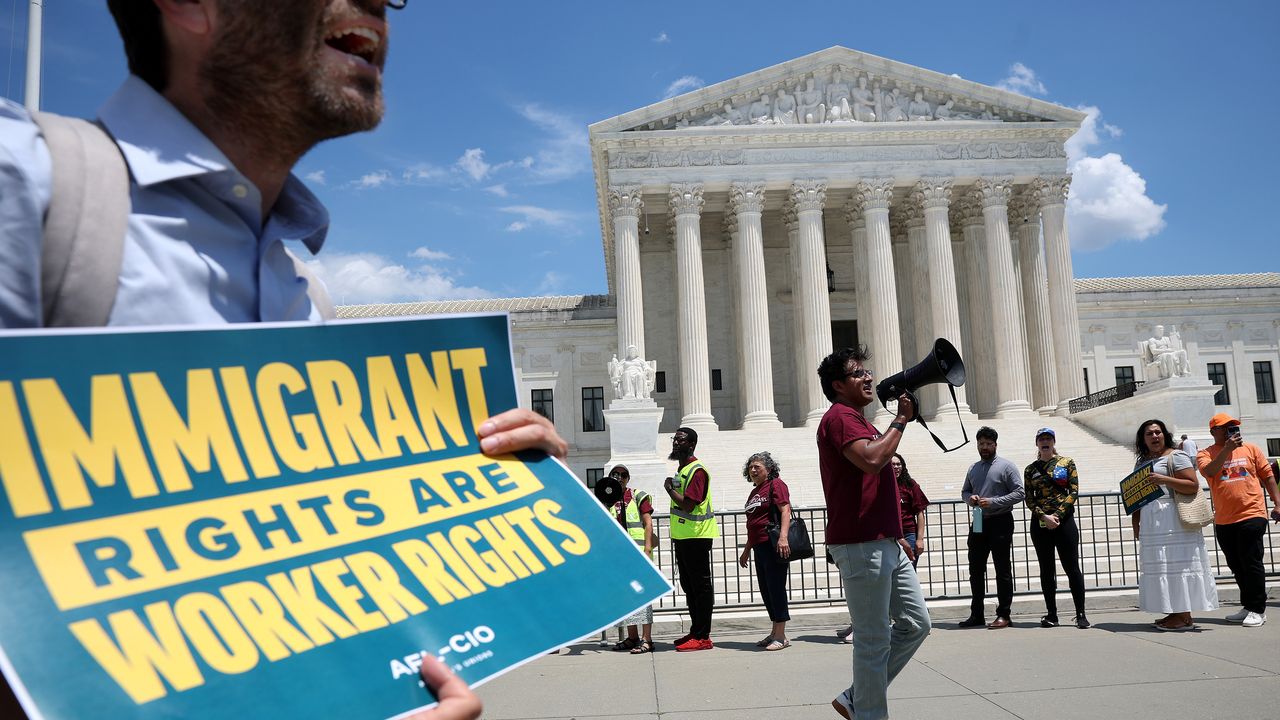
Supreme Court Deliberation on Immigration Policies Centered Around Asylum and TPS
A recent Supreme Court case raises a critical question regarding immigration: Does an alien seeking to enter the United States from Mexico “arrive in the United States while in Mexico”? Justice Samuel Alito articulated the majority view, stating that in everyday language, one doesn’t typically say a person “arrives” at a destination—be it a city or country—until they have actually entered it. He reinforced his point through analogy, explaining that while running backs might reach the one-yard line, they have not yet entered the end zone. Similarly, guests do not arrive at a house until they have crossed the threshold.
Justice Alito brushed aside concerns about the metering system, labeling it an inconvenience at worst. He emphasized that the policy does not bar foreign nationals from entering the United States and applying for asylum; rather, it merely delays their entry to improve conditions that currently render ports of entry unsanitary and potentially dangerous. Alito’s perspective suggests a practical approach to humanitarian concerns, however, Justices like Clarence Thomas took a more expansive view, questioning whether Congress could compel the president to authorize the hearings for immigrants’ asylum cases.
In stark contrast, Justice Sonia Sotomayor’s dissent highlights that the situation is not as straightforward as the majority suggests. She argues that the interpretation of ‘arrival’ within immigration law has never been merely about the physical location of individuals. According to her, the Court has acknowledged that immigration procedures should never incentivize illegal border crossings. Unfortunately, she claims, the majority’s ruling does precisely that—encouraging asylum seekers to enter illegally rather than wait at official ports of entry.
Sotomayor also challenges the majority’s portrayal of metering as benign. She points to the humanitarian crisis at the border, where thousands of rejected asylum seekers are often left waiting for days, weeks, or even months with little hope of receiving asylum. Her comments present a sobering account that counters the majority’s seemingly benign analysis.
A second significant ruling, Marin v. Doe, explores efforts to revoke Temporary Protected Status (TPS) for approximately 350,000 Haitian refugees and 6,100 Syrian refugees. Under the 1990 law, the Secretary of Homeland Security has the authority to grant this temporary status if conditions in their home countries are deemed unsafe due to crises like war or natural disasters. A key aspect of this law states that courts cannot review decisions regarding foreign designations, including TPS determinations. Alito’s opinion interprets “decision” as encompassing not only the final verdict on TPS but also the prior actions leading to that decision.
Justice Elena Kagan, dissenting alongside two colleagues, argues that the final decision should rest solely with the Secretary. She also stressed that the process should include consultation with appropriate authorities regarding the conditions in these countries. Kagan highlights a concerning lack of evidence suggesting that the Secretary properly complied with these requirements, emphasizing that after this ruling, the Secretary could declare decisions without proper evaluations or consultations, thus limiting judicial oversight.
One alarming segment of Alito’s ruling pertains to the judicial review of the claim that terminating TPS for Haitians was motivated by racial bias that would breach the Equal Protection Clause. Kagan cited substantial evidence, including statements from President Trump that disparaged Haiti and Haitian refugees, as racially charged. She noted that such remarks reflect deep-seated stereotypes that would not only tarnish the dignity of the refugees but also warrant serious constitutional concerns. In his response, Alito insists that none of the statements cited were overtly racist and that they could have been interpreted through race-neutral perspectives. This dismissal echoes the conservative majority’s approach taken in previous cases, such as Trump v. Hawaii, where the justices overlooked the implications of discriminatory comments linked to policy decisions.
