


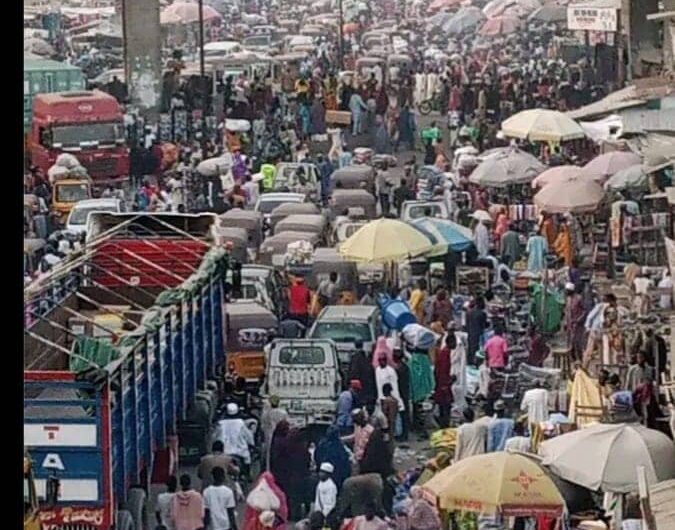
Vibrant Life at Kwari Market Amid Economic Challenges
As the first rays of sunlight filter through the air, the bustling Kwari Market in the heart of Kano awakens with the sounds of cloth rustling, traders maneuvering bales, and customers negotiating prices. This vibrant marketplace showcases an extensive array of textiles, including lace, shada, ankara, chiffon, and imported fabrics. Situated in a dense network of shops and plazas, Kwari is a testament to Nigeria’s rich history of cross-border commerce.
Kano State has long been a pivotal commercial center in West Africa, historically positioned at the nexus of the trans-Saharan trade route. Today, it continues to serve as a vital hub for manufacturing, trade, and distribution in Northern Nigeria. The region’s markets link Nigeria with producers and consumers from neighboring Sahel and West African countries, reinforcing its role as a commercial gateway.
At the core of this thriving ecosystem is the Kwari Market, renowned as Africa’s largest textile trading center. However, beneath its colorful exterior lies a less favorable reality. Rising prices and the doubling of import costs and customs duties have led consumers to purchase less. Additionally, currency instability and security issues in some northern regions have curtailed the influx of long-distance buyers.
Transformation from Residential Area to Textile Powerhouse
According to Ishak Al-Qassam, known as Bararabe Tatari and chairman of the Kuwari Market Housing, Square and Shops Association, the area’s commercial evolution reflects a deeper history. Initially, Kantin Kuwari was a thriving residential neighborhood akin to modern areas such as Nasarawa and Dara.
Kano has long been a vital trade center, attracting foreign settlers from Lebanon, Pakistan, India, and other regions, who initially engaged in trade of local commodities like cotton and groundnuts. When that trade dwindled, they seamlessly transitioned to importing textiles from their home countries. Over time, local Hausa traders joined the market, evolving from clerks to independent operators and fuelling the transformation into the expansive marketplace we see today.
With an estimated 275 plazas and over 13,000 stores, the market has witnessed consistent growth as more residential spaces convert to commercial ones. Bararabe Tatari elaborates on the market’s structure, noting that it is predominantly privately owned, driven by an association model, and has seen around 19 leadership changes since its inception as a major market. It generates significant governmental revenue through taxation, employing thousands in roles from loaders to security personnel.
Economic Strains Facing Traders
Inside the bustling corridors of Kwari Market, traders face mounting pressures from inflation, currency fluctuations, elevated tariffs, and a drop in purchasing power. Muhammadu Awwal, who sells Atampa cloth from Cotonou, shared concerns about profit margins narrowing due to escalating costs. Once available for one million naira, his imports now exceed two million naira.
Despite focusing on higher quality fabrics from Cotonou over cheaper alternatives from China, the limited customer base makes profitability challenging. To adapt, Awwal has begun splitting larger quantities into smaller offerings, allowing customers to make more affordable purchases while keeping his business viable.
Umar Faruk, a lace merchant, echoes similar sentiments as reduced sales have forced him to diversify his income streams, stating some days yield no sales at all. He now operates a tricycle business after market hours to make ends meet. Retail prices have surged significantly, prompting traders to sell smaller quantities and closely monitor seasonal peaks, especially during Ramadan and festive occasions, to maintain cash flow.
Understanding the Customer Experience
Nigeria’s annual inflation rate climbed to 15.93% in May, the highest in months, primarily influenced by supply-side pressures and rising energy costs. Customers, such as Abdulrazaq Abdullahi, have adjusted their spending habits, noting that products that once cost ₦2,300 now exceed ₦3,000. He supplements his purchases with additional income to manage rising costs, appreciating the market’s quality and accessibility.
Sadiya Idris, another regular patron, explained that inflation and soaring fuel prices have diminished her purchasing power, forcing adaptations in how traders price their goods. While Al-Qassam acknowledges the struggles faced due to high customs duties and multiple taxation, he insists that the community must adapt, citing that existing security concerns have further limited the flow of buyers from neighboring states.
Resilience Through Informal Systems
Despite these economic challenges, Kwari Market thrives on a trust-based credit system built on long-standing relationships. Many traders extend credit terms to customers, depending on their reliability. Al-Qassam emphasizes the need for governmental support to stabilize the economy, reduce tariffs, and regulate the import process, which would greatly ease traders’ burdens.
Looking ahead, Al-Qassam maintains an optimistic outlook on the market’s future, emphasizing that it remains integral to the livelihoods of countless individuals across generations, borders, and economies. His unwavering faith in the resilience of the Kwari Market stands as a testament to its significance amid adversity.
