


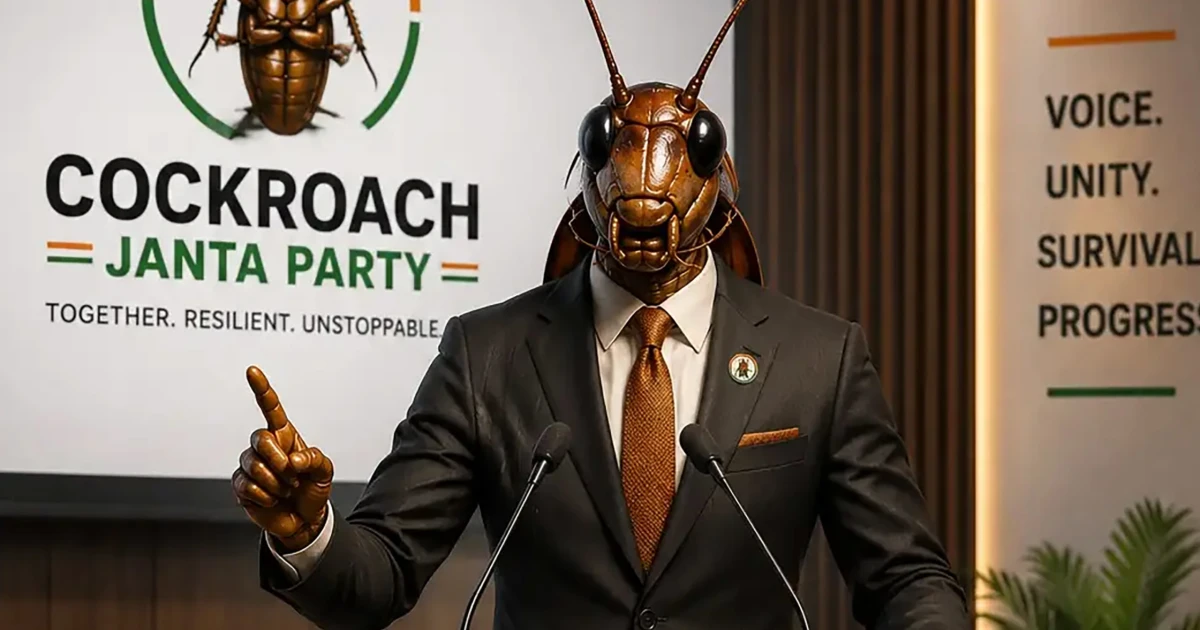
From Satire to Social Movement
What began as an internet joke is evolving into a significant political phenomenon in India. The Cockroach Janata Party (CJP), initially a parody political movement, has transformed into a platform for citizens to express their frustrations over unemployment, corruption, and the current state of democracy.
A Wave of Public Dissatisfaction
This movement takes a playful jab at Prime Minister Narendra Modi’s ruling Bharatiya Janata Party (BJP) and has inundated social media with memes, mock campaign slogans, and humor aimed at generating public discontent. The vibrant online presence reflects a growing tide of disaffection among young Indians.
A New Era of Political Expression
Abhijeet Dipke, the founder of CJP, noted that five years ago, few dared to voice opposition to Modi’s government. “The times are changing,” he remarked, highlighting a notable shift in public sentiment and willingness to challenge authority.
Provoking a National Conversation
The movement, which launched just last month, gained momentum following remarks by Supreme Court Justice Surya Kant. He controversially likened some young critics of the system to “cockroaches” and “parasites,” catalyzing widespread backlash on social media. While Kant later clarified that he wasn’t intending to insult young people, the damage was done; his comments resonated broadly and fueled the CJP’s growth.
Rapid Growth and Engagement
The CJP has amassed around 19 million followers on Instagram, significantly outpacing the BJP’s 9 million and the Congress party’s 13.4 million followers. This extraordinary engagement illustrates the depth of frustration felt by youth who are eager for a platform to voice their concerns. Dipke emphasized that the movement emerged organically from genuine anger among young citizens lacking an appropriate outlet.
Impact of Critical Commentary
Dipke, a political communications strategist and graduate of Boston University, believes that the CJP’s rise signals a broader change in India’s political landscape. His previous experience with the Aam Aadmi Party, which arose from an anti-corruption movement, informs his vision for the CJP’s potential impact.
Challenges to Free Expression
As the CJP continues to gain traction, the controversy surrounding Kant’s remarks has inadvertently elevated its profile and turned a negative comment into a unifying rallying point. Despite facing challenges such as hacks to their social media accounts, Dipke maintains strong engagement with followers. However, the official CJP account on X has become inaccessible within India, prompting concerns over freedom of expression in the world’s largest democracy.
The Call for Open Dialogue
Political leaders, including Shashi Tharoor of the Nationalist Congress Party, have expressed support for the movement, emphasizing the need for channels where young people can express their feelings. Tharoor criticized the restrictions on the CJP’s account as detrimental to democracy, arguing that it stifles necessary dissent and the expression of grievance through humor and satire.
