


Increasing Bird Strikes Disrupt Nigeria’s Aviation Sector
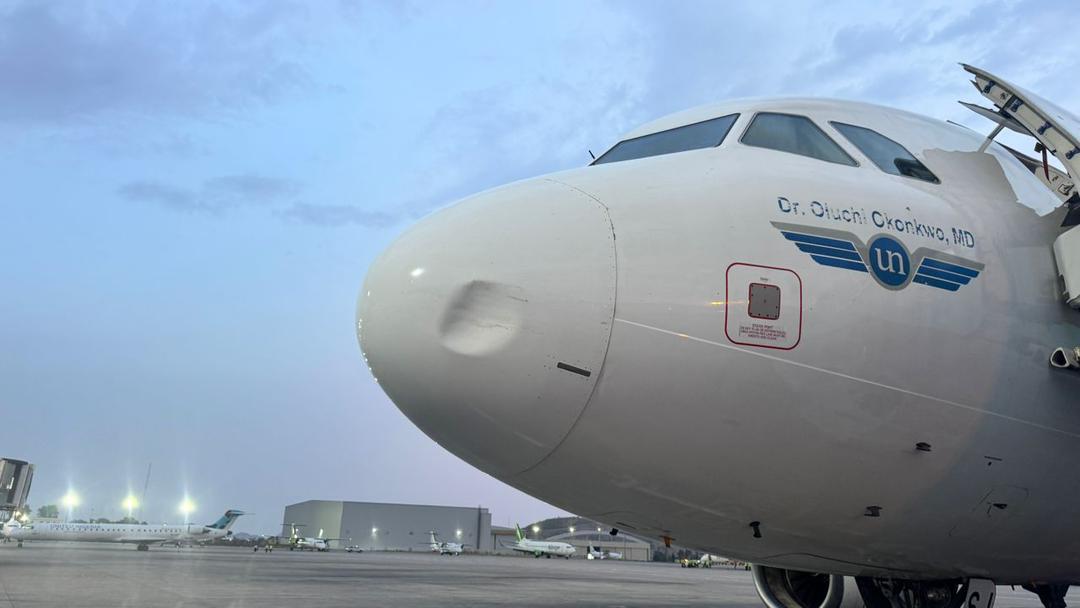
Bird strikes are becoming a significant challenge for Nigeria’s aviation industry, with a recent incident involving an Embraer 190 operated by United Nigeria Airlines (flight UN0561). Shortly after taking off from Benin for Abuja on April 16 at approximately 4:20 p.m., the aircraft collided with a bird, resulting in damage to its nose gear. Consequently, it was taken out of service.
Fortunately, there were no injuries reported from this incident, but it marked the third bird strike affecting the airline within a span of just 48 hours. The day prior, an Airbus A320 on flight UN0515 from Port Harcourt to Abuja encountered a similar issue while landing at Nnamdi Azikiwe International Airport, damaging the nose section of that aircraft as well. The situation escalated on April 14 when a CRJ-900 aircraft (flight UN0579) experienced a bird strike while approaching Abuja.
During this brief period, three aircraft were grounded due to bird strikes, intensifying operational pressures on United Nigeria Airlines. Since January 2026, the airline has reported a total of seven such incidents, highlighting not only the frequency but also the alarming speed at which these events are occurring.
Speaking on Channels Television’s Politics Today on April 16, Obiola Okonkwo, chairman of United Nigeria Airlines, discussed the operational impact of these disruptions. He revealed that two of the airline’s aircraft were currently grounded due to bird strikes just within 24 hours, with similar experiences reported by other operators.
Okonkwo pointed to a broader industry problem, citing that Air Peace experienced 52 bird strikes throughout 2025. Each incident forces airlines to ground aircraft, disrupt schedules, and incur significant maintenance costs. The implications extend beyond mere operational delays, affecting the entire aviation ecosystem, as only incidents that lead to a plane being grounded are publicly reported, suggesting more frequent, less serious encounters may be occurring.
Industry Trends Reflecting a Broader Challenge
The difficulties faced by United Nigeria Airlines mirror a wider trend in the industry. For instance, on January 22, an Air Peace flight from Lagos to Port Harcourt also suffered a bird strike upon arrival, necessitating safety checks and a replacement aircraft. In February, two additional incidents were reported involving flights from Lagos to Asaba and Kano, both requiring evacuation after landing.
While these occurrences did not result in injuries, they underscore ongoing operational challenges that a multitude of airlines are grappling with. Interviewing with ARISE News in December 2025, Air Peace Chairman Allen Onyema disclosed that his airline had recorded 49 bird strike incidents just in the first nine months, indicating the serious operational strain these challenges present.
The issue isn’t isolated to recent events. In May 2021, a Max Air flight was forced to return shortly after takeoff when a bird struck the engine, damaging multiple blades and causing significant vibrations, though it landed safely. Such events illustrate the serious implications of bird strikes, raising questions about the increasing frequency and intensity of these occurrences.
Global Context and Environmental Factors
Bird strikes remain a persistent hazard not only in Nigeria but globally. A notable incident occurred in 2009 when US Airways Flight 1549 struck a flock of geese shortly after takeoff from LaGuardia Airport, leading to an emergency landing in the Hudson River. This event, known as the “Miracle on the Hudson,” spotlighted the dangers associated with bird strikes.
Similarly, in the UK, a British Airways flight had to make an emergency diversion due to suspected bird strike-induced smoke in the cabin. These incidents serve to emphasize the frequency of this issue—while most bird strikes don’t lead to crashes, they can result in engine failures, emergency landings, and operational disruptions, particularly during critical phases such as takeoff and landing.
Environmental Considerations and Prevention Challenges
The repercussions of bird strikes extend to regulatory oversight as well. In response to an incident in December 2025 that stranded over 100 passengers, the Nigerian Civil Aviation Authority stepped in, illustrating how technical incidents can quickly become matters of passenger welfare.
Experts attribute the rise in bird strikes to environmental factors surrounding airports. Many accidents occur during takeoff and landing when aircraft are vulnerable and at lower altitudes where birds are more active. Airports located near open landfills, wetlands, or agricultural areas often attract birds, heightening the risk of collisions.
In Nigeria, rapid urbanization and waste management issues around airport corridors have exacerbated this risk. While airport authorities have implemented bird control measures such as patrols and dispersal techniques, the recurring incidents suggest that these efforts are struggling to keep pace with evolving environmental realities.
Aviation analyst Noura Ahmad stresses that recent bird strike incidents must be contextualized within broader environmental management challenges around airfields. Strengthening wildlife risk management practices is essential, as most bird strikes—while generally not catastrophic—can significantly disrupt operations and erode passenger confidence.
The recent surge in bird strikes is prompting a shift in perception within the Nigerian aviation industry. Increasingly, such incidents are viewed as symptomatic of larger systemic challenges around environmental management, infrastructure resilience, and regulatory oversight, leading to a growing emphasis on prevention rather than reactive measures.
