


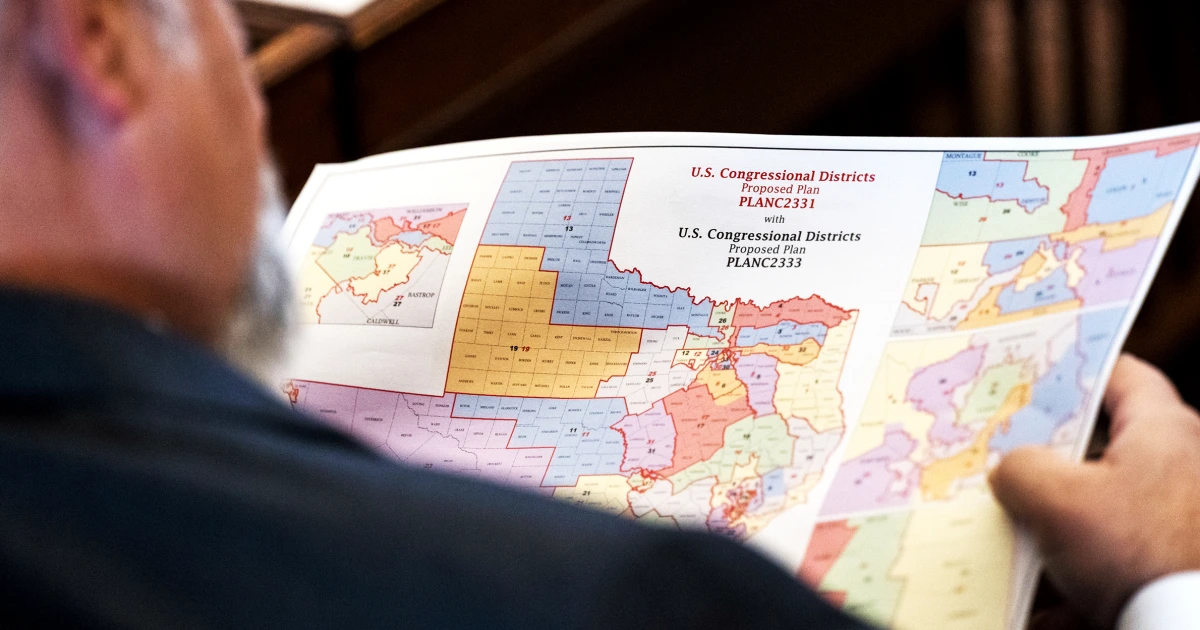
The Redistricting Struggle for Democrats
The past six weeks have been challenging for Democrats as they navigate the ongoing redistricting battles.
By late April, the party managed to secure enough Democratic-leaning seats to counteract the contentious changes to congressional maps initiated by President Donald Trump a year prior.
However, the situation shifted dramatically when the U.S. Supreme Court invalidated key provisions of the Voting Rights Act. This landmark decision allowed Republican-led states in the South to dismantle districts where Black voters represent a majority. Subsequently, the Virginia Supreme Court blocked the enforcement of a new Democratic-friendly map that had been approved by voters during a special election.
As the general election approaches in just five months, the turbulent landscape of the 2026 redistricting is beginning to stabilize. Over the past year, ten states have enacted new congressional boundaries, with Alabama, Louisiana, and Tennessee recently acting in response to Supreme Court rulings.
Despite ongoing litigation in several states, the newly drawn maps position Republicans to potentially gain up to 16 House seats this fall, compared to just six for Democrats. These redistricting battles have dramatically reshaped tightly contested House races.
Alabama’s Predicted Gains for Republicans
The U.S. Supreme Court recently greenlit Alabama’s use of its preferred congressional map for the midterm elections. This contentious map, originally drawn in 2023, had been blocked by a federal court for allegedly discriminating against Black voters. The new boundaries could reduce the number of House seats held by Democrats in Alabama from two to one, enhancing Republican prospects.
Changes in Louisiana’s Representation
Following the Supreme Court’s decision to strike down Louisiana’s congressional map as an unconstitutional racial gerrymander, Republican lawmakers quickly moved to create a new map that eliminates one of the state’s two majority-Black districts. This reshaped district stretches from New Orleans to Baton Rouge and now predominantly favors Republican candidates.
Tennessee’s Legislative Developments
In the wake of the Supreme Court ruling, Tennessee’s Republican-led General Assembly swiftly passed a new map that alters the state’s only majority-Black district in Memphis by merging it with more rural, Republican-leaning areas. This realignment is likely to result in an all-Republican congressional delegation from Tennessee in the upcoming elections.
Florida’s Tensions in Redistricting
In April, Republicans approved a congressional map that could potentially yield four additional Republican-leaning seats, in alignment with Governor Ron DeSantis’s agenda. This move has sparked significant legal challenges, as Republicans aim to leverage the Supreme Court’s recent decisions to dismantle Florida’s anti-gerrymandering rules.
Democratic Strategies in California
California witnessed one of the most substantial responses from Democrats against Republican redistricting efforts. In November, voters backed a map proposed by the Democratic-led legislature and Governor Gavin Newsom, which could provide the party with up to five additional seats.
Potential Shifts in Ohio and Beyond
Ohio’s redistricting commission, initially stalled due to party contention, reached an agreement to redraw its congressional maps last year. The sanctioned map could provide Republicans with an advantage, significantly altering districts currently held by Democrats.
The environment remains contentious as North Carolina Republicans have introduced a new map for the 1st Congressional District, strategically shifting Democratic areas into neighboring districts to bolster Republican representation. Similar trends are emerging in Missouri, where Republican legislators have crafted a new map that further divides Kansas City into predominantly Republican districts.
As the redistricting saga unfolds, the consequences of these changes will become increasingly evident. Texas stands to benefit from up to five additional Republican seats, although predictions regarding electoral outcomes in light of Trump’s influence remain uncertain.
Looking Ahead to the Next Redistricting Cycle
While the current round of redistricting for 2026 is winding down, it is set to resume in full force as stakeholders prepare for the next election. Georgia’s Governor Brian Kemp has already called for a special legislative session to redraw maps for the 2028 cycle, with the Mississippi Republican Party also expected to engage in redistricting efforts.
On the Democratic front, New York is poised to advance a bill aimed at establishing new district boundaries for the upcoming cycle. Additionally, Democrats in Colorado, Maryland, New Jersey, and Washington are contemplating their own initiatives as redistricting continues to shape the political landscape.
