


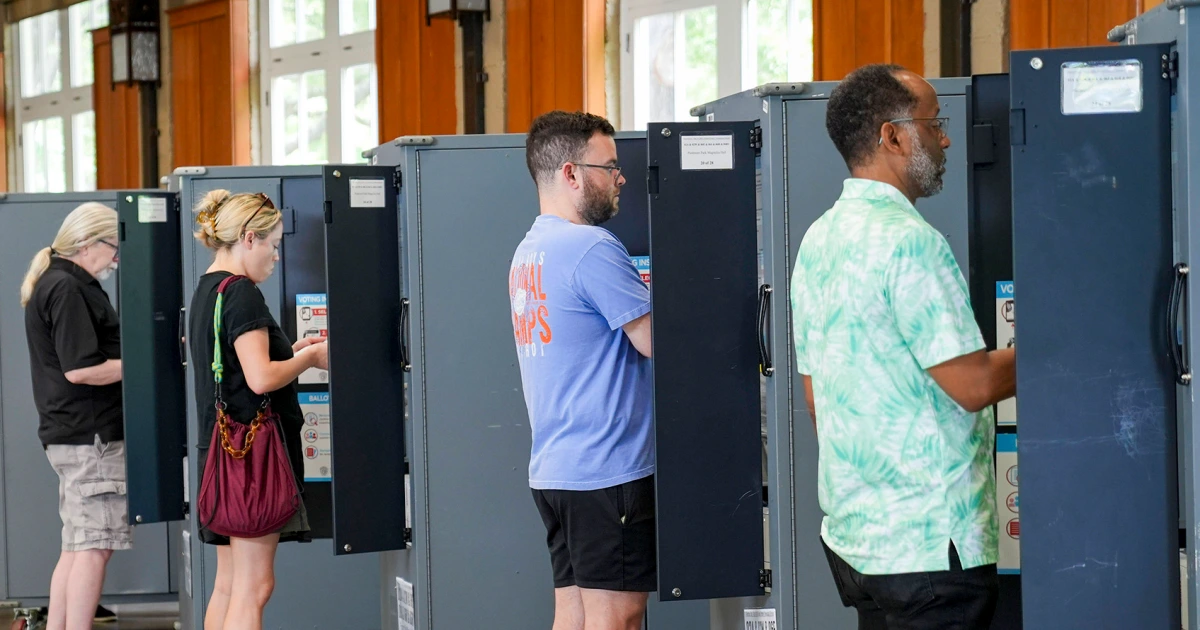
President Donald Trump’s influence will be put to the test once again on Tuesday as several Republican primaries unfold, signaling the start of a significant general election campaign for both Senate and governorship in Georgia, a pivotal battleground state.
Voters are poised to cast their ballots in the primaries across Oklahoma and the District of Columbia, where mayoral contests are exposing deeper divisions within the Democratic Party. In Alabama and Georgia, primary runoffs are also set, addressing elections where no candidate secured a majority of votes on May 19.
In California’s 14th Congressional District, candidates are contesting to replace former Democratic Representative Eric Swalwell. If no contender achieves a majority of the votes, a special general election may be scheduled for August.
Key Republican Races in Georgia
President Trump extended his endorsement to Republican Representative Mike Collins in Georgia’s Senate runoff elections early Sunday. Collins will compete against former football coach Derek Dooley, with the winner facing Democratic Senator Jon Ossoff in November.
In the initial primary on May 19, Collins led with 40% of the vote, compared to Dooley’s 30%. Collins has emphasized his Trump endorsement, adjusting his advertising to prominently feature the support.
Dooley, on the other hand, has gained traction through endorsements from Governor Brian Kemp, who is closely associated with the Dooley family—Mr. Dooley’s father was a celebrated football coach at the University of Georgia. The Kemp family have actively campaigned alongside Dooley, presenting him as a political outsider committed to working with Trump and prioritizing Georgia’s interests.
Kemp commented on his choice to endorse Dooley, arguing that his position as a political outsider would better serve the party against Ossoff. In response, Collins has touted his grassroots support, maintaining he performed well during the June primary season.
During the runoff debate, Collins characterized himself as a “conservative workhorse” and frequently referenced his alignment with Trump, particularly regarding his support for the Laken-Riley Act, an immigration enforcement law enacted during Trump’s presidency.
Collins has faced some controversies, particularly the termination of a longtime staffer who allegedly made disparaging posts on social media. This individual is also involved in a House Ethics Committee investigation related to campaign fund misuse. Collins dismissed the allegations as unfounded.
Alabama’s Senate Runoff Elections
In Alabama, the Republican primary to succeed U.S. Senator Tommy Tuberville has narrowed down to a runoff between U.S. Representative Barry Moore and former Navy SEAL Jared Hudson. Moore, who has Trump’s backing, emerged with 39% of the May 19 primary votes, while Hudson gathered 26%.
Advertising expenditures for the runoff have reached nearly $7 million, primarily in support of Moore. He is backed by Defend American Jobs, a super PAC linked to the cryptocurrency sector, alongside another group affiliated with the conservative Club for Growth Action.
Hudson has branded himself as a “warrior” ready to stand alongside Trump, while some outside allies criticized Moore, labeling him “the swamp king of Washington, D.C.” and suggesting he lacks genuine courage.
Moore’s campaign has encountered scrutiny related to his military service. A recent communication inaccurately referred to him as a retired sergeant, despite his honorable discharge as a cadet. He stressed that he has never claimed to have served in combat, although he did refer to wearing combat boots during his National Guard training.
There will also be a Democratic runoff for the nomination between lawyer Everett Wess and businessman Dakari Larriet. However, Democrats face substantial challenges in this overwhelmingly Republican state.
Trump’s Endorsements in Oklahoma
Trump has also weighed in on the race to replace term-limited Governor Kevin Stitt, endorsing former state Senator Mike Mazzei as a “MAGA warrior.” Other Republican candidates include Attorney General Gentner Drummond and former House Speaker Charles McCall.
In the lieutenant governor’s contest, Stitt is running against Trump’s favored candidate, former House Speaker T.W. Shannon. Ongoing Governor Stitt has backed David Ostrow, the chief operating officer for Oklahoma.
Rep. Kevin Hahn, whom Trump nominated for the Oklahoma State Senate, is expected to perform strongly in the primary race to replace former Senator Markwayne Mullin. Hahn’s competition has not significantly raised campaign funds.
In Oklahoma, if candidates do not achieve a majority in the primaries, the top two contenders will advance to a runoff election scheduled for August 25.
Democratic Contest in Washington, D.C.
The retirement of Washington, D.C. Mayor Muriel Bowser has sparked a fierce competition between established Democrats and progressives. The outcome could lead to a self-identified democratic socialist heading another major U.S. city.
Results from Tuesday’s Democratic primary may be delayed, as the ranked-choice voting process allows mail-in ballots to be counted up to ten days post-election if no candidate secures a majority.
The winning candidate in the Democratic primary will likely be well-positioned in the overwhelmingly blue city come November. Leading contenders include City Councilwoman Janice Lewis George, former City Councilwoman Kenya McDuffie, and various other candidates.
Lewis George, who has served on the city council since 2021, embraces progressive values and has the backing of unions and the Democratic Socialists of America. Her platform emphasizes affordability.
McDuffie, in contrast, highlights his extensive experience on the council while criticizing Lewis George’s proposals as impractical. He maintains support from several prominent figures, including Maryland Senator Angela Alsobrooks.
With Democratic Representative Eleanor Holmes Norton retiring, the race for her seat is generating considerable interest. Prospective candidates include City Council members and former officials, all vying for the chance to represent a district pivotal in the fight for statehood and autonomy.
California’s Special Election
In California’s 14th District, voters will also participate in a special election to fill the vacancy left by former Representative Eric Swalwell, who resigned amid allegations he denies.
In the state’s regular primary elections, voters have already selected two Democrats to advance: State Senator Aisha Wahab and Bay Area Rapid Transit Commissioner Melissa Hernandez. These candidates will appear on the special election ballot alongside others.
The special election winner will occupy the seat for the remainder of the year, providing a possible advantage for the upcoming fall election. If no candidate achieves a majority, the top two will proceed to a general election on August 18.
Expectations for Republican Districts on Tuesday
Tuesday’s elections may introduce two new members to Congress, resulting in competitive races within heavily Republican districts.
In Oklahoma’s 1st Congressional District, which includes Tulsa, Trump endorses Rev. Jackson Rahmeyer amidst a tightly contested primary featuring state Rep. Mark Tedford and former Senate Majority Leader Kim David.
However, Rahmeyer faces challenges late in the race following revelations he sent inappropriate messages to a woman not his wife.
In Georgia’s 11th Congressional District, a Republican runoff is underway to fill the seat vacated by Congressman Barry Loudermilk. Competing are Dr. John Cowan, an unsuccessful candidate in the 2020 election, and Rob Adkerson, Loudermilk’s chief of staff, who enjoys the backing of his former boss.
