


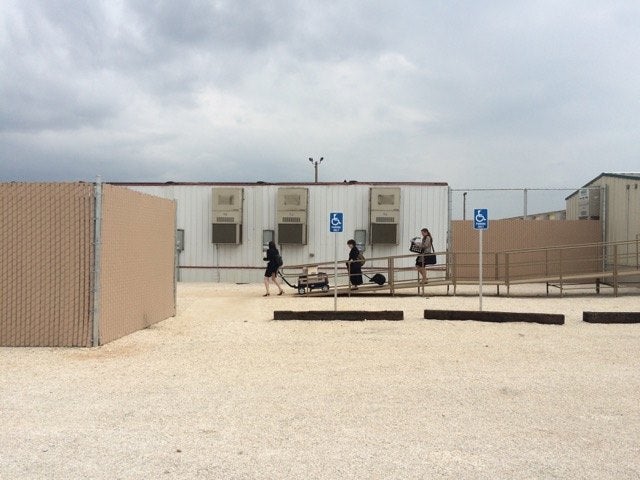
A Wisconsin woman and her son are currently detained by U.S. Immigration and Customs Enforcement (ICE) at a facility in Texas known for its challenging conditions.
Diana Socha Torres, who originally hails from Colombia, is seeking asylum in the U.S. due to the violence she faced in her home country. She now resides in Wisconsin Dells.
Mark Christopher, the immigration attorney representing Socha Torres, reported to WPR’s “Wisconsin Today” that a recent immigration court hearing was rescheduled. Unfortunately, Socha Torres was unaware of the change and did not appear in court.
Christopher noted that immigration courts frequently alter their schedules, often with little to no prior notice. This unpredictability increases the likelihood that individuals may miss their court dates, potentially jeopardizing their cases.
In April, ICE issued a deportation order for Socha Torres after she failed to attend a scheduled hearing. Shortly thereafter, both she and her son were detained in Wisconsin Dells and transferred to the Dilley Immigration Detention Center in southern Texas.
Erin Barbato, director of the Immigrant Justice Clinic at the University of Wisconsin School of Law, described the environment as deeply troubling. She emphasized the detrimental impact of confining children in facilities that resemble prisons, stating that society often overlooks the fact that these are, in fact, children.
Barbato previously visited the Dilley facility during the Biden administration and reported concerns raised by detainees regarding overcrowding and inadequate access to essential resources like food, water, and medical care.
In a statement to WPR, ICE contended that Socha Torres has chosen to return to Colombia with her son. The agency claimed that “detention is a choice” and that parents can use the CBP Home app to manage their legal status and ensure a proper opportunity to return.
Christopher disputed ICE’s assertion, clarifying that Socha Torres did not opt to return to Colombia. He stressed that she has a genuine fear of returning to her home country with her son, as evidenced by her timely submission of an asylum application.
Christopher emphasized that the Trump administration’s policy of transferring immigrants to facilities located far from Wisconsin has complicated his work as an immigration lawyer. He lamented the challenges faced when attempting to hold consultations with clients in remote facilities, sometimes over poor audio and video connections.
Currently, Socha Torres’ case awaits a judge’s determination on whether her missed court date was justified. Until then, she and her son will remain in ICE custody.
The Supreme Court’s Ruling Heightens Deportation Risks for Immigrants in Wisconsin
The detention of Socha Torres coincided with a recent U.S. Supreme Court decision allowing the Trump administration to rescind Temporary Protected Status for immigrants from Haiti and Syria, as well as turning asylum seekers back at the border.
Barbato remarked that the ruling underscores the considerable authority held by the U.S. executive branch over immigration policy, raising significant implications for the interpretation and enforcement of existing laws.
She highlighted the barriers currently faced by asylum seekers, noting that most cannot even access the application process upon reaching the southern border. Asylum seekers are often unable to apply for protection, detracting from the United States’ commitment to human rights and legal obligations.
Christopher, who represents numerous Haitian refugees in Wisconsin, emphasized the profound impact of the Supreme Court’s ruling on his clients. Many will likely face forced repatriation to their home countries amidst ongoing crises, often with little notice and without evidence of improved conditions.
