


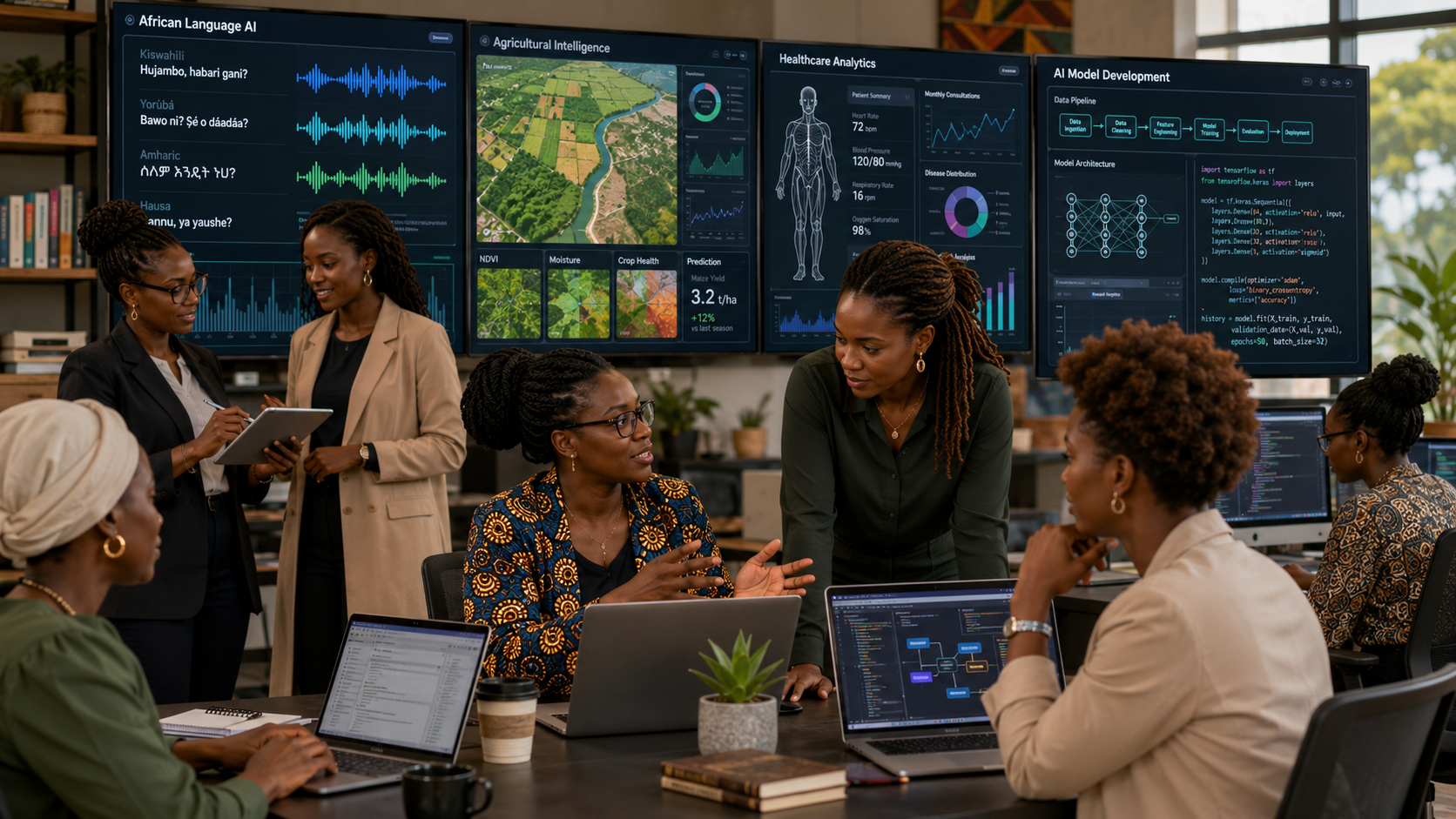
African Female Founders Lead Growth in AI Startups
In 2025, African startups led by women secured $254 million in equity funding, marking a 60% increase from the previous year. However, this figure still accounts for only 10% of the continent’s total capital raised, highlighting an ongoing disparity in funding opportunities.
Despite these challenges, women at the helm of AI startups in Africa are pioneering technology that addresses critical issues often overlooked by broader global firms. These range from developing solutions for African languages to improving environmental data, healthcare, and skills training, while also tackling the scarcity of relevant local datasets.
The stakes are high as the question of who determines the focus and direction of AI development in Africa comes to the forefront. While much of the international AI discourse is preoccupied with scaling models and harnessing expansive computing power, African startups are innovating around the constraints of limited data, modest computing resources, multilingual demographics, and inconsistent infrastructure. Women founders are increasingly at the forefront of this transformative work.
Developments in Africa’s AI Landscape
Africa’s AI ecosystem is advancing beyond mere experimentation. Startups are now engaged in creating specialized models, data platforms, and products tailored to the local market. For instance, Lelapa AI, based in South Africa, is spearheaded by CEO Peronomi Moiloa and Chief Technology Officer Jade Abbott. The company is focused on developing language technology optimized for environments characterized by limited bandwidth, computing power, and linguistic diversity.
Lelapa AI’s flagship project, InkubaLM, involves the creation of a 400 million parameter language model designed for low-resource African languages. According to supporting research, these smaller, thoughtfully designed systems can successfully compete with larger counterparts in tasks such as translation, question answering, and sentiment analysis.
This development is crucial since mainstream AI systems typically excel in languages with abundant digital training data. Yet, many African languages remain vastly underrepresented online, which severely hampers the capacity of global models to accurately understand and generate content in these languages.
Addressing Local Challenges Through Innovation
Similarly, Vambo AI, co-founded and led by CEO Chido Dzinotyiwei, is focused on enhancing communication in African languages across various sectors, from business to government. The company collaborates with native speakers to enrich its datasets and enhance system accuracy.
Furthermore, Amini, founded by Kate Kallot in Kenya, leverages AI and satellite data to furnish information for industries such as agriculture, insurance, and climate finance, aiding organizations in evaluating factors like crop health and environmental risks. Amini exemplifies how machine learning can serve as a foundational tool for climate and agricultural decision-making.
On another front, Zindi, co-founded by CEO Celina Lee, is tackling the gap in AI talent and experience in Africa. The platform connects data scientists with real-world challenges, promoting projects across healthcare, agricultural forecasting, traffic management, and climate analysis. In Kenya, Qhala, led by Dr. Shikoh Gitau, focuses on applied AI in health, agriculture, education, and government services, demonstrating the diverse applications of AI technology across sectors.
Understanding the Importance of Representation
These enterprises share significant characteristics; they do not implement AI merely as a trend but rather focus on addressing specific gaps that could enable AI to genuinely serve the African market. However, a pressing challenge remains: the scarcity of adequate data. AI systems learn from training data, and without comprehensive representation of African languages and socio-economic contexts, models from external sources often fall short in local applications.
Advanced AI systems predominantly trained on data from English or other widely digitized languages may not deliver value to speakers of indigenous languages such as Yoruba, Wolof, or IsiZulu. This limitation is exacerbated in the medical field, where data primarily from Europe or North America fails to encapsulate prevalent diseases and health practices in African nations.
Addressing Funding Disparities in the AI Sector
The funding landscape remains stark, as female founders received only 10% of the total equity financing in Africa in 2025. Although female-led startups raised $254 million, representing 19% of all equity deals, male founders still attracted an average of 8.5 times more venture capital. Notably, no women-led firms secured growth-stage equity funding that year, particularly in the AI sector, where the funding gap is more pronounced.
Creating AI products requires substantial investment in engineering talent, cloud services, infrastructure, model development, and data collection. While founders may develop promising initial prototypes, scaling these innovations often proves challenging without adequate late-stage funding.
Recognizing this gap, initiatives like the International Finance Corporation’s She Wins Africa program aim to enhance investment preparation, offer guidance, and facilitate connections with investors. Following the success of its initial cohort in raising more than $4 million, the program plans to expand to support 1,000 women entrepreneurs by 2026.
Future Prospects for African AI
The burgeoning AI ecosystem in Africa is characterized by its emphasis on specialized applications rather than merely competing with established models from Silicon Valley. As startups like Lelapa AI, Vambo AI, and Amini pave the way with innovative solutions, the continent stands a chance of becoming a leader in specialized AI technologies.
Challenges remain, including a need for adequate capital, robust computing infrastructure, and a growing talent pool encompassing engineers, researchers, and local experts highly familiar with the respective industries. Furthermore, ownership of the invaluable datasets being created will be a significant consideration as African businesses generate data across various sectors, leading to questions about control and economic value.
Women-founded AI startups may represent a fraction of the funding landscape, but they are crucial in driving the development of language models and climate intelligence platforms. Thus, the future of African AI will hinge on how well it can leverage and scale these innovations across the continent, ensuring that the voices and needs of local communities are integral to its growth.
