


Nigeria has undergone a series of challenging economic reforms over the past two years, with officials emphasizing that such sacrifices are essential for a brighter future. The government has eliminated fuel subsidies, floated the naira, and increased electricity and interest rates. Inflation has pressured household budgets, but officials argue that these measures are necessary to restore fiscal discipline, attract investments, and position the economy for long-term stability.
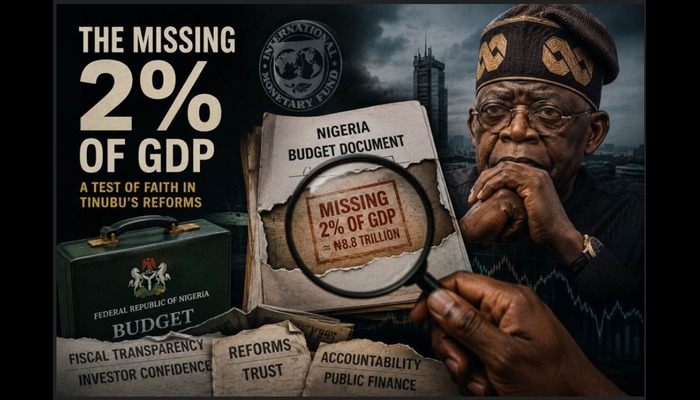
Recent disclosures from the International Monetary Fund (IMF) have cast doubt beyond mere politics. The IMF revealed that approximately 2% of Nigeria’s gross domestic product (GDP)—equivalent to significant government spending—was omitted from recent budget documents. Christian Ebeke, the IMF’s representative in Nigeria, noted that this oversight leads to a misleading picture, suggesting the budget deficit is smaller than the true borrowing needs of the government because certain capital expenditures were neglected.
This revelation has ignited a crucial debate on fiscal transparency, especially as the government seeks public support for its reform agenda.
Political Fallout from IMF Findings
Atiku Abubakar, a former vice president and the African Democratic Congress (ADC) presidential candidate for the 2027 elections, estimates that the omitted expenditure amounts to about ₦8.8 trillion, relative to Nigeria’s economic size. He is calling for an investigation by the National Assembly, the Auditor General, and anti-corruption agencies like the EFCC and ICPC. He presented a compelling question to the public: “If expenditures worth 2% of Nigeria’s GDP were omitted, who is responsible for this discrepancy?”
Economic Implications of Missing Data
The significance of this issue extends beyond potential financial misconduct to encompass the very foundation of economic confidence, according to economists. Economic reform hinges on trust, with citizens willing to accept higher costs—be it for fuel, electricity, or everyday living expenses—when they believe in increased fiscal transparency. Investors, too, allocate capital under the impression that government accounts accurately reflect fiscal realities.
However, these assumptions can erode if expenditures are conducted outside the established budget framework. The IMF’s concerns transcend mere accounting; budget documents serve as critical instruments for investors, lenders, and credit rating agencies as they evaluate a nation’s financial stability. Missing expenditures can artificially deflate a government’s deficit, complicating any accurate assessment of debt sustainability and actual borrowing needs.
Investor Confidence at Stake
This situation has critical implications for countries trying to convince global investors of the credibility of their reform initiatives. Following the removal of fuel subsidies and the liberalization of the foreign exchange market, Nigeria has started to see an uptick in foreign portfolio inflows and renewed investor interest in government securities. These shifts are driven not only by attractive interest rates but also by a growing perception that economic policy decisions are increasingly predictable.
Nonetheless, it is important to recognize that confidence can be more readily lost than regained. Abubakar has framed the issue as beyond mere accounting errors, calling it a “constitutional, legal, and moral scandal.” He posits that public funds do not vanish without someone approving, spending, or profiting from them.
Government’s Response Needed
The government has yet to provide a comprehensive response to the IMF’s assertions. If the discrepancies stem from differences in financial reporting or accounting methods, a thorough explanation could help to mitigate concerns among both Nigerian citizens and investors. Addressing any budget reporting weaknesses promptly could preserve the integrity of the reform agenda.
The Tinubu administration faces a complex challenge that extends beyond simply adhering to a unified budgetary framework. Economic reforms are imposing significant living costs on Nigerians while promising future stability. This commitment relies not only on robust economic policies but also on ensuring that the funds raised and expended are accounted for meticulously.
The missing 2% of GDP symbolizes more than just public spending; it raises fundamental questions about whether Nigerians and global investors can continue to trust that the nation’s arduous reforms are matched with equally rigorous standards of transparency, accountability, and fiscal discipline.
