


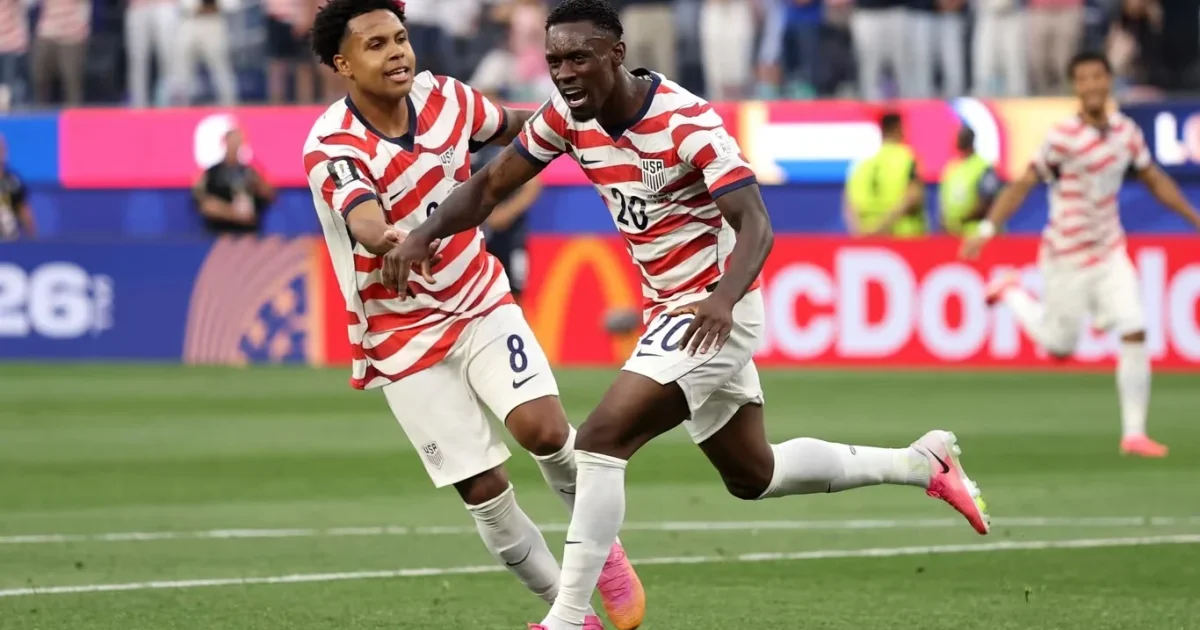
Folarin Balogun, the American striker, faced an unexpected twist after being sent off in the Round of 32 match against Bosnia and Herzegovina during the ongoing 2026 World Cup. Initially, it was widely assumed that he would miss the crucial last-16 clash against Belgium.
Typically, this would be the case. However, significant developments have occurred.
On Sunday, President Donald Trump publicly expressed gratitude to FIFA for their decision to suspend the red card handed to Balogun, allowing him to participate in the World Cup’s last-16 showdown with Belgium. Trump took to his Truth Social platform, stating his appreciation for FIFA’s intervention in what he deemed a major injustice.
The decision has sparked widespread interest and debate within the soccer community. PUNCH Online delves into FIFA’s regulations and explains how Balogun’s eligibility was upheld despite the red card, alongside the surrounding controversy.
Understanding FIFA’s Disciplinary Rules
The regulations governing the FIFA World Cup are unequivocal. A player receiving a direct red card is automatically suspended for the team’s subsequent match. The official guidelines clearly state, “If a player or team official is ejected, he or she will be automatically suspended from the team’s subsequent games.” This foundational rule is why Balogun was initially deemed ineligible, according to the Royal Belgian FA’s response on Sunday.
Clarification on the Red Card
Many observers are perplexed by the current situation. It is crucial to clarify that FIFA did not overturn or revoke the red card; rather, they permitted Balogun to play without formally canceling the disciplinary action. This means the red card remains in place, even as FIFA allowed an exception for the player to continue in the tournament. Reuters confirmed that the decision was based on FIFA’s interpretation of its own disciplinary code.
Article 27 and Its Implications
FIFA’s Disciplinary Committee invoked Article 27 of its Disciplinary Code instead of directly lifting the red card. This article allows for discretionary power concerning the suspension of disciplinary actions during a one-year probationary period. Consequently, while Balogun faces a suspended penalty, FIFA has chosen not to enforce it at this time. This means the one-match ban remains valid but is temporarily set aside.
The Potential for Future Suspensions
As it stands, Balogun is not automatically facing suspension for one game. Unless he commits a similar disciplinary infraction during the one-year probation, he may escape the one-match suspension altogether. This decision has reportedly been influenced by direct appeals from President Trump and discussions with FIFA officials leading up to this pivotal moment, according to the Guardian UK.
Belgium’s Reaction to the Controversy
The Belgian Football Federation has voiced strong objections, asserting that Law 27 contravenes World Cup regulations that necessitate automatic suspensions for red cards. They argue that Article 10.5 of the World Cup Regulations explicitly mandates an automatic suspension in such cases. This has prompted concerns about the integrity of the tournament, with Belgium claiming that the ruling undermines fairness in the sport.
Precedents in FIFA’s History
Interestingly, FIFA has previously employed similar measures. Notably, Cristiano Ronaldo received a partially suspended sentence for a red card, allowing him to participate in a World Cup event. This precedent appears to have influenced FIFA’s recent decision concerning Balogun, raising questions among critics about the validity and consistency of disciplinary actions.
In summary, while the red card remains intact, FIFA’s decision to suspend its enforcement has generated considerable debate. The controversy centers on whether FIFA possesses the authority to apply Article 27 in this context, revealing deeper complexities in the governance of soccer discipline.
