


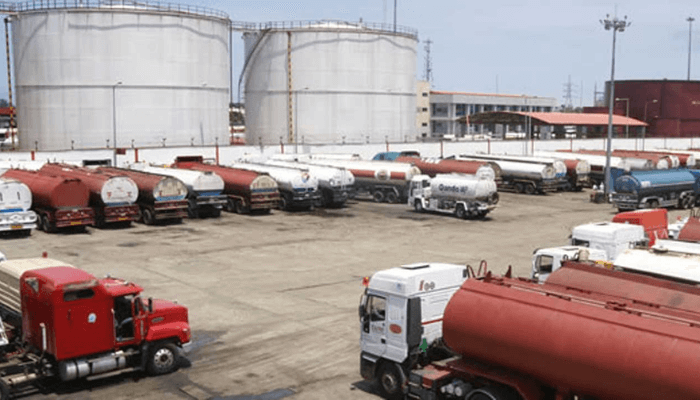
Nigeria Sees Dramatic Surge in Petrol Imports
Emmanuel Ade in Abuja
Nigeria’s petrol imports witnessed a remarkable surge from 5.9 million liters per day in May to 18.1 million liters per day in June, marking a substantial 207% increase month-on-month, according to the latest data from the Nigerian Midstream and Downstream Petroleum Regulatory Authority (NMDPRA).
This spike has intensified pressure on the naira, as the escalating demand for foreign currency among market participants has risen correspondingly.
Gasoline Supply Dynamics Shift
In June, the country’s gasoline imports surged to a total of 543 million liters, up significantly from 182.9 million liters in May 2023, according to an analysis of the NMDPRA fact sheet. This notable shift raises concerns about the domestic fuel supply dynamics, as the Dangote refinery has consistently warned that ongoing imports could undermine local refining initiatives.
Market Data Reflects Increased Petrol Demand
According to downstream statistics, Nigeria’s total daily petrol consumption reached 50.6 million liters in June, an increase from 47.4 million liters in May. The management of Dangote Refinery asserts that its robust production capacity, operating at an average utilization rate of 101.36%, can comfortably meet domestic consumption needs.
Regulators Address Concerns Over Supply Stability
Market players and the NMDPRA are advocating for a balanced approach, emphasizing the importance of securing supply and preserving price stability for consumers, particularly given fluctuations in domestic production. They argue that reliance on a single source for fuel creates a potential monopoly, which can adversely affect market dynamics.
Local Refining Efforts Show Mixed Results
The conflict surrounding the importation of petrol persists despite a 10% rise in crude oil intake at local refineries, which increased from 578,000 barrels per day in May to 632,000 barrels per day in June, according to NMDPRA statistics. Notably, Dangote has commenced selling products in dollars amid ongoing challenges with local currency policies.
Gasoline Stock Adequacy Improves
During this same period, Nigeria’s total gasoline stock sufficiency improved from 16.2 days to 19.7 days, reflecting a 22% increase compared to May. Additionally, figures for diesel (automotive gas oil) show a total intake of 16.2 million liters per day, a decline from 18.8 million liters the previous month. The amount of kerosene received also fell to 2.5 million liters per day, down 31% from 3.6 million liters in May.
Gas Supply Trends Present Mixed Performance
Natural gas usage has fluctuated between 4.888 billion standard cubic feet per day (Bscf/d) and 5.142 Bscf/d throughout the first six months of this year. For instance, January recorded 5.015 Bscf/d, while June noted a slight rise to 5.116 Bscf/d. However, sector-specific gas consumption reveals a mixed performance. Gas supply for power generation dropped to 0.509 Bscf/d, despite an overall increase in gas supply, whereas commercial and industrial gas consumption rose to 0.643 Bscf/d and 0.554 Bscf/d, respectively.
Gas Infrastructure Development Progresses
On the infrastructure side, progress is being made with key projects such as the Ajaokuta-Kaduna-Kano (AKK) gas pipeline, which reached a completion rate of 94.3% by June 2026. The OB3 gas pipeline project has achieved a completion rate of 96%, signifying advancements in Nigeria’s efforts to enhance its gas utilization capacity.
