


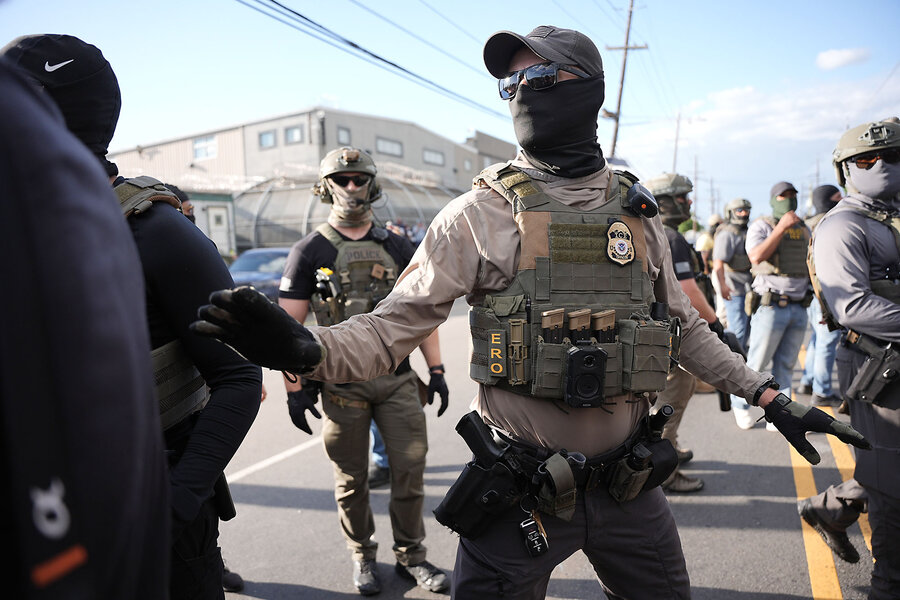
In discussions surrounding immigration, a consensus is a rare achievement. However, there seems to be a shared understanding between the Trump administration and its critics regarding the imperative to equip police officers with body cameras.
Recently, Immigration and Customs Enforcement (ICE) agents shot and killed two immigrant drivers in Texas and Maine. The Department of Homeland Security (DHS) defended the actions of the ICE officers as defensive but noted that these officers were not outfitted with body cameras at the time of the incidents. While more than half of ICE field offices are now equipped with the technology, the remaining offices are expected to have cameras by September, according to DHS.
Both federal officials and ICE critics view body cameras as a means to foster accountability on the streets. Yet, while video can provide context, it cannot capture the full narrative. The increased deployment of body cameras also raises concerns about surveillance and the potential for selective release of footage, which could influence public perceptions of events.
Rationale Behind the Article
The recent killings of immigrants by ICE agents have sparked critical discussions about the justification of these shootings. Equipping officers with body cameras could add crucial evidence to disputed encounters.
The recent shootings, which were captured by a bystander’s footage, occur amidst a significant increase in ICE arrests during Trump’s second term, with an average of over 1,470 arrests daily in early July. As vehicle stops continue at President Trump’s direction, officers may increasingly confront protesters and critics who claim government overreach.
DHS has committed to deploying additional body cameras following incidents where police fatally shot two U.S. citizens during immigration-related protests in Minnesota earlier this year. Currently, the Trump administration cites the ongoing government shutdown and its impact on DHS funding as hindrances to the rollout of body camera technology, amid pressures from Democratic lawmakers for reform. On the other hand, President Biden was already piloting body camera initiatives five years ago.
The administration had initially planned for a nationwide body camera rollout over several years, but more resources were needed for quicker implementation, noted Scott Schuchart, who was ICE’s deputy director for regulation and policy during the Biden administration. Beyond cameras, the program faces additional costs related to training and data storage.
Last April, Congress allocated $20 million to procure body cameras for immigration enforcement personnel, following a significant funding boost for DHS in the previous year. However, the current administration’s budget proposal suggests potential cuts to the body camera program.
Government Initiatives
ICE has now mandated that each arrest team includes at least one body camera as officers nationwide undergo training. DHS has yet to comment on this updated body camera policy, implemented through a directive in February 2025, which requires ICE officers to activate their cameras during activities such as arrests and federal facility deployments. However, covert operations, including surveillance, are exempt from this requirement.
Some former officials have expressed support for this initiative. Scott Mechikowski, who served as ICE’s deputy field director during Trump’s first term, emphasized the need for body cameras to document the challenges encountered during deportations.
He recalled that, without agency-wide body cameras, ICE officers sometimes took it upon themselves to record their enforcement actions to provide evidence in case situations escalated. Mark Morgan, who led Customs and Border Protection and ICE under Trump, also supports the idea, noting that federal agencies should have adopted body cameras long ago. Yet, he points out that ICE personnel face greater scrutiny for shootings compared to other federal officers due to the polarized nature of immigration policies.
For instance, according to an NBC News analysis, investigators associated with the Justice Department shot and killed 223 individuals from 2018 to 2022, with over half of the incidents being fatal. While many of these individuals were wanted for criminal activities, the public response was far less intense when compared to recent ICE-related fatalities.
The Department of Justice has directed law enforcement agencies to formulate body camera policies since 2021. Some agencies, like the Bureau of Alcohol, Tobacco, Firearms and Explosives, have publicly documented their gradual implementation of cameras, while the U.S. Marshals Service reported equipping all its deputies with body cameras by last year.
Historical Context of Body Cameras in Law Enforcement
Body cameras began to emerge in various U.S. police forces in the early 2010s, but John Sandweg, who served as acting director of ICE from 2013 to 2014, noted a lack of significant discussion regarding the adoption of body cameras within ICE at that time. The Obama administration usually pursued less overt enforcement approaches, such as detaining migrants already incarcerated rather than engaging in more active patrols.
In recent years, however, ICE has adopted more aggressive enforcement tactics, leading to activities similar to those of patrol officers, including traffic stops. Sandweg contended that body cameras are vital in these scenarios. In 2021, ICE initiated a pilot body camera program in response to Congressional mandates. A limited RAND investigation two years later found no significant barrier to expanding this initiative.
Chuck Wexler, executive director of the Police Executive Research Forum, remarked on the importance of understanding the dangers faced by officers, noting that body-worn cameras may help illuminate this aspect.
Limitations and Concerns
Though increasing the number of body cameras could enhance accountability, research indicates certain limitations. It remains uncertain whether the presence of body cameras effectively reduces overall instances of force. Additionally, studies suggest body camera footage may inadvertently perpetuate racial biases, particularly against individuals with darker skin tones.
Experts in privacy and evidence also raise concerns about the implications of widespread camera use. They warn of the potential for ICE surveillance systems to utilize recorded footage. Spencer Reynolds, a former DHS attorney, expressed concern that video recordings could be added to the department’s extensive surveillance framework.
DHS maintains vast repositories of video and imagery, combining various forms of intelligence—ranging from DNA to vehicle tracking—to monitor immigrants and compile information on protesters. The February 2025 directive generally prohibits “live” recordings from activating facial recognition systems, albeit with a footnote allowing still images taken from these cameras for related searches.
Furthermore, experts have expressed apprehension regarding the selective or manipulated release of recorded video. Sandra Ristowska, director of the Visual Evidence Lab at the University of Colorado Boulder, advocates for clear policies governing public access to this footage, adding that society may over-rely on video evidence, which can obscure as much as it reveals. Ultimately, fair immigration enforcement is a societal issue that technology alone cannot resolve.
