


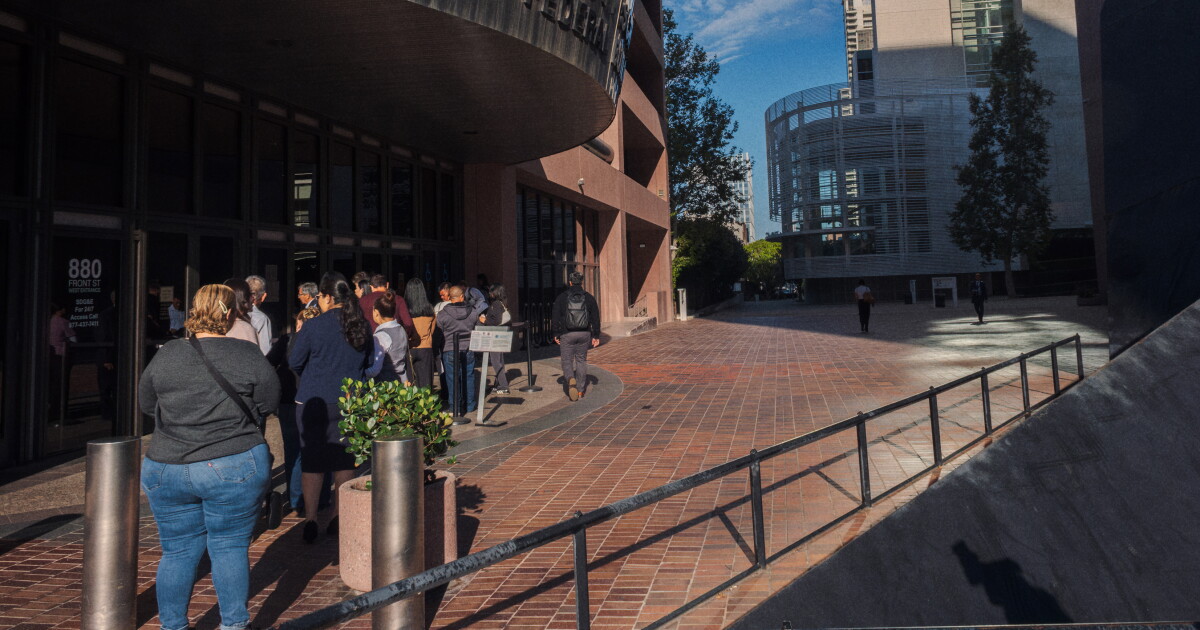
Mass Deportations Ordered Following Immigration Court Hearing
Fifty individuals were ordered deported from the United States after missing a significant immigration court hearing in San Diego, according to court observers. This decision came during a session that was part of a broader agenda involving over 80 cases scheduled that morning under Judge Katherine Halliday Roberts.
While approximately 24 individuals were present and heard during the initial morning session, Judge Halliday-Roberts postponed her determination on absent cases until the afternoon. The deportation orders were first reported by Daylight San Diego, raising concerns among immigrant advocacy groups.
Paulina Reyes, director of the Immigrant Defenders Law Center in San Diego, highlighted that this hearing represents the latest phase in a national initiative by the U.S. Department of Justice aimed at accelerating deportations via expedited hearings. She expressed concerns that this approach risks undermining due process protections. “We believe this is part of the Trump administration’s strategy for mass deportations,” Reyes stated.
Ken Nolet, a volunteer monitor at the San Diego immigration court, noted he had never witnessed such a high volume of cases set for a single hearing. “On a typically busy morning, one judge might oversee around 20 cases,” Nolet explained. “However, approximately 90 cases were heard in Courtroom 6 alone that morning.”
In contrast, Justice Department officials emphasized in an emailed statement that this hearing was part of efforts to tackle the immigration court backlog. “Reducing the immigration court backlog remains a top priority for this administration,” the statement said. “We are committed to restoring the integrity of our immigration system by ensuring fair, prompt, and uniform hearings in compliance with the law.”
Nolet raised additional concerns about the court’s practices, noting that some individuals have reported last-minute changes to their court dates. This raises alarms about the potential for absenteeism to lead to deportation. “It seems like they are rescheduling cases from a year or two out to much sooner dates,” he said, suggesting systemic issues affecting due process.
Reyes indicated these troubling practices are not confined to San Diego. “We are hearing similar reports from our partners in other states,” she remarked. “Many individuals who expected hearings scheduled for late 2026 or even 2027 suddenly found themselves notified of imminent hearings.”
In response to these concerns, the Justice Department’s Office of Immigration Review stated via email that adjusting court dates is intended to eliminate protracted litigation. “As we continue to add new immigration officers, the EOIR will adjust schedules to ensure timely and lawful processing of all cases,” the spokesperson noted.
Reyes criticized the current state of the courts, asserting that they are failing to protect individuals adequately. “This new policy seems designed to facilitate more orders in absentia,” she stated. “It ultimately aims to increase removals without due process.”
Master hearings, like the one that occurred in San Diego, typically form an early part of the immigration court process. During these hearings, refugees and immigrants assert their rights in response to government allegations of unlawful entry. Judges provide these individuals the chance to seek legal counsel, laying out the specifics of the violation along the way.
Daylight San Diego also noted that not all individuals who failed to appear were immediately ordered to leave. Some were allowed to remain, with two couples being discharged and another transferred to a different state. Additionally, several individuals had their schedules pushed back to the following month.
