


T. William Lester, associate professor of urban planning and public policy at the University of California, Irvine, addressed community concerns regarding the repercussions of recent Immigration and Customs Enforcement (ICE) raids in Los Angeles and Orange County.
Call for Policy Change to Address Economic Impact of Immigration Enforcement
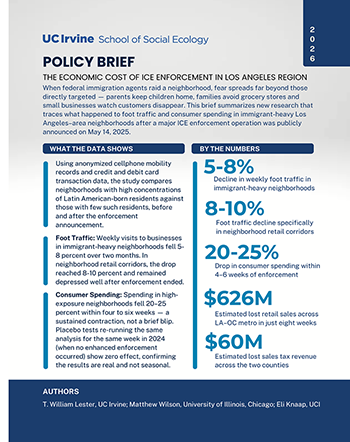
A new policy brief co-authored by researchers from the University of California, Irvine and the University of Illinois at Chicago reveals that aggressive federal immigration enforcement incurs significant economic costs—burdens ultimately borne by local businesses, neighborhoods, and their respective governments.
The brief, authored by T. William Lester and Eli Knap from the University of California, Irvine, alongside Matthew Wilson from the University of Illinois at Chicago, analyzes the economic ramifications on local communities resulting from increased ICE activities in immigrant neighborhoods. Their findings indicate a widespread and prolonged economic contraction that extends well beyond those directly targeted by enforcement actions.
Focusing on a sizable ICE operation announced on May 14, 2025, which led to the arrest of 239 individuals in the Los Angeles area, the researchers utilized cell phone location data and anonymized consumer spending records to assess economic activity before and after the operation. This data was juxtaposed with areas characterized by lower immigrant populations.
The findings were striking. Within eight weeks following the operation, foot traffic in immigrant-heavy retail districts declined by 8 to 10 percent, while consumer spending plummeted by 20 to 25 percent.
Estimates suggest that the enforcement campaign resulted in over $625 million in lost retail sales and nearly $60 million in diminished sales tax revenue across Los Angeles and Orange counties within just two months. The researchers caution that the actual economic consequences may be even more severe, as undocumented and mixed-status households are generally less likely to utilize credit and debit cards captured in their data.
Lester emphasized that fear stemming from immigration enforcement is the primary driver behind the economic downturn. The brief’s compelling message to policymakers highlights that federal immigration enforcement incurs significant costs, which will inevitably impact state and local governments through diminished tax revenues. This situation extends its reach to workers in small businesses and immigrant communities who are not at all connected to enforcement activities.
Describing what they term the “atrophy effect,” the researchers shed light on the extensive ramifications of enforcement-related fear, leading to behavioral changes that reverberate throughout communities. When residents fear leaving their homes, they reduce shopping, dining out, and patronizing local businesses, resulting in revenue losses for businesses and tax deficits for local governments.
To address these critical issues, the policy brief advocates for specific responses: Enhanced Federal Transparency—ICE should provide local governments with timely information regarding the timing and scale of its enforcement actions, allowing communities to brace for economic impacts; Fiscal Responsibility—state and local governments should be equipped with formal mechanisms to document revenue losses attributed to federal enforcement activities and seek compensation; and Impact Assessment—large-scale internal enforcement operations ought to undergo thorough economic impact evaluations akin to those mandated for substantial federal infrastructure and environmental initiatives.
The ICE operation in Los Angeles triggered large-scale protests and violent confrontations between demonstrators and federal agents, leading to the deployment of the National Guard and Marines in the area. These events contributed to escalating fears within immigrant communities, according to Lester.
The researchers underline that economic repercussions should be central to discussions about the design and implementation of immigration enforcement policies. The costs are tangible, manifesting as lost revenue, weakened neighborhood economies, and reduced public services.
The findings of this research are currently being prepared for publication in an academic journal.
