


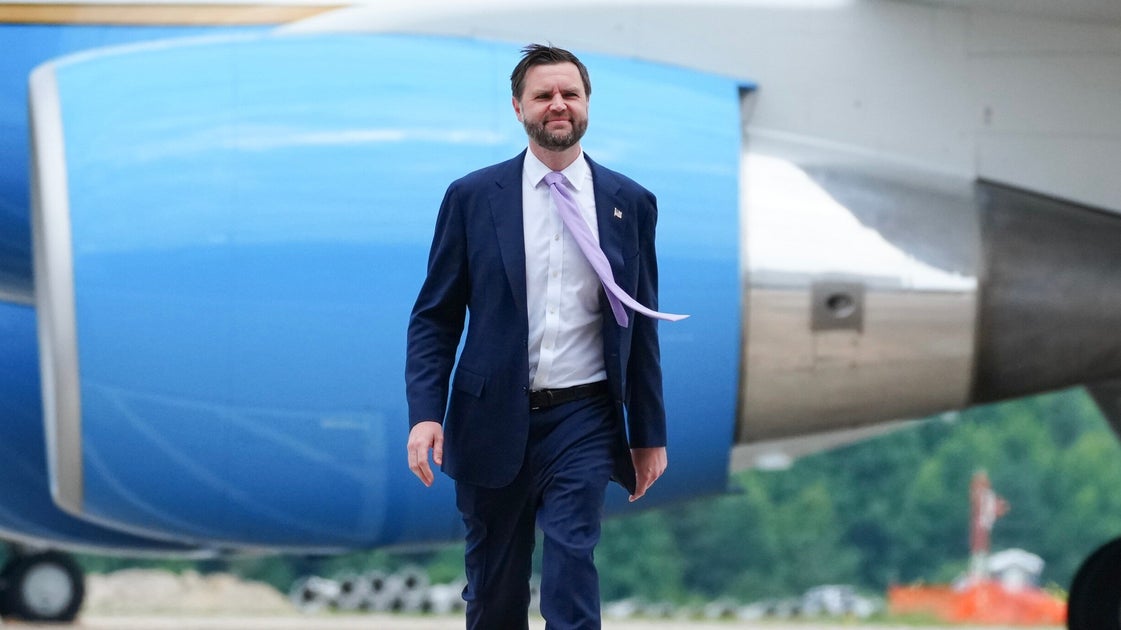
Analyzing J.D. Vance’s Approach to Immigration Policy
J.D. Vance has adeptly navigated two primary strategies in discussing President Donald Trump’s immigration policies. The first tactic involves obscuring facts by casting doubt on their accuracy, while the second seeks to dehumanize immigrants, portraying them as threats to national integrity. This method not only serves to justify harsh policies of mass detention and deportation but also creates a narrative that simplifies complex issues.
Vance’s Faith and Political Narrative
Currently promoting his memoir, “Communion,” which recounts his journey to Catholicism, Vance appears to be using his faith to distance himself from the more controversial aspects of Trump’s immigration policies. As he positions himself for a potential presidential run, Vance seems to be experimenting with a more palatable narrative that minimizes the cruelty inherent in these policies.
Detention Policies Under Scrutiny
The harshness of Trump’s immigration policies becomes clearer when examining the record number of individuals currently held in detention facilities. A significant portion of these detainees have not been convicted of any crimes, and many are awaiting asylum hearings, raising questions about the legality and morality of detaining them indefinitely. Reports indicate that the administration is leveraging the fear associated with detention to pressure individuals into abandoning their immigration cases.
Generalizations and Evasions in “Communion”
In “Communion,” Vance addresses immigration policy in vague terms, likely to avoid confronting uncomfortable truths. He writes about the inherent difficulties faced by law enforcement without acknowledging the legality or morality of the actions taken during deportations. Notably, Vance sidesteps criticism from high-ranking Catholic officials regarding Trump’s immigration stance, instead opting for a sarcastic commentary on the need for realistic institutional beliefs.
Challenging Facts and Cherry-Picking Statistics
During public appearances, Vance often deflects pressing questions regarding the consequences of strict immigration enforcement by framing them as inherent challenges of law enforcement. This tactic has led him to make unsubstantiated claims about child trafficking under the Biden administration, diverting attention from the critical issues surrounding immigration policy. He frequently challenges factual representations of immigration statistics, attempting to create a narrative that questions the integrity of the prevailing discourse.
Immigrant Dehumanization and Pervasive Rhetoric
Vance’s rhetoric has frequently leaned toward dehumanizing immigrants, especially visible in his remarks about Haitian immigrants in Springfield, Ohio. By propagating unfounded rumors, he aimed to shift media focus onto the American populace’s suffering while failing to present evidence or substantial context for his claims. Such strategies have only served to amplify the stigmatization of immigrant communities, especially under the broader Trump administration messaging.
The Complex Relationship Between Immigration and Religion
In his writings, Vance posits that immigration undermines America’s Christian foundation, despite evidence to the contrary. While he contends that declining religious observance is tied to increased immigration, research from the Pew Research Center highlights that immigrants tend to place a higher value on religious practice than U.S.-born citizens. This disconnect reveals a broader misunderstanding of the role immigration plays in shaping cultural and religious landscapes in the U.S.
