


Rising Immigration Arrests in Pontiac Highlight Community Concerns
Community Aid For Empowerment (CAFE) estimates that over 400 immigration arrests have taken place in Pontiac since 2025, predominantly in the city’s Latino communities on the north side. Local advocates report a significant presence of Oakland County sheriff’s deputies at sites of these arrests, although the sheriff’s office denies involvement in federal immigration enforcement. The pervasive fear of detention has led many families to curtail their activities, negatively impacting attendance in schools and churches throughout the area.
The surge in immigration enforcement efforts was first brought to the attention of Elida Reyes during her church services. The changes she observed prompted her to inquire about the Latino families that seemingly vanished from her congregation. “People were being taken away by ICE,” Reyes explained, referencing U.S. Immigration and Customs Enforcement.
Reyes, who founded CAFE, leads efforts to support families affected by immigration actions. The organization not only tracks arrests but also provides food, transport to court appointments, and operates an ICE hotline. Since the surge in enforcement began in 2025, CAFE estimates that well over 400 Pontiac residents have faced arrest. However, local organizers believe that the actual number may be significantly higher in a city with a population of 62,104.
The visible enforcement activity near community hubs—grocery stores, places of worship, and schools—has caused residents to retreat into their homes. Reyes characterizes the situation as “voluntary house arrest,” where fear dictates daily routines and community engagement.
Impacts on Pontiac’s Latino Neighborhoods
Father’s Day this year was particularly alarming, according to Alexis Huyck, a local teacher and executive at CAFE. “It was the worst I’ve ever seen,” she recounted, noting that the immigration arrests seem indiscriminate. Many individuals apprehended in Pontiac bear work permits and appropriate documentation, raising concerns about the legality of their detentions.
Huyck stated that the speed of these arrests is troubling, citing an instance where the time from arrest to completion was under six minutes. Reyes expressed her profound concern for the emotional toll these actions take on families and the community. “I don’t understand how people can turn away,” she lamented, reflecting the complex feelings surrounding these enforcement actions.
CAFE actively supports families attending court to seek the release of detained loved ones, though Reyes noted that successful outcomes are rare. Many face the looming threat of deportation, a harrowing reality that resonates with Reyes, who carries her passport and birth certificate as a precaution against potential detention.
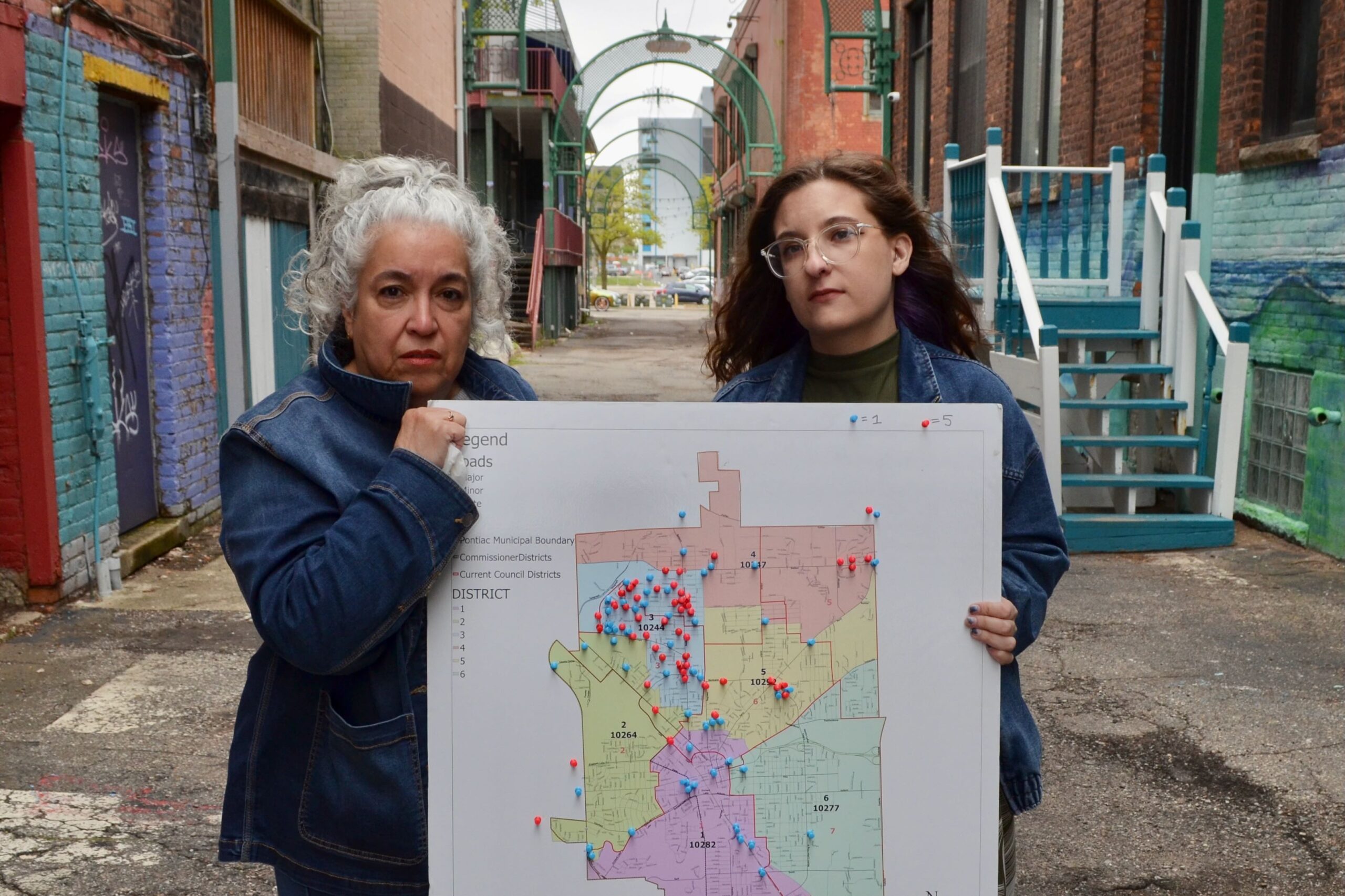
Organizers maintain a visual representation of arrests with a map dotted with pushpins: blue for individual arrests, red for five actions, and dark purple for ten. A majority of these pins crowd the north side of Pontiac City, underlining the concentrated impact on the city’s diverse Latino population.
Questions Surround Local Law Enforcement’s Rules
CAFE advocates regularly observe Oakland County sheriff’s deputies at immigration arrest scenes, raising questions about the collaboration between local law enforcement and ICE. Reyes pointedly questioned the rationale behind police assistance in these operations if no 287(g) agreement—allowing police to perform certain immigration enforcement functions—exists. Currently, the Taylor Police Department is the only law enforcement agency in Metro Detroit with such an agreement.
Though the Oakland County Sheriff’s Office asserts it is not involved in federal immigration enforcement, spokesperson Stephen Huber acknowledged that cooperation occurs when individuals are arrested on state or local charges and subsequently referred to federal authorities. He emphasized that immigration enforcement is ultimately the federal government’s responsibility, despite the local sheriff’s office handling state and local laws.
In February, the Oakland County Commission adopted a resolution opposing immigration enforcement operations by ICE in non-public spaces owned by the county. The resolution aims to safeguard community spaces, expressing concerns over the chilling effects of enforcement actions on community participation and cohesion.
ICE Defends Its Mission Amidst Local Tensions
ICE refrained from commenting specifically on enforcement in Pontiac, but a spokesperson defended the agency’s adherence to established immigration laws. “We welcome and encourage Michigan law enforcement to work with us in the interest of public safety and national security,” the representative stated.
In 2025 alone, ICE conducted 3,298 arrests across Michigan, according to the Deportation Data Project. Such figures further amplify community anxiety and illustrate the impact of enforcement in areas with significant immigrant populations.
Challenges Faced by Pontiac’s Governance
The Pontiac Police Department was dissolved during a period of state-imposed emergency management, leading to the Oakland County Sheriff’s Office assuming law enforcement responsibilities in 2011. This transition, initiated under emergency manager Michael Stampfler, has remained a point of contention for local leaders. Councilman Mikal Goodman acknowledged the limitations placed on local governance as a result of the county’s involvement in policing.
Mayor Mike McGuinness, who took office in January, is currently engaging with the sheriff’s office to clarify immigration enforcement roles. He expressed his intent to ensure that community concerns are addressed without preemptively setting terms for future contract negotiations.
Community Action Rallying Against Fear
In a unanimous resolution passed on March 3, the Pontiac City Council called for respectful and safe access to essential community services, highlighting sensitive locations such as schools, churches, and polling places. The council has implemented a one-year moratorium on establishing new detention facilities, underscoring their commitment to alleviating fears associated with immigration enforcement.
Mayor McGuinness has echoed the concerns of his constituents, noting the rising anxiety surrounding immigration raids. “These actions are heartbreaking and hurt the American people,” he shared. The mayor emphasized the vital contributions of immigrant communities to Pontiac, arguing against the use of aggressive enforcement tactics which can foster an environment of fear and intimidation.
The Impact on Children’s Lives
CAFE representatives noted that these troubling trends are adversely affecting school attendance and participation in Pontiac. Reyes mentioned that the district risks significant enrollment declines if immigrant families feel compelled to leave the area. Many parents are not U.S. citizens, and their children—born American citizens—face painful decisions when deportations occur.
Huyck highlighted the profound losses these children are experiencing, as their rights to play and socialize diminish due to the oppressive climate. “They can’t really leave the house,” she lamented, emphasizing the deep psychological effects on these young residents who grow up under the shadow of uncertainty.
To support families during these difficult times, CAFE has created initiatives to help detained immigrants stay connected with their loved ones. By depositing funds into their commissary accounts, CAFE enables detained immigrants to maintain communication with children, ensuring that family bonds remain strong in spite of challenging circumstances.
