


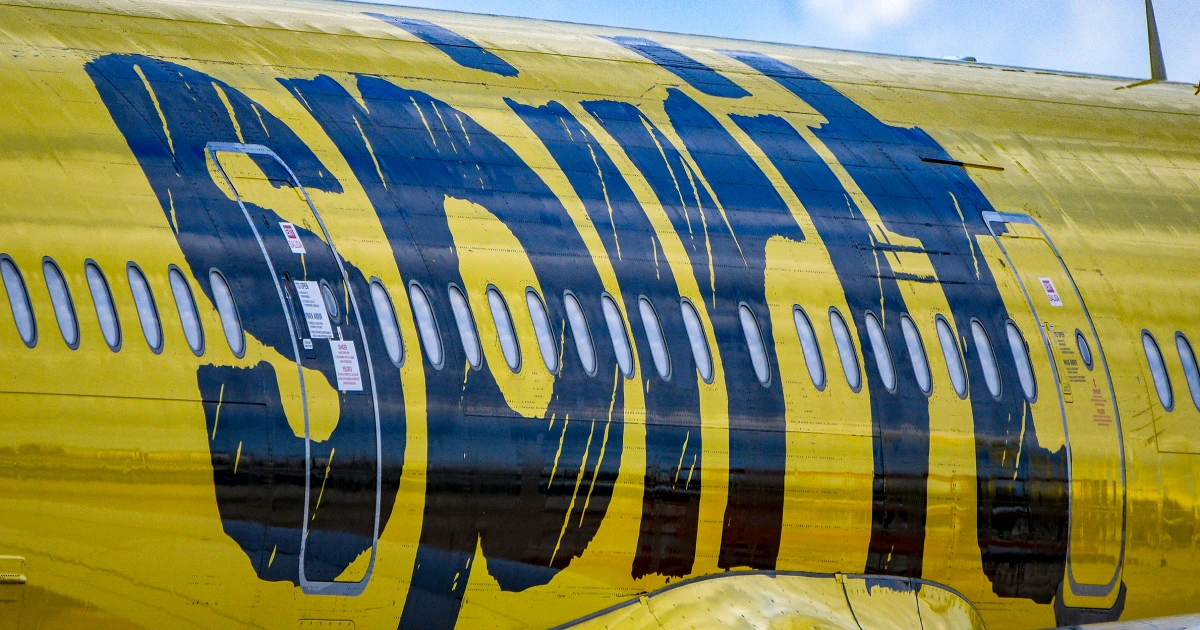
Spirit Airlines Faces Shutdown Amid Crowdfunding Revival Effort
Spirit Airlines, once regarded as America’s go-to budget airline, has officially ceased operations, prompting a viral crowdfunding initiative aimed at resuscitating the bankrupt carrier.
On May 2, after the airline’s failed merger attempts and lack of federal assistance, Hunter Peterson, a 22-year-old voice actor and content creator, leveraged social media to propose a plan to revive Spirit. He suggested that if one-fifth of Americans contributed $45 each—the cost of a typical Spirit ticket—it might be feasible to purchase the airline.
Peterson initially pitched the idea as a humorous parallel to the Green Bay Packers, the only publicly owned team in the NFL, which boasts over 5 million shares held by more than 530,000 owners. This lighthearted take quickly transformed into a serious call to action. While he has yet to receive cash contributions, his website indicates he has garnered $337 million in pledges from over 370,000 verified supporters.
Despite Peterson’s engaging approach, he refrained from media comments, stating he would only speak once plans are more concrete. However, he did acknowledge on social media that he is acutely aware of the regulatory challenges his proposal faces and is consulting with legal experts to navigate these complexities.
The public’s enthusiasm about this crowdfunding effort reflects a broader desire to disrupt the traditional airline industry. Nevertheless, experts caution that the multitude of regulatory hurdles could significantly impede any forward momentum. Charles Elson, a former finance professor at the University of Delaware, noted that airlines are intricate financial entities with numerous stakeholders, making them less suited to a crowdfunding model.
Elson elaborated on the complexities, stating, “There are liens on the lessor, the airplane, the government agencies that lease space to airlines, as well as labor contracts with pilots, flight attendants, ground staff, and mechanics.” He acknowledged that while the concept has merit, the feasibility is questionable, likening its successful execution to venturing to Mars.
Adding to the challenges, John Coffee Jr., a law professor at Columbia University, highlighted the arduous and costly process of registering an airline as a public company with the Securities and Exchange Commission (SEC). Crowdfunding efforts typically face a $5 million annual limit under SEC regulations, a sum that falls short for such a massive acquisition.
Other financing avenues, such as private placement services, offer the potential for more significant funding but typically restrict participation to individuals with a net worth of $1 million or more. “The average citizen won’t qualify under these limitations,” Coffee noted, emphasizing the additional complications presented by Spirit’s bankruptcy.
As outlined in a 2025 bankruptcy filing, Spirit Airlines has struggled financially for years, with cumulative debts reaching approximately $8.1 billion by August 2025. The airline’s woes were exacerbated by skyrocketing oil prices attributed to ongoing geopolitical conflicts, including the war with Iran. In a poignant statement, CEO Dave Davis remarked, “We just ran out of runway,” underscoring the financial strain the airline has endured.
It’s clear that merely selling tickets will not suffice to ensure a viable future for any potential revival of the airline. However, Peterson’s crowdfunding campaign, dubbed ‘Spirit 2.0,’ has captured public interest, evident in the repeated crashes of the website from overwhelming traffic. Individuals like Indiana radiologist Abigail Hartman expressed eagerness to invest, hoping to be part of a transformative venture. “If this works, doesn’t it mean we can do anything?” she posed on social media.
With urgency mounting as an auction for Spirit’s assets approaches, Peterson claims he has gained legal backing for his bid and has the support of the airline’s flight attendant union. While he acknowledges the uncertainty of success, he remains optimistic about the potential for collective ownership and decision-making should the campaign succeed. “There’s no guarantee this will work,” he admitted, “but we are one step closer to everyone owning Spirit 2.0.”
