


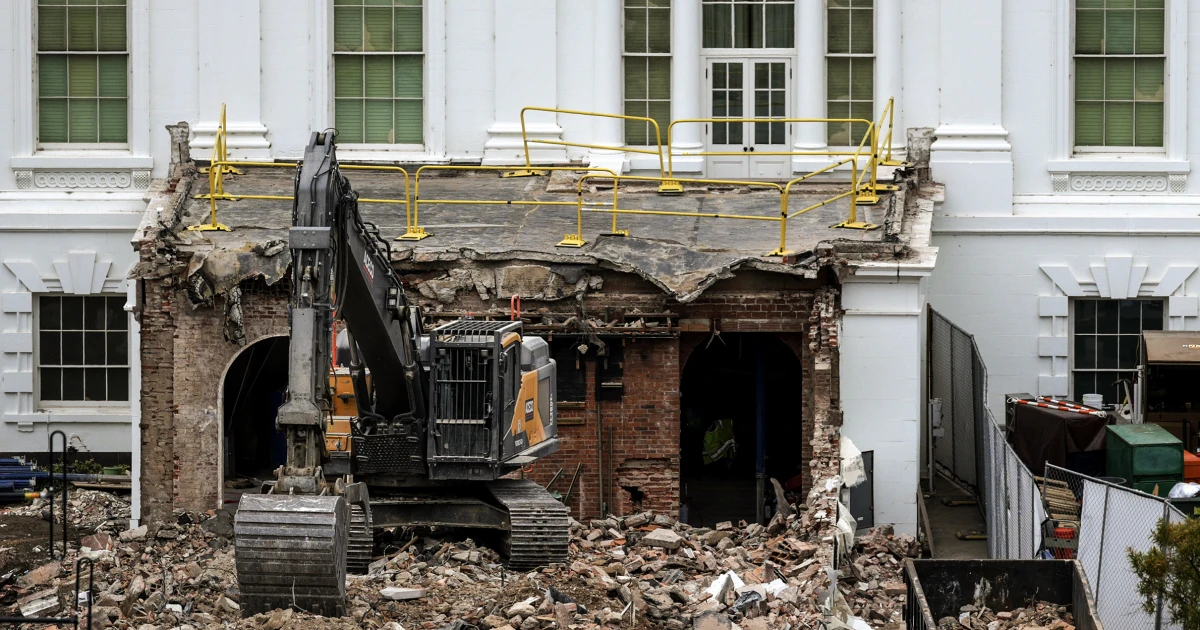
Trump’s Ballroom Project Raises Questions Over Funding
WASHINGTON — For months, President Donald Trump has touted the new ballroom being constructed on the White House grounds as a gift from patriotic private donors to the nation. He has consistently emphasized that this lavish addition, covering 90,000 square feet, will cost the public nothing. However, recent developments suggest that taxpayers may ultimately bear a significant financial burden.
During an Oval Office meeting last November, Trump reiterated, “There is no government funding. These are all individuals who invested a lot of money to build banquet halls.” He insisted that “not a penny has been spent by the federal government.” Yet, the project, while initially claimed to be cost-free, could potentially result in expenses for taxpayers, with estimates reaching up to $1 billion due to necessary security enhancements.
Senate Judiciary Committee Chairman Chuck Grassley (R-Iowa) has introduced a long-term funding bill that allocates $1 billion specifically for security improvements related to the ballroom. This legislation aims to enhance coordination and security features in collaboration with the U.S. Secret Service as part of the broader East Wing modernization project.
The discourse surrounding funding has sparked contention among lawmakers. The Senate is preparing to deliberate on a Republican-only reconciliation bill designed to pass within the year. However, some Republican senators expressed reservations about taxpayer dollars being used for what they view as extravagant banquet facilities.
In response to the proposed funding, White House Press Secretary Davis Engle issued a statement praising the Republican-led initiative. Engle cited the urgent need for enhanced security measures in light of a recent assassination attempt on President Trump during the White House Correspondents’ Dinner, asserting that the proposal is crucial for fortifying the White House complex.
Conversely, Senate Democrats are determined to eliminate the $1 billion proposal, planning to challenge it on the Senate floor later this month. Senator Brian Schatz (D-Hawaii) remarked that the members of the ballroom will soon face a decisive vote regarding its funding.
When first announcing plans for the ballroom, Trump maintained that it would fulfill the need for a venue to host large public gatherings without incurring costs to the White House. He described the ballroom as a “gift” valued at $300-400 million, funded entirely by private donations. Nevertheless, as construction has progressed and legal hurdles emerged, the administration has shifted its narrative, highlighting safety as a primary reason for the ballroom’s necessity.
Opponents argue that the recent funding proposal indicates a failure to adhere to initial promises, alleging that Trump misled the public regarding the project’s financial implications. As the project moves forward amid legal challenges, including claims questioning its Congressional authorization, the courtroom’s decisions may ultimately shape the future of the ballroom.
