


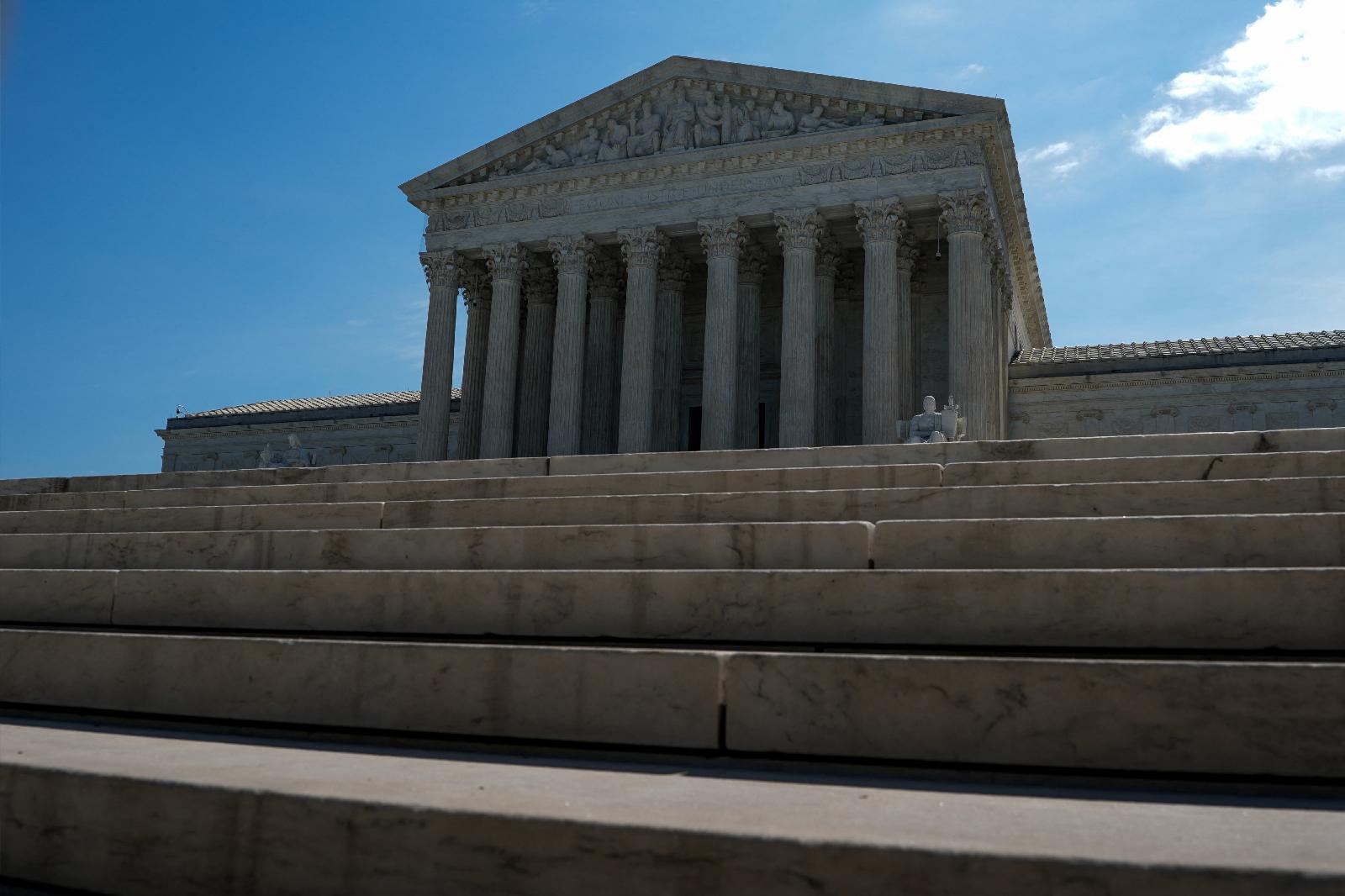
WASHINGTON — The U.S. Supreme Court has recently made significant rulings regarding immigration policy, coinciding with ongoing political developments in Washington, including the uncertain future of a bipartisan housing bill following President Trump’s cancellation of a signing ceremony. This week also marks the fourth anniversary of the landmark Dobbs v. Jackson Women’s Health Organization decision.
Court Rulings Address Immigration Policy and Religious Rights
On June 25, the U.S. Supreme Court ruled that the Trump administration could reinstate a contentious policy that turns away asylum seekers at the U.S.-Mexico border, known as “metering.” The court also permitted the administration to end temporary protections for eligible Haitian and Syrian immigrants residing in the country, putting them at risk of deportation.
Kevin Appleby, a senior fellow for policy and communications at the New York Center for Immigration Studies, expressed concern about the latest asylum ruling. He noted, “This decision could force vulnerable asylum seekers into dangerous situations that expose them to smugglers and life-threatening conditions as they attempt to access U.S. soil.” He added that over one million Temporary Protected Status (TPS) holders now face the peril of deportation.
Bishop Brendan J. Cahill, chair of the U.S. Conference of Catholic Bishops’ Committee on Immigration, urged the administration to rethink its approach regarding TPS in a statement on June 26. He emphasized the moral implications of revoking legal status for individuals when returning to their home countries presents severe risks to their safety. “As a nation, we cannot ignore these injustices,” he asserted.
Additionally, in a separate ruling issued on June 23, the Supreme Court dismissed a lawsuit by Damien Landau, a Rastafarian who alleged that Louisiana prison officials violated his religious rights by forcibly shaving his head. Despite a federal appeals court previously instructing prison staff to accommodate Landau’s religious practices, the Supreme Court ruled against him, stating he could not sue an individual guard under the Religious Land Use and Institutionalized Persons Act.
Uncertainty Surrounds Bipartisan Housing Bill
President Trump abruptly canceled plans on June 24 to sign a bipartisan housing bill aimed at alleviating rising housing costs. Instead, he is pushing Congress to advance a voter ID bill that faces significant hurdles in the Senate.
The proposed housing legislation, known as the Pathways to 21st Century Housing Act, was co-sponsored by Representatives Tim Scott (R-SC), Elizabeth Warren (D-MA), French Hill (R-AR), and Maxine Waters (D-CA). It aims to relax regulations surrounding new home construction and restrict corporate acquisitions of large-scale housing, addressing concerns about escalating housing prices. Various Catholic organizations, including the U.S. bishops, have expressed their support for this legislation.
In lieu of the housing bill, Trump urged lawmakers to push forward with the SAVE America Act, which mandates proof of citizenship for voter registration, including items like birth certificates and U.S. passports. Proponents argue it would help combat voter fraud, but critics contend that such requirements may disenfranchise eligible citizens who lack easy access to official documents. According to the Bipartisan Policy Center, a significant proportion of registered voters do not possess a valid passport.
Although the SAVE America Act has passed in the House, it lacks sufficient support in the Senate to meet the necessary 60-vote threshold to overcome a filibuster. The future of the housing bill remains uncertain; if Trump chooses to veto it, Congress could potentially override this decision, as the bill received broad bipartisan support in both chambers.
Fourth Anniversary of the Dobbs Decision Sparks Debate
The anniversary of the Supreme Court’s Dobbs decision, which terminated nearly 50 years of constitutional abortion rights, has reignited discussions among lawmakers about reproductive policies. Following the court’s ruling on June 24, 2022, which involved Mississippi’s law prohibiting abortions after 15 weeks, legislative efforts to regulate or safeguard abortion access have largely stalled.
As a 2024 presidential candidate, Trump has indicated that he believes abortion should be a matter for individual states rather than federal lawmakers, asserting he would veto any abortion-related legislation presented to him.
In the wake of the Dobbs ruling, states have either sought to restrict or enhance access to abortion services. Recent reports indicate an increase in abortion rates across the United States since the ruling was issued.
Members of Congress are divided on the issue, with some advocating for a more proactive federal approach. Co-chairs of the Congressional Pro-Life Caucus have stated that the Dobbs decision empowers both federal and state legislators to enact laws that protect maternal and fetal rights.
Conversely, advocates for abortion rights argue that the repercussions of the ruling have severely impacted women’s autonomy and well-being. Senator Patty Murray (D-Wash.) highlighted concerns about the lack of responsiveness to women’s voices since the Dobbs decision, underscoring the urgency for substantive dialogue on reproductive rights.
As discussions continue, the Catholic Church maintains its position on the sanctity of human life from conception, opposing abortion in all forms, a stance that adds complexity to the ongoing debate.
