


Nigerian Banking System Sees Surge in Liquidity Post-Recapitalization
Liquidity within Nigeria’s banking system has surged significantly following the completion of a sector-wide recapitalization initiative. However, the expansion of lending to the private sector has not kept pace, revealing a widening gap between the financial system’s robustness and its ability to transmit credit to the real economy.
Significant Increase in Banking Liquidity
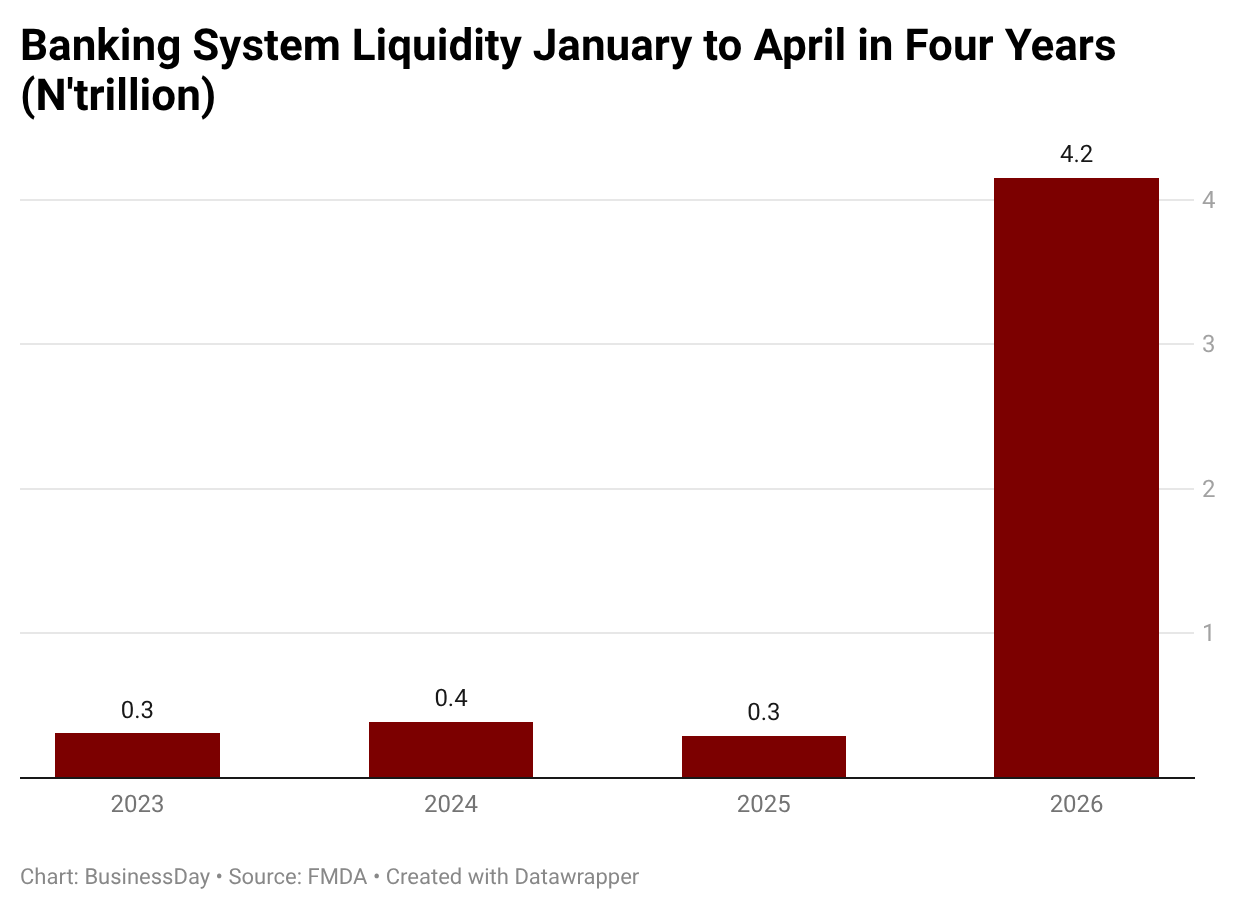
Recent data from the Financial Market Dealers Association (FMDA) indicates that liquidity in the banking sector reached N4.15 trillion as of April 2026. This represents an astonishing increase of 1,253.06% from just N306.54 billion in April 2023, when the Central Bank of Nigeria (CBN) first unveiled the recapitalization program.
Recapitalization Reshapes Industry Dynamics
The recapitalization effort, which concluded on March 31, 2026, fundamentally revised the industry’s balance sheets. Over the past two years, banks raised an impressive N4.65 trillion to comply with new capital mandates. Despite this liquidity surge, growth in private sector credit remains modest.
Credit Growth Lags Behind Liquidity Expansion
In February 2026, total loans rose by just 0.9% month-on-month, reaching N94.61 trillion, up from N93.74 trillion in January. However, year-over-year, this figure has seen a more robust increase of 24.06% compared to N76.26 trillion in February 2025. This divergence underscores the disconnect between the growing liquidity in banks and the slower credit flows to businesses.
Expert Insights on Liquidity Dynamics
Ayodele Akinwunmi, Chief Economist at United Capital, notes that the recent recapitalization, along with improved deposit mobilization and heightened confidence in the banking sector, are pivotal factors driving this liquidity expansion. The jump to N4.15 trillion marks a substantial structural shift, exhibiting a 1,325% increase compared to 2025 figures.
Slow Lending Growth Amid Macroeconomic Challenges
Ayokunle Olubunmi, Head of Financial Institutions Ratings at Agust & Co., acknowledges that while banks are gradually increasing loan disbursements, the challenging macroeconomic environment remains a significant hurdle. He emphasizes that the influx of capital from these activities has considerably bolstered industry liquidity.
Banking Sector Meets Revised Capital Requirements
The CBN has confirmed that 33 banks have successfully met the updated minimum capital mandates, thereby enhancing capital adequacy ratios (CARs) and ensuring that the sector surpasses international Basel standards. Currently, the minimum CAR is set at 10% for local and national banks, while internationally chartered banks are held to a standard of 15%.
Persistent Disconnect Between Finance and Real Economy
Muda Yusuf, CEO of the Center for the Promotion of Private Enterprises, raises concerns regarding the effectiveness of recapitalization in supporting the real economy. Despite improved banks’ shock-absorbing capabilities, the link between financial strength and economic performance remains tenuous. Notably, Nigeria’s private sector credit accounts for 17% of GDP—below the sub-Saharan Africa average of 25%—with countries like South Africa and Mauritius showing significantly higher rates of financial intermediation.
Challenges in Credit Accessibility
Consumer credit in Nigeria remains low, comprising only about 7% of total credit circulation, which suppresses domestic demand and stifles growth. Alarmingly, funding for small and medium-sized enterprises (SMEs) constitutes merely 1% of total credit, despite SMEs accounting for 50% of GDP and over 80% of employment. Additionally, the distribution of loans is uneven, with the services sector receiving 55% of total loans, while manufacturing and agriculture attract much less—just 14% and 5%, respectively. Furthermore, 55% of bank loans are short-term, maturing in less than one year, inadequately aligned with the long-term needs of manufacturing and infrastructure sectors.
