


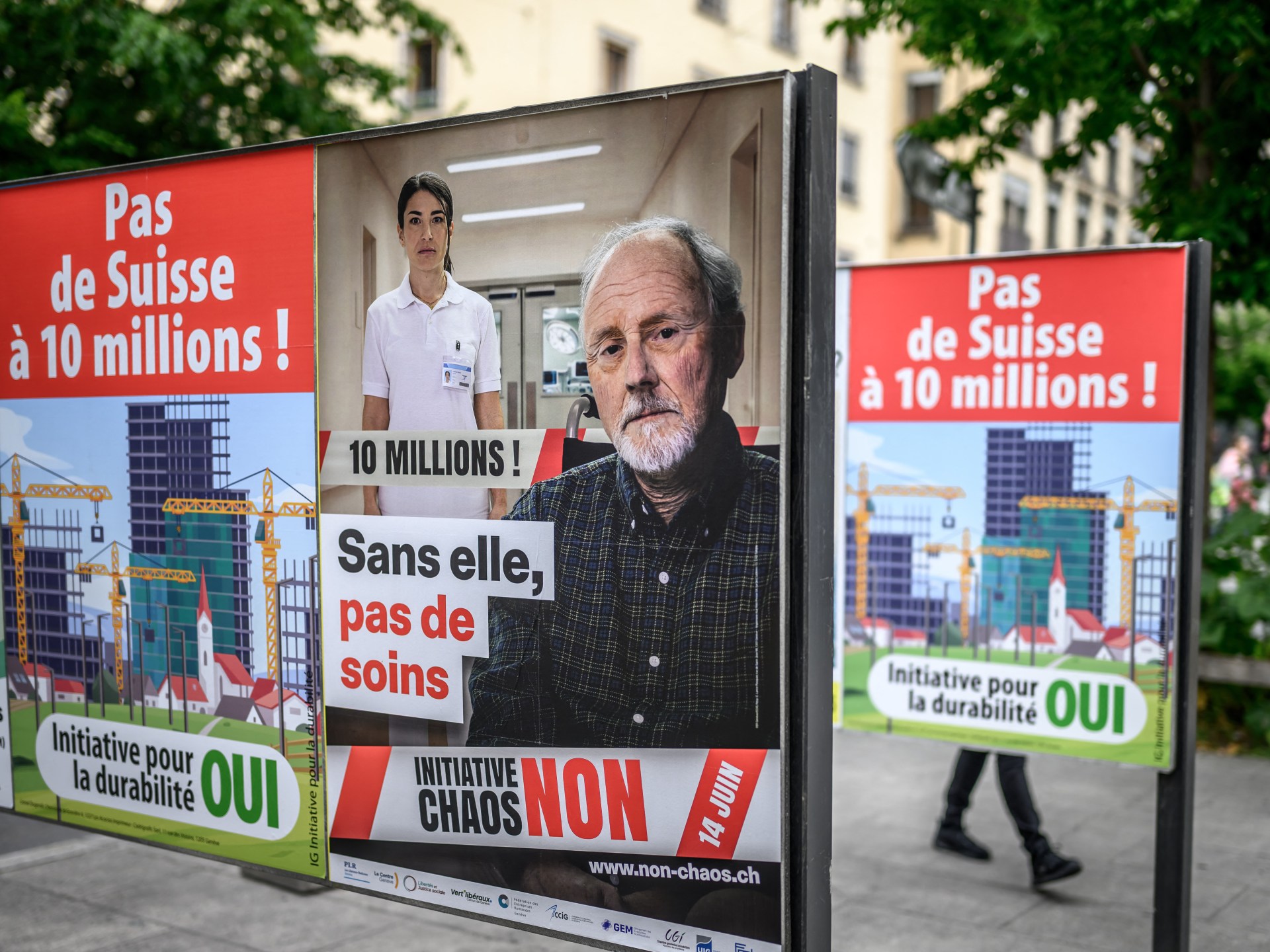
A vote in favor of the proposal could lead to the government limiting asylum and residence permits, ultimately abandoning Switzerland’s agreements with the EU regarding the free movement of people.
Published June 14, 2026
Switzerland is facing a critical referendum regarding a proposed population cap of 10 million, which is backed by significant right-wing factions. This proposal carries the potential to strain relations with the European Union.
This vote, held on Sunday, was initiated by the Swiss People’s Party (SVP), a group known for its strong stance on anti-immigration issues, introducing legislation aimed at limiting population growth.
Proposed Constitutional Reforms
In response to rising immigration concerns and the strain on public services and housing, the SVP has put forward reforms mandating that Switzerland’s population not exceed 10 million by 2050. Current demographic trends indicate the nation is likely to reach this figure by the early 2040s.
Results from the vote are expected to be released around noon (10:00 GMT), and recent polling data from the gfs.bern agency suggests the outcome may be closely contested.
If the population hits 9.5 million by 2050, the Swiss government would be compelled to impose restrictions on asylum, family reunification, and residence permits, and may need to withdraw from key EU accords concerning the free movement of individuals.
The SVP has called for a “sustainability commitment,” arguing that Switzerland’s infrastructure, housing, social programs, and lifestyle are increasingly threatened by population growth.
However, the federal government and members of Congress have expressed opposition to the proposal.
Concerns and Consequences
Opponents of population control highlight that the recent influx of immigrants has brought essential labor and skills to vital sectors such as healthcare, finance, pharmaceuticals, and technology. Furthermore, there are fears that approving this measure could weaken Switzerland’s integral trade relationships with Brussels, given that the EU represents Switzerland’s largest trading partner.
Some senior figures within the vice-presidential ranks have clarified that the aim of the proposal is not to eliminate the free movement of people but to serve as a wake-up call to government action.
Heinz Tenler, a prominent politician and finance director for the canton of Zug, noted, “We don’t want freedom of movement to disappear,” adding that while one million additional immigrants could be absorbed, government intervention is crucial.
In Switzerland’s direct democracy, citizens influence policy decisions through regular referenda, typically held four times annually.
According to the Organization for Economic Co-operation and Development, by 2024, 32% of Switzerland’s population will be foreign-born, making it the second-highest in this regard among the 38 member countries, following Luxembourg and Australia.
Immigration remains a contentious topic across Europe, as nations confront aging populations and rising anti-immigrant sentiments. Notably, while other European countries often focus their sentiments on immigrants from the Global South, the majority of foreign residents in Switzerland originate from Europe.
Since the bilateral agreements established in 2002 that eased mobility for EU citizens, Switzerland’s population has surged by 23%, amounting to 9.1 million at the end of last year. Economic growth has mirrored this trend, with a 24% increase in output during the same period, according to government reports.
Switzerland has seen its voters engage with immigration issues for decades; only one referendum—against mass immigration in 2014—has successfully passed, narrowly fueled by concerns over overpopulation and the increasing Muslim demographic.
Experts point out that while various nations have implemented immigration restrictions, no country has ever voted to impose an explicit population limit.
