


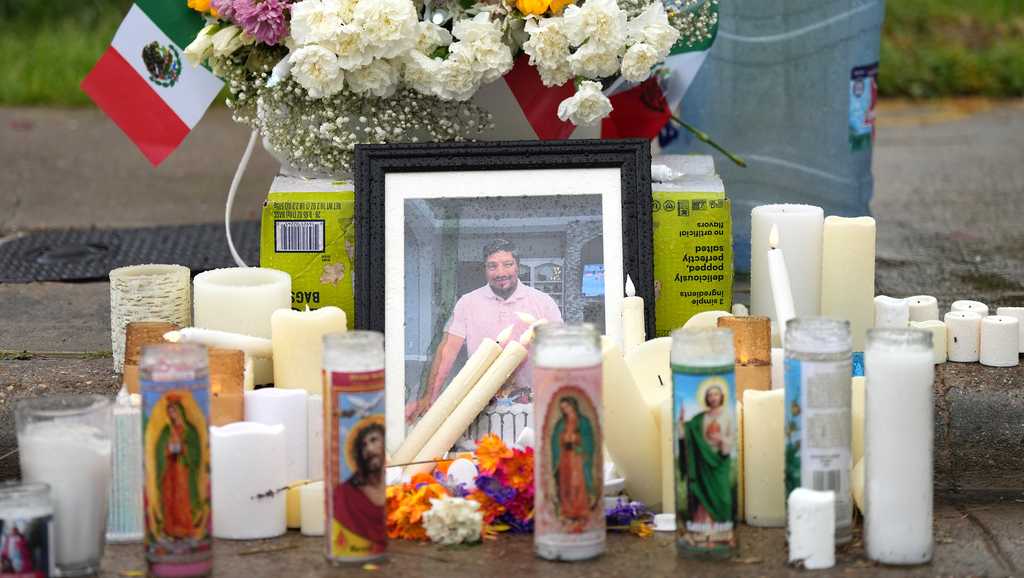
New Details Emerge in Fatal Shooting of Longtime U.S. Resident by Immigration Officer
Federal prosecutors in Texas have unveiled crucial information regarding the moments leading up to the fatal shooting of Lorenzo Salgado Araujo, a 52-year-old Mexican national and long-term U.S. resident, by an immigration officer in early July. This new evidence complicates the government’s earlier assertions that Salgado Araujo crashed into an ICE vehicle prior to being shot.
Background of the Incident
On July 7, an agent from U.S. Immigration and Customs Enforcement (ICE) shot and killed Salgado Araujo while he was driving with three co-workers, including his brother, to a construction site in Houston. The incident ignited protests in the city, amplifying calls for transparency from Salgado Araujo’s family. They described him as a dedicated father who had lived in the U.S. for 35 years and was almost on the path to obtaining legal status.
Escalating Tensions Amid Immigration Crackdown
This shooting coincided with a series of other fatal incidents involving federal immigration enforcement actions, raising alarms about the Department of Homeland Security’s (DHS) tactics. Days later, two other men were killed in related operations in Florida and Maine as part of the broader immigration crackdown initiated under the Trump administration.
Targeted Operation and Initial Claims
Aaron Reitz, the U.S. attorney for the Southern District of Texas, revealed that ICE agents were specifically targeting two Guatemalan men believed to be at risk of deportation. They were reportedly operating a van similar to the one driven by Salgado Araujo when he was killed. On the day of the shooting, the DHS labeled Salgado Araujo as a target of immigration enforcement, stating that he was lacking legal authorization to remain in the U.S.
Confrontation Details
According to Reitz, the officers believed that Salgado Araujo and his passengers matched the description of the Guatemalan men they were pursuing. Four officers in two vehicles activated police lights in an attempt to stop Salgado Araujo’s van. Reitz noted that Salgado Araujo made a U-turn and crossed the median to evade capture.
Final Moments and Lack of Clarity
Later that same morning, law enforcement again encountered Salgado Araujo’s van, this time successfully surrounding the vehicle. Two agents exited their cars and instructed him to pull over. Reitz stated that one officer was positioned either inside or right next to the van just moments before shooting occurred, as Salgado Araujo tried to maneuver the vehicle again. Earlier DHS statements accused him of using his vehicle as a weapon, suggesting that he rammed it into a law enforcement vehicle, which prompted the officer to fire in self-defense. The most recent statements, however, do not mention this collision or indicate that the officers feared for their lives. No injuries were reported for the agents involved in the confrontation.
Claims of Potential Evidence and Ongoing Custody
The latest communication from the U.S. Attorney’s Office did not identify the officer responsible for shooting Salgado Araujo, nor did it clarify if the shooter was the same individual found next to or partially inside the van. Reitz indicated that officers had observed several small bags containing a white crystal-like substance within the vehicle, leading the FBI to execute a search warrant for further investigation into potential illegal substances. Meanwhile, Salgado Araujo’s brother, who was present in the van during the shooting, remains in ICE custody. His attorney asserts that the substance in question was actually a salt mixture used to maintain hydration during the grueling Texas heat.
Limited Visual Documentation of the Incident
In contrast to many other incidents involving federal immigration agents, this particular shooting has not generated significant visual documentation, as only a handful of photos or videos have surfaced on social media, raising concerns over transparency and accountability.
