


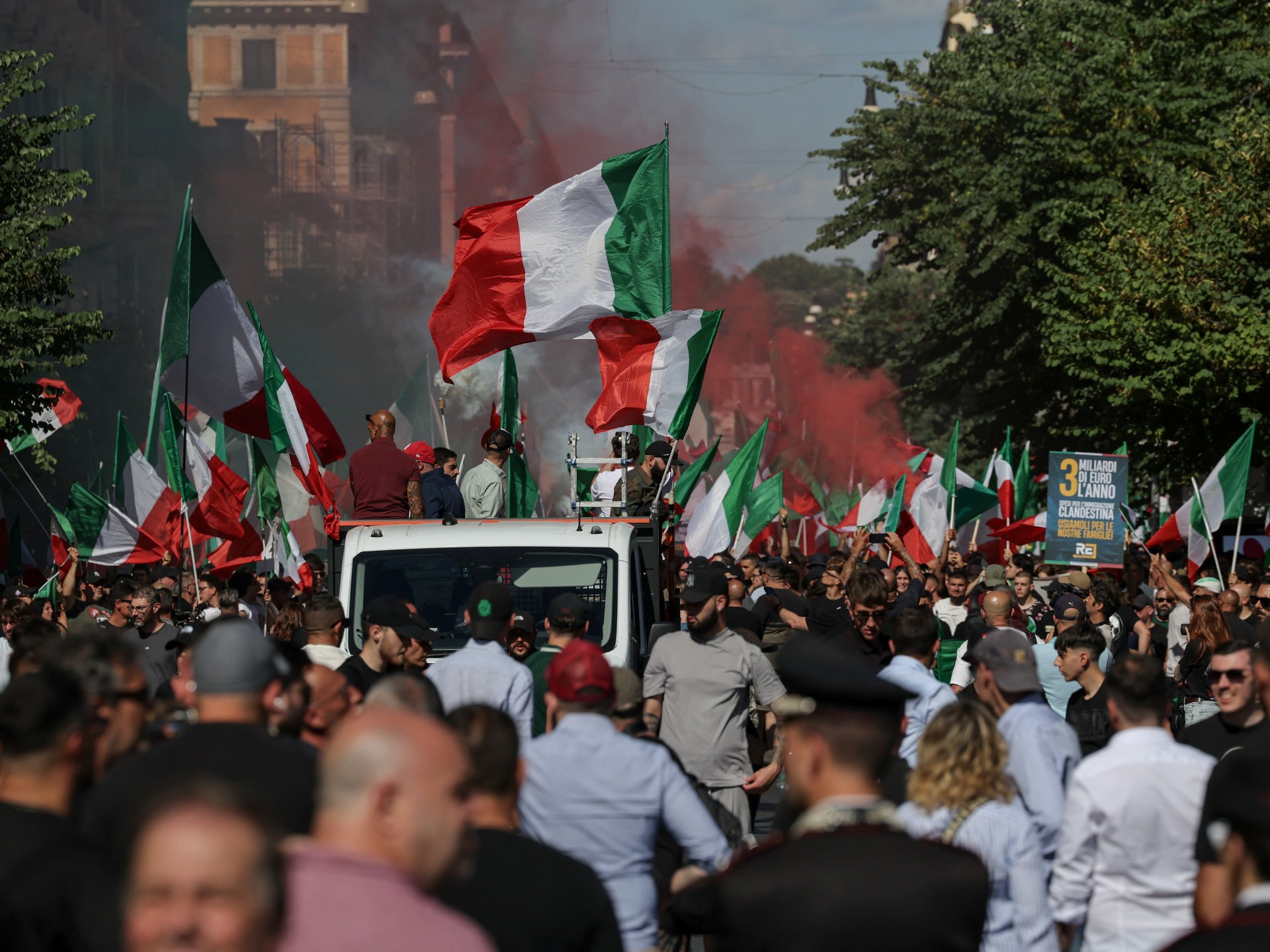
Tensions escalate in Italy as police intervene to manage opposing rallies amid a rising far-right initiative focused on immigration reform.
Published June 13, 2026
In a dramatic display of public sentiment, tens of thousands gathered in Rome to protest against current immigration policies as far-right proposals for stringent immigration reforms are set to be reviewed by parliament. The protests highlight a deepening divide within the country regarding immigration, a topic that remains highly contentious.
On Saturday, the Prati district witnessed an anti-immigration march that attracted thousands, while a pro-immigration demonstration in another area of the city drew a significantly larger crowd. The contrasting nature of these events underscores the polarized landscape surrounding immigration issues in Italy.
To maintain order between the two opposing groups, a substantial police presence was deployed across the city. Law enforcement worked diligently to prevent clashes amid escalating tensions, reflecting an urgent need for careful management of large public gatherings.
The protests were ignited by a petition advocating for severe measures against foreigners. This petition, titled “Migration and Reconquest,” amassed over 50,000 signatures, thereby mandating a parliamentary debate. It has thrust the controversial concept of “migration”—often associated with the exclusion of ethnic minorities—into mainstream political discourse.
Luca Marcela, a spokesperson for the neofascist group Casapondo, expressed the group’s intent during Saturday’s rally: “We want to eliminate illegal immigrants and reinforce our borders.” He further declared that they also aimed to repatriate legal immigrants who he believes have not assimilated, indicating a broader agenda that raises concerns about racial and ethnic discrimination.
During the anti-immigration demonstration, many participants engaged in provocative expressions of support for fascist ideology, raising their arms in salute and chanting “Duce! Duce!”—a tribute to the infamous dictator Benito Mussolini, as reported by the Associated Press. Such actions have intensified scrutiny of the far-right movement’s revival in Italy.
Debate Over Immigration Policy Reflects Challenges for Government Coalition
The timing of this immigration debate poses significant challenges for Prime Minister Giorgia Meloni’s right-wing coalition. While Meloni’s party, the Brothers of Italy, supports discussions surrounding the petition, her coalition partners express concerns over extremist affiliations associated with the proposals.
Opposition parties and legal experts have criticized the initiatives for their potential constitutional violations, arguing that they could infringe upon principles of non-discrimination by targeting individuals based on ethnicity, including naturalized citizens. Left-wing politician Angelo Bonelli stated, “Such proposals are predicated on exclusion based on ethnic and cultural identity, conflicting with the Italian constitution and core tenets of the rule of law.”
This contentious issue arises amid Meloni’s administration endorsing a comprehensive plan to recruit hundreds of thousands of non-EU laborers to fill gaps in various economic sectors while simultaneously pursuing strategies to expand legal immigration channels. The government’s dual approach reflects a complex balancing act in addressing Italy’s labor market needs alongside the rising tide of nationalist sentiment.
